
Our free Class Rank Calculator helps you instantly estimate your class rank, GPA percentile, and overall academic standing within your graduating class. Whether you’re trying to reach the top 10%, improve your GPA ranking, or simply monitor academic progress, this calculator provides fast, accurate, and easy-to-understand results in seconds.
🔢 Calculate Your Class Rank Instantly
Enter your GPA and total class size to quickly estimate your class rank, percentile position, and academic performance compared to other students in your grade.
📊 Weighted & Unweighted GPA Support
See how honors, AP, IB, and advanced courses can affect your weighted GPA and overall class ranking in competitive academic systems.
🎯 Test “What-If” GPA Scenarios
Experiment with different grades and GPA improvements to understand how small academic changes can impact your future class rank and percentile.
🏆 Plan for College Admissions & Scholarships
Find out how competitive your academic profile is for college admissions, honor roll goals, scholarships, and top-ranking university applications.
Your class rank is typically calculated by comparing your GPA with other students in your graduating class. In many schools, students with higher weighted GPAs often achieve stronger academic rankings due to advanced coursework and consistent academic performance.
Start calculating now to see where you stand academically and how close you are to reaching the top of your class.
📊 Choose Your Input Method
🔮 What-If Scenarios ℹ
📋 Scenario Comparison
| Scenario | Weighted GPA | Estimated Rank | Percentile | Status |
|---|
📈 Your Academic Standing
📊 Academic Progress Visualization
📚 Calculation History ℹ
| Date/Semester | Current GPA | Weighted GPA | Rank | Status | Courses | Action |
|---|
⚙️ Calculator Settings
🧮 How to Use the Class Rank Calculator (Step-by-Step Guide)
If you’re wondering how to calculate your class rank quickly and accurately, follow this simple step-by-step guide. This Class Rank Calculator allows you to estimate your GPA, percentile, and academic standing using three different input methods.
- ✅ Step 1:
- ✅ Step 2:
- ✅ Step 3:
- ✅ Step 4:
- ✅ Step 5:
- ✅ Step 6:
- ✅ Step 7:
Choose Your Input Method
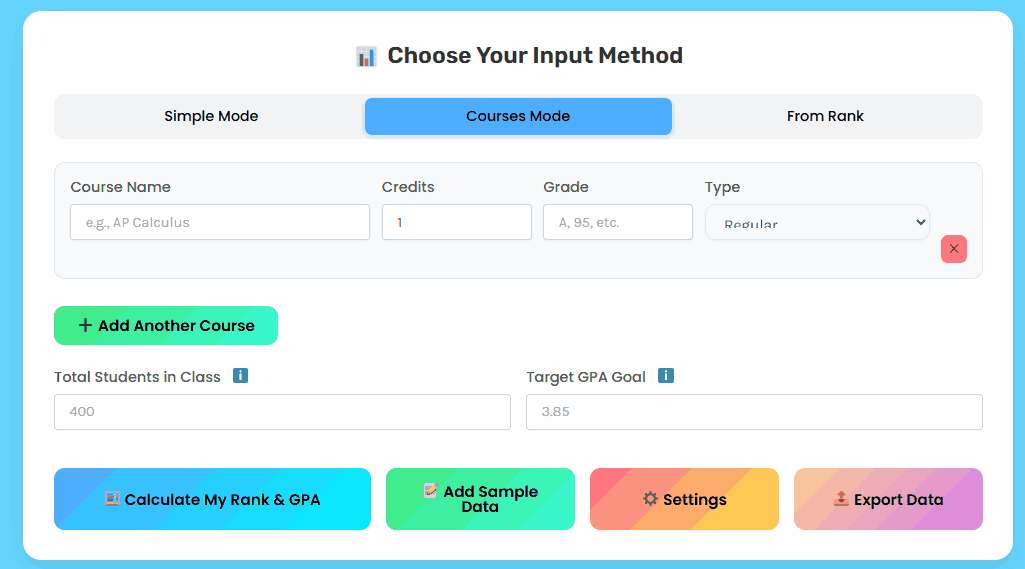
At the top of the calculator, select one of the three input modes:
Simple Mode – Enter your current GPA and class size
Courses Mode – Add individual courses with grades and credits
From Rank Mode – Enter your current class rank to calculate percentile
Choose the option that best matches the information you have.
💡 Pro Tip:
If you don’t know your exact rank, start with Simple Mode. It’s the fastest way to estimate your class percentile.
Enter Your Academic Details

The fields will change based on your selected mode.
In Simple Mode:
Enter your Current Unweighted GPA
Enter Total Students in Class
Add any Weighted GPA Adjustment
Set a Target GPA Goal (optional)
In Courses Mode:
Add each course name
Select course type (Regular, Honors, AP/IB)
Enter credits and grades
Click “Add Another Course” if needed
In From Rank Mode:
Enter your Current Class Rank
Enter total number of students
Add GPA (if known)
💡 Pro Tip:
If your school uses weighted GPA, make sure you include AP or Honors courses. This can significantly impact your estimated class rank.
Click “Calculate My Rank & GPA”
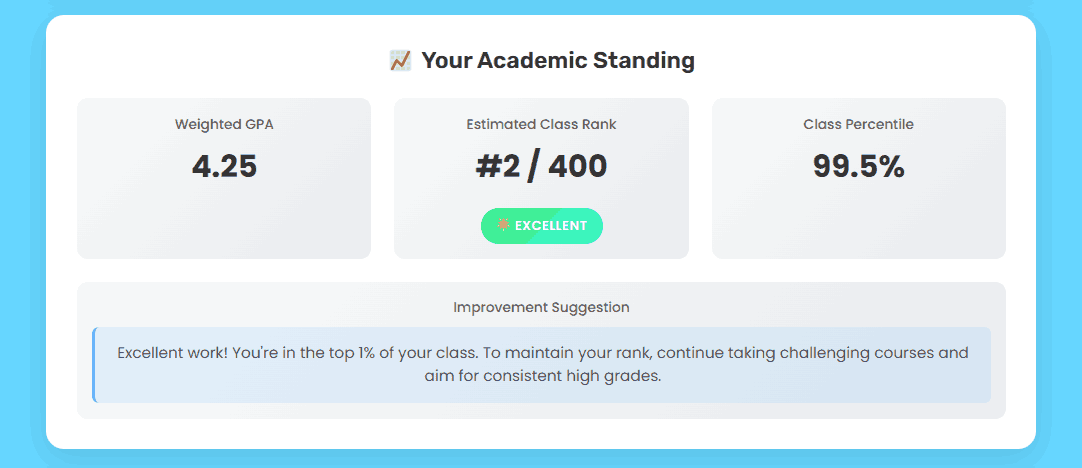
Once all required fields are filled:
Click the “Calculate My Rank & GPA” button.
The calculator will instantly generate:
Weighted GPA
Estimated Class Rank
Class Percentile
Academic Standing Label (Example: Excellent)
Improvement Suggestion
💡 Pro Tip:
Pay close attention to your percentile score. Colleges often evaluate students based on percentile rather than just numerical rank.
📊 Analyze Your Academic Standing
After calculation, review your results carefully:
📊 Weighted GPA – Shows the impact of advanced courses like AP or Honors
🏅 Estimated Rank – Your exact position among classmates
📈 Class Percentile – The percentage of students you outperformed
🌟 Performance Status – Academic level such as Excellent, Strong, or Competitive
Use this information to understand your competitiveness for college admissions or scholarships.
If you want a deeper breakdown of your grades, attendance, and exam performance, you can also use our Academic Performance Calculator to track your overall academic progress in one place.
💡 Key Takeaway
A small increase in GPA can sometimes move you up several rank positions, especially in competitive classes. Tracking your numbers regularly using both your class rank and overall performance tools can help you plan smarter and improve faster.
Test What-If Scenarios
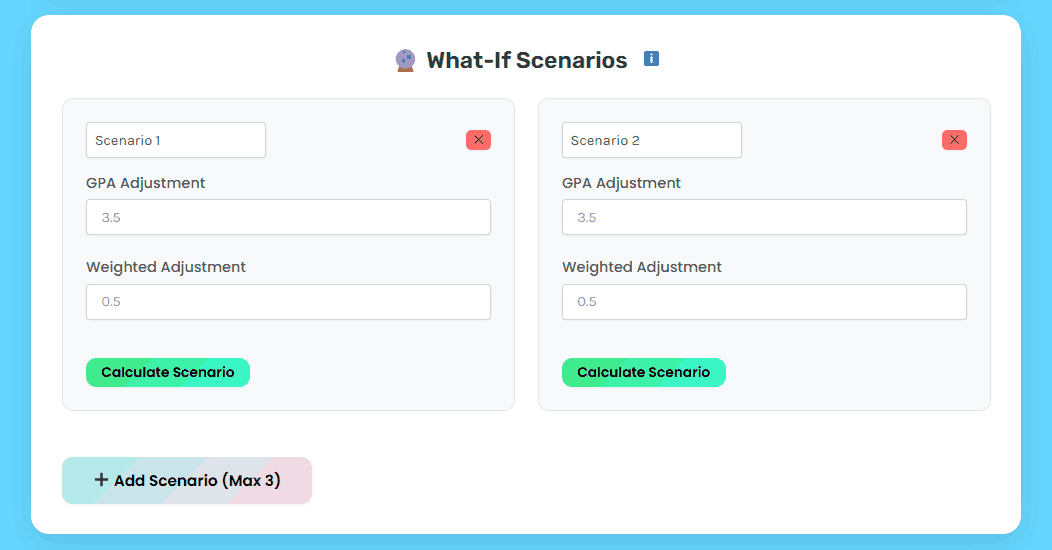
Click “Add Scenario” under the What-If section.
You can test:
A higher GPA goal
Additional AP or Honors courses
Improved semester performance
The calculator will compare scenarios side-by-side.
💡 Pro Tip:
Use this feature before selecting next semester courses. It helps you plan strategically to improve your class rank.
Track Progress with Visual Charts
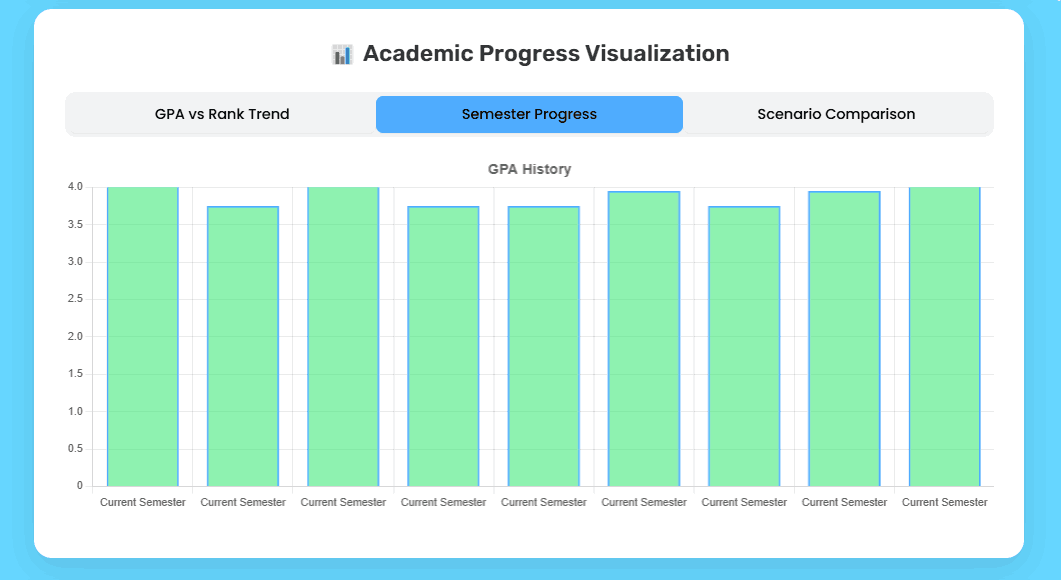
Scroll to the Academic Progress Visualization section.
You can view:
GPA vs Rank Trend
Semester Progress
Scenario Comparison Graph
These charts help you monitor academic growth over time.
Save or Export Your Results
Use:
📤 Export Data (for reports)
📚 Calculation History (to track past entries)
🗑️ Delete History (if needed)
This makes it easier to compare semester performance and set new academic goals.
🎯 Why This Calculator Is Helpful
Understanding your academic position can be difficult when schools use different grading scales and ranking systems. This Class Rank Calculator simplifies the process by providing a quick estimate of your class rank, percentile, and overall standing within your graduating class.
Whether you’re planning for college admissions, scholarship opportunities, or personal academic goals, this tool helps you evaluate where you currently stand and how future performance may influence your results.
This calculator can help you:
Estimate your class rank in seconds
View your percentile position within your class
Compare weighted and unweighted GPA outcomes
Explore potential ranking changes through What-If scenarios
Monitor academic progress over time
Set realistic goals for future improvement
Because ranking policies vary between schools, the results are intended for educational planning and academic analysis rather than official school reporting.
Why Class Rank Matters for Students
Your class rank shows how your academic performance compares to other students in your grade. Schools calculate class rank based on GPA and overall academic achievement, placing students in order from highest to lowest GPA.
Understanding your position can help you make smarter academic decisions and set realistic goals.
🎓 College Admissions Advantage
Many colleges in the United States use class rank to evaluate applicants from different schools fairly. When GPA scales vary between schools, class rank provides a standardized comparison.
Students in the top 10% of their class are often considered strong academic performers, especially at competitive universities. A higher class rank reflects consistency, course rigor, and long-term academic effort.
💰 Scholarship Eligibility
Several merit-based scholarships consider class rank as part of eligibility requirements. Some programs require students to be in the top 5%, 10%, or 25% of their graduating class.
Improving your GPA and class rank can increase your chances of qualifying for financial awards and academic recognition.
📚 Course Planning & Academic Strategy
Your class rank can guide important decisions about taking:
AP (Advanced Placement) courses
IB (International Baccalaureate) programs
Honors classes
Because weighted GPA systems award extra points for advanced coursework, strategic course selection can positively influence your class rank.
Monitoring your performance regularly helps you stay competitive and focused on long-term academic goals. For a broader evaluation of your grades, attendance, and exam scores, you can also use our Academic Performance Calculator to track your overall academic progress in one place.
What Is a Good Class Rank?
General Class Rank Benchmarks
| Class Rank | Academic Standing |
| Top 1% | Exceptional academic performance |
| Top 5% | Extremely competitive college applicant |
| Top 10% | Highly competitive for many universities |
| Top 25% | Above-average academic standing |
| Top 50% | Average academic performance |
| Below Top 50% | May benefit from GPA improvement and stronger coursework |
Is Being in the Top 10% of Your Class Good?
- Consistent academic achievement
- Strong study habits
- Competitive GPA performance
- Success in challenging coursework
- College readiness
What Does Top 25% Class Rank Mean?
Is Top 5% or Top 1% Important?
- Competitive college admissions
- Merit-based scholarships
- Academic honors and recognition
- Selective university programs
What Is Considered an Average Class Rank?
Class Rank vs GPA — What’s the Difference?
GPA: Your Personal Academic Performance
- GPA focuses only on your own grades.
- It does not compare you with other students.
- It is usually measured on a 4.0 or weighted scale.
Class Rank: Your Position Compared to Others
- Class rank is a comparison system.
- It depends on how others in your class perform.
- It is often reported as a number or a percentile.
Why Both GPA and Class Rank Matter
- GPA shows consistency and effort
- Class rank shows relative performance and competitiveness.
- Together, they provide a balanced academic profile.
Admissions Perspective
- GPA helps evaluate individual academic strength
- Class rank helps compare students from different schools.
- Top universities may consider both, along with course rigor and extracurricular activities.
Summary
How Class Rank Percentile Works
Difference Between Rank and Percentile
- Class Rank: Your position in the class (e.g., 10 out of 200)
- Percentile: Your relative performance score (e.g., top 95%)
Class Rank Percentile Formula
Example Calculation
- They are in the top 10% range.
- Their percentile would be approximately 95%
What Does Top 10% Mean?
Why Percentile Matters
Weighted vs Unweighted GPA in Class Rank
How Weighted GPA Can Improve Class Rank
- Student A earns straight A’s in standard courses and has a 4.0 unweighted GPA.
- Student B earns straight A’s in several AP and Honors classes and has a 4.5 weighted GPA.
Why Schools Use Weighted GPA Systems
- AP (Advanced Placement) courses
- Honors classes
- IB (International Baccalaureate) programs
- Dual enrollment college courses
GPA Scales Can Vary Between Schools
Which GPA Matters More for Class Rank?
- Schools using unweighted GPAs rank students solely by grades.
- Schools that use weighted GPAs also consider course difficulty.
- Some schools report both weighted and unweighted GPA values.
- A growing number of schools have reduced or eliminated traditional class rank reporting altogether.
Understanding Class Rank Reporting Methods
Not all schools report class rank in the same way. While some schools provide an exact numerical rank, others use broader ranking categories such as deciles, quintiles, quartiles, or percentiles.
Understanding these reporting methods can help students interpret their academic standing more accurately during college admissions and scholarship applications.
Exact Class Rank
Exact class rank reports a student’s specific position within the graduating class.
For example:
Rank #12 out of 300 students
Rank #45 out of 500 students
This method provides the most precise measure of academic standing and allows colleges to see exactly where a student ranks among classmates.
Decile Rank
A decile system divides the graduating class into 10 equal groups.
Decile 1 = Top 10% of students
Decile 2 = Top 11–20%
Decile 3 = Top 21–30%
Students in the first decile are generally considered among the strongest academic performers in their class.
Quintile Rank
A quintile system divides students into 5 equal groups of 20%.
Quintile 1 = Top 20%
Quintile 2 = Top 21–40%
Quintile 3 = Middle 20%
Quintile 4 = Bottom 40%
Quintile 5 = Bottom 20%
Many schools use quintiles to provide academic context while reducing competition associated with exact rankings.
Quartile Rank
Quartiles divide the class into 4 equal groups.
First Quartile = Top 25%
Second Quartile = Top 26–50%
Third Quartile = Top 51–75%
Fourth Quartile = Bottom 25%
Quartile rankings are commonly used by schools that prefer broader academic categories rather than exact numerical rankings.
Percentile Rank
Percentile rank shows the percentage of students you outperform within your graduating class.
For example:
99th Percentile = Performed better than 99% of students
90th Percentile = Performed better than 90% of students
75th Percentile = Performed better than 75% of students
Percentiles are widely used because they make academic standing easier to understand across different schools and grading systems.
Why Schools Use Different Reporting Methods
Many schools have moved away from reporting exact class rank in order to reduce academic pressure and competition among students. Instead, they may report quartiles, quintiles, deciles, or percentiles while still providing colleges with meaningful information about student performance.
Regardless of the reporting method used, colleges typically evaluate class rank alongside GPA, course rigor, academic achievements, extracurricular involvement, and overall application strength.
| Academic Standing | Percentile |
|---|---|
| Top 1% | 99th Percentile |
| Top 5% | 95th Percentile |
| Top 10% | 90th Percentile |
| Top 25% | 75th Percentile |
| Top 50% | 50th Percentile |
GPA Needed for Top 10% Class Rank
There is no fixed GPA required to reach the top 10% of a graduating class. The GPA needed depends on your school’s grading scale, ranking method, course weighting system, and the overall academic performance of your classmates.
A GPA that places a student in the top 10% at one school may not achieve the same ranking at another. For this reason, class rank is determined by how your academic performance compares with other students rather than by a universal GPA requirement.
Factors That Influence Top 10% Class Rank
Several factors can affect the GPA needed to reach the top 10%, including:
The competitiveness of your graduating class
Weighted vs. unweighted GPA systems
AP, Honors, IB, and advanced coursework
School-specific ranking policies
Overall grade distribution among students
Does Weighted GPA Matter?
In schools that use weighted GPA systems, students enrolled in advanced courses often receive additional GPA points. As a result, strong performance in AP, Honors, or IB classes can improve class rank and increase the likelihood of reaching the top 10%.
How to Increase Your Chances of Reaching the Top 10%
Rather than focusing on a specific GPA target, students should focus on:
Maintaining consistently high grades
Taking challenging courses when appropriate
Improving academic performance each semester
Understanding how their school’s ranking system works
Building strong study habits and time management skills
In most schools, reaching the top 10% requires a combination of academic consistency, course rigor, and long-term performance rather than a single GPA benchmark.
Can You Improve Your Class Rank?
Yes. Although class rank is influenced by the performance of other students, improving your academic results can help you move higher within your graduating class over time.
One of the most effective ways to improve class rank is to consistently earn stronger grades each semester. Even gradual GPA improvements can positively impact your standing, particularly in large graduating classes.
Students attending schools that use weighted GPA systems may also benefit from taking AP, Honors, IB, or other advanced courses, as these classes can contribute additional GPA points when completed successfully.
Tips to Improve Class Rank
Focus on improving grades in every semester
Take advanced courses when academically appropriate
Complete assignments and coursework on time
Develop consistent study habits
Monitor academic progress regularly
Seek extra support in challenging subjects when needed
Class rank is built over multiple semesters, so steady academic improvement often produces better long-term results than short-term gains.
Is Class Rank Still Important in 2026?
Some Schools No Longer Report Class Rank
The Rise of Holistic Admissions
- GPA and academic performance
- AP, Honors, and advanced coursework
- Extracurricular activities
- Leadership experience
- Essays and recommendations
GPA Still Plays a Major Role
Competitive Colleges May Still Consider Rank
Percentile and Other Alternatives
- Class percentile
- Academic honors distinctions
- GPA distributions
- Cum laude or honor roll recognition
📌 Frequently Asked Questions :
What is a good class rank?
A good class rank depends on your academic goals and school competitiveness. Students in the top 10% are generally considered strong candidates for competitive colleges, while those in the top 25% are often viewed as above-average academic performers.
How is class rank calculated?
Class rank is typically calculated by comparing a student’s GPA to the GPAs of other students in the same graduating class. Students are then ordered from highest to lowest academic performance.
Does weighted GPA affect class rank?
Yes. In schools that use weighted GPA systems, AP, Honors, and other advanced courses can increase GPA values and potentially improve class rank.
How do I calculate my class rank percentage?
You can calculate percentile using the formula:
Percentile = (1 − Rank ÷ Total Students) × 100
Do all high schools report class rank?
No. Some schools choose not to publish class rank. In such cases, students may estimate their position using GPA comparison and percentile calculations.
Is class rank more important than GPA?
Both matter. GPA shows overall academic performance, while class rank shows how you compare to classmates. Colleges often review both together.
What GPA do I need to be in the top 10% of my class?
There is no fixed GPA requirement. The GPA needed for a top 10% class rank depends on your school’s grading scale, ranking system, and the performance of other students.
What is the difference between class rank and class percentile?
Class rank shows your exact position in the class, while class percentile shows the percentage of students you performed better than. Percentile is often easier to compare across different schools.
Can I improve my class rank?
In many cases, yes. Improving grades, maintaining a higher GPA, and taking advanced coursework can help increase your ranking position over time.