

Table of Contents
Introduction
Have you ever looked at a quadratic trinomial and wondered, “Where do I even start?”
If you need to factor 2x² − x − 3, the process becomes much easier once you understand the right steps. This problem is a useful example for learning how factoring trinomials works in Algebra 1 and Algebra 2.
Factoring helps you rewrite a quadratic into simpler expressions. This skill can make equations easier to solve and helps you recognize patterns in algebra problems.
In this guide, you’ll learn how to factor 2x² − x − 3 step by step. We’ll explain each step in simple terms and show how to check your answer.
You’ll also see how the factored form connects to 2x² − x − 3 = 0. By the end, you’ll be able to factor this quadratic confidently and use the result to find its solutions.
What Are the Factors of 2x² − x − 3?
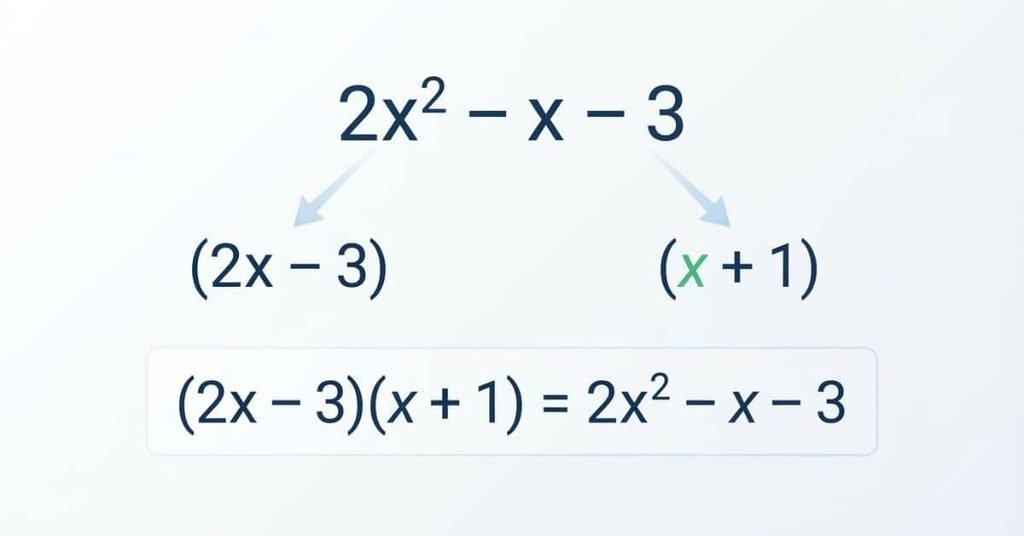
The quick answer is:
You can verify this factorization using the FOIL method. Multiply the two binomials:
First, multiply each term:
Combine the middle terms:
This matches the original quadratic exactly. Therefore, the factorization is correct:
These factors can also help when solving the related equation .
How to Factor 2x² − x − 3
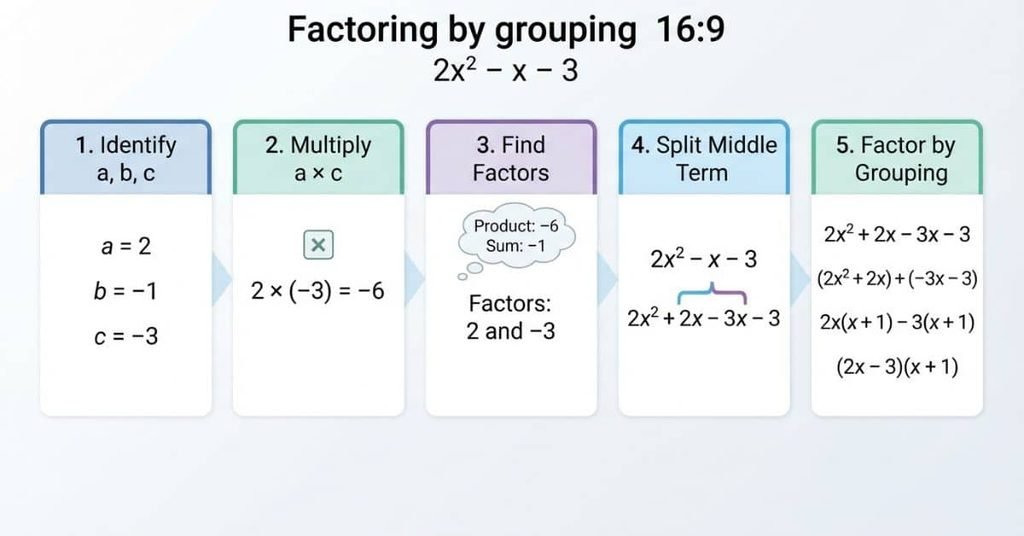
A standard approach uses the AC method, also called splitting the middle term. It works well for quadratic trinomials written as:
For , identify the three coefficients:
The AC method starts by multiplying and . Then, find two numbers that produce that product and add to .
Once you find those numbers, split the middle term. Finally, factor the expression by grouping.
Step 1 — Identify a, b, and c
Start with the quadratic:
Compare it with the standard form:
Therefore:
This step simply identifies the three coefficients. Keep their signs exactly as they appear.
Step 2 — Multiply a × c
Now multiply by :
We need two numbers that satisfy two conditions. Their product must equal , and their sum must equal .
So, look for numbers with:
- Product:
- Sum:
These conditions help us split the middle term correctly.
Step 3 — Find the Two Numbers
List the factor pairs that can produce :
Now check which pair adds to . The correct pair is and :
Their product also equals :
Therefore, the two numbers we need are:
Step 4 — Split the Middle Term
Use and to rewrite the middle term.
Start with:
Rewrite it as:
The new middle terms still equal the original middle term because:
So, we haven’t changed the value of the quadratic. We have only rewritten it in a form that’s easier to factor.
Step 5 — Factor by Grouping
Group the first two and last two terms:
Factor each group:
Both terms now contain the common binomial . Factor it out:
Reordering the factors gives the same result:
Step 6 — Write the Final Answer
The completely factored form is:
This is the final answer for the factoring problem. You can always multiply the factors back together to verify your result.
How to Check the Factorization
You can check a factorization by multiplying the factors back together. This confirms whether they produce the original quadratic.
Use the FOIL method to multiply . FOIL stands for First, Outer, Inner, and Last.
First:
Outer:
Inner:
Last:
Now combine all four terms:
Combine the like terms:
This matches the original expression exactly. Therefore, the factorization is correct:
Checking your work this way can help catch sign or multiplication errors.
How to Solve 2x² − x − 3 = 0
Factoring becomes even more useful when you need to solve a quadratic equation. Start with:
From the previous steps, we know that:
Now use the Zero Product Property. If two factors multiply to zero, at least one factor must equal zero.
Solve the First Factor
Set the first factor equal to zero:
Add 3 to both sides:
Divide by 2:
Solve the Second Factor
Now set the second factor equal to zero:
Subtract 1 from both sides:
Final Solutions
The equation has two solutions:
You can substitute either value into the original equation to verify the solutions.
Why Does 2x² − x − 3 Factor This Way?
The factors come from rewriting the quadratic so its terms can group together. Start with the factored form:
Multiply each term using FOIL:
The first and last terms produce and . The middle terms are and .
Combine the middle terms:
This gives:
So the factors work because their multiplication recreates every term in the original quadratic. Understanding this connection is more useful than simply memorizing the final answer.
Common Mistakes When Factoring 2x² − x − 3
Factoring becomes easier when you know which errors to watch for. A small sign mistake can change the entire result.
Choosing the Wrong Factor Pair
The two numbers must satisfy both conditions in the AC method:
and
Here, and . The pair and works because:
and
A pair that meets only one condition won’t produce the correct factorization.
Getting the Sign Wrong
Pay close attention to the signs when multiplying and :
The product is −6-6, not . Using the wrong sign leads to the wrong factor pair and incorrect factors.
Forgetting to Split the Middle Term Correctly
The middle term must be split into two terms that still combine to :
This works because:
Changing either sign would change the original quadratic.
Not Checking the Final Answer
Always multiply your factors back together after factoring. If the result matches , your factorization is correct.
A quick FOIL check can catch errors before you use the factors to solve the equation.
Can You Factor 2x² − x − 3 Using Another Method?
Yes, you can use several approaches to factor or solve this quadratic. Common options include:
- Factoring by grouping: Rewrite the middle term, then group terms.
- Trial and error: Test possible binomial factors until multiplication gives the original expression.
- AC method: Multiply and , then split the middle term.
- Quadratic formula: Use the formula to find the roots instead of factoring.
For this example, splitting the middle term with the AC method is usually the clearest approach. It shows exactly where the numbers and come from.
The quadratic formula can also find the solutions, but it isn’t necessary when the expression factors easily.
2x² − x − 3 Factored at a Glance
Use this quick summary to review the factoring process:
| Step | Result |
|---|---|
| Original expression | |
| Numbers | and |
| Split middle term | |
| Factored form |
The key step is finding two numbers with a product of and a sum of . Those numbers let you split the middle term correctly.
Practice Problems
Now try the same factoring process on these quadratic expressions. Work through each one before checking the answer key.
For each problem, identify a, b, and c. Then multiply a × c and find the correct factor pair.
Answer Key
Check your work after completing the problems:
Factoring 2x2 – x – 3 becomes easier when you follow each step carefully. We identified the coefficients, found the correct factor pair, split the middle term, and factored by grouping.
The final result is:
We also used the factors to solve the related quadratic equation. The solutions are x = 3/2 and x = -1.
If you’re learning how to factor 2x² − x − 3, practice the same process with similar trinomials. Always multiply your factors back together to check your work.
Frequently Asked Questions
What is the factorization of 2x² − x − 3?
The factorization is:
You can verify it by multiplying the two binomials using FOIL.
How do you factor 2x² − x − 3?
First, identify a = 2, b = −1, and c = −3. Multiply a × c to get −6.
Find two numbers that multiply to −6 and add to −1. Those numbers are 2 and −3.
Split the middle term, then factor by grouping.
What two numbers multiply to −6 and add to −1?
The numbers are 2 and −3.
These numbers let you split the middle term correctly.
What is the AC method for factoring this quadratic?
The AC method multiplies the first and last coefficients.
Here, a × c = 2(−3) = −6.
Find two numbers with a product of −6 and a sum of −1. Then use them to split the middle term.
What is the split middle term for 2x² − x − 3?
The middle term −x becomes 2x − 3x.
This creates groups that can be factored easily.
Can 2x² − x − 3 be factored by grouping?
Yes. After splitting the middle term, group the expression:
Factor each group:
Then factor out x + 1:
What are the solutions to 2x² − x − 3 = 0?
Start with the factored equation:
Set each factor equal to zero. The solutions are:
Is 2x² − x − 3 a quadratic trinomial?
Yes. It is a quadratic trinomial because it has three terms and its highest exponent is 2.
Its standard form is ax² + bx + c, with a = 2, b = −1, and c = −3.
How can I check my factorization?
Multiply the factors back together using FOIL:
Combine the middle terms:
Because the result matches the original expression, the factorization is correct.
Can I use the quadratic formula instead of factoring?
Yes. The quadratic formula can solve the equation, but factoring is simpler for this example.
The expression factors cleanly into two binomials, so the factoring method is more direct.
What is the factored form of 2x² − x − 3?
The factored form is:
Multiplying these factors returns the original quadratic 2x² − x − 3.
What is the easiest way to factor 2x² − x − 3?
For this quadratic, the AC method is a clear choice.
Multiply 2 and −3, find 2 and −3, split the middle term, and factor by grouping.
What are the factors of 2x² − x − 3?
The binomial factors are:
Together, they give:

Team ClassRank builds smart, student-friendly calculators to make grade and rank tracking simple and accurate. For questions or feedback, contact us at classrankcalculator@gmail.com.