

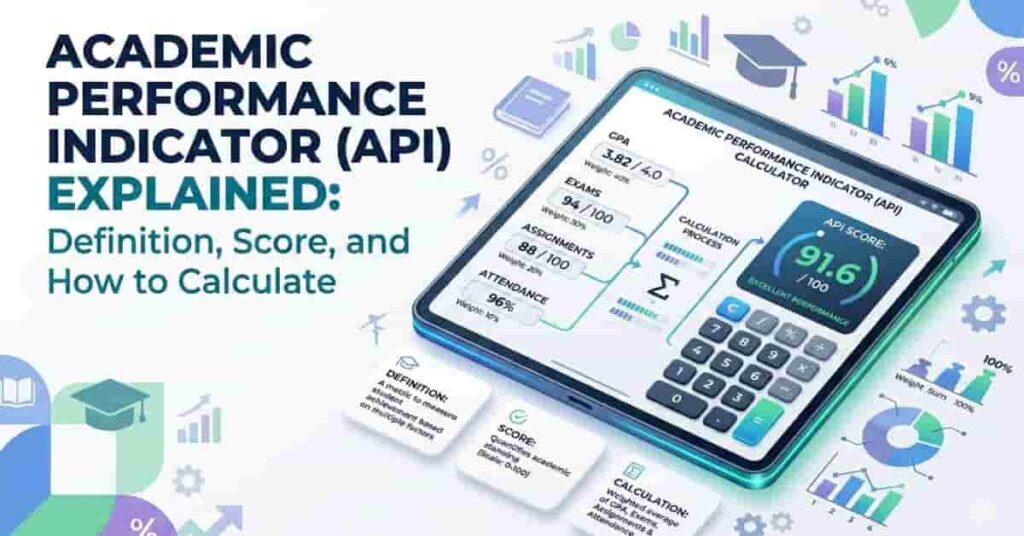
Introduction
Are your grades telling the full story about your academic progress?
Many students in the USA focus only on GPA. But schools often look beyond just one number. Attendance, exams, and assignments all shape your success. That’s where an academic performance indicator becomes useful. It gives a broader view of how you’re really doing in school.
If you’ve ever asked, what is an academic performance indicator, and how does it differ from GPA, you’re not alone. Beginners often feel confused by terms like academic performance index or performance score. The good news? It’s simpler than it sounds.
In this guide, you’ll learn what an academic performance indicator means and how it works. I’ll break down the score format in clear steps. You’ll also see practical examples that make the math easy to follow. By the end, you’ll know how to calculate your own score and use it to improve your results.
What Is Academic Performance Indicator?
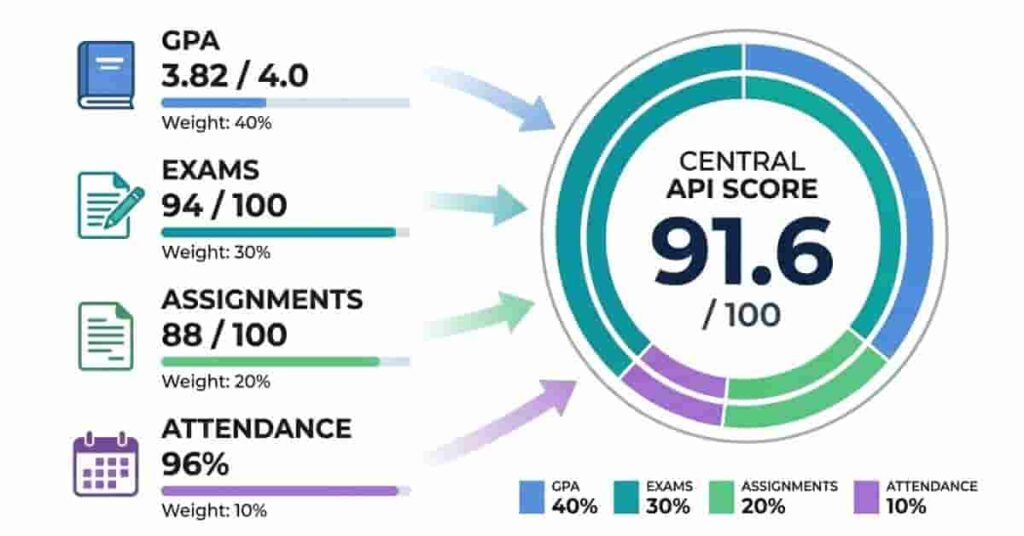
An academic performance indicator is a combined measure of how well a student performs across key academic areas. It looks beyond GPA and includes exams, assignments, and attendance. This gives a fuller picture of student progress.
If you’re wondering what an academic performance indicator is, think of it as a performance summary score. Instead of tracking only grades, it combines multiple academic factors into a single number. Many students confuse it with the academic performance index, but they are not the same.
The California Department of Education used the term academic performance index to measure school-wide results. That system evaluated overall school performance, not individual students. In contrast, an academic performance indicator focuses on a single student’s results.
So, what is the academic performance index compared to an indicator?
- Academic Performance Index (API): School-level measurement system.
- Academic Performance Indicator: Student-level performance tracking method.
Most academic performance indicator formats include:
- GPA
- Exam scores
- Assignment grades
- Attendance rate
| Component | What It Measures |
|---|---|
| GPA | Overall grade average |
| Exams | Test and midterm performance |
| Assignments | Homework and project completion |
| Attendance | Class participation and presence |
Want to see how these parts combine into one score? Try the Academic Performance Indicator Calculator to check your own results.
Academic Performance Indicator Score
The academic performance indicator score measures a student’s overall performance by combining multiple academic components. Unlike GPA alone, it accounts for exams, assignments, attendance, and other key areas. This provides a more complete view of a student’s strengths and weaknesses.
How the API Score Is Calculated
To calculate your academic performance indicator score, each component is assigned a weight based on its importance. Then, your score in that component is converted to the same scale and multiplied by its weight. Finally, all weighted contributions are added to get your total API score.
Here’s an example using a typical academic performance indicator format:
| Component | Weight | Example Score | Contribution |
|---|---|---|---|
| GPA | 40% | 3.5 | 35/40 |
| Exams | 30% | 85% | 25.5/30 |
| Assignments | 20% | 90% | 18/20 |
| Attendance | 10% | 95% | 9.5/10 |
| Total API Score | 100% | – | 88/100 |
Grading Scale / Performance Levels
| API Score | Performance Level |
|---|---|
| 90–100 | Excellent |
| 75–89 | Good |
| 60–74 | Average |
| Below 60 | Needs Improvement |
This grading scale helps students identify areas for improvement.
💡 Pro Tip: Using an API calculator can save time and instantly show your total score. It’s especially useful for tracking progress over multiple subjects or semesters.
How to Calculate Academic Performance Indicator (Step-by-Step)
Calculating your academic performance indicator may sound tricky, but it’s simple when you follow a clear process. Here’s a beginner-friendly step-by-step guide to get your academic performance indicator score.
Step 1: Gather Your Scores
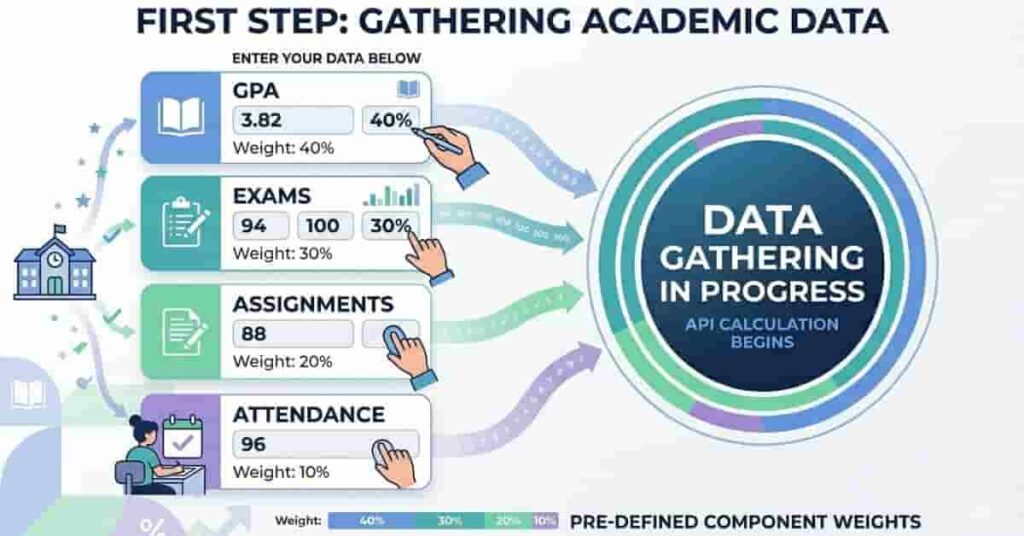
Collect all relevant academic data:
- GPA or grade point average
- Exam scores (midterms, finals, quizzes)
- Assignment grades (projects, homework, labs)
- Attendance percentage
This ensures every component of your API is accounted for.
Step 2: Normalize Scores
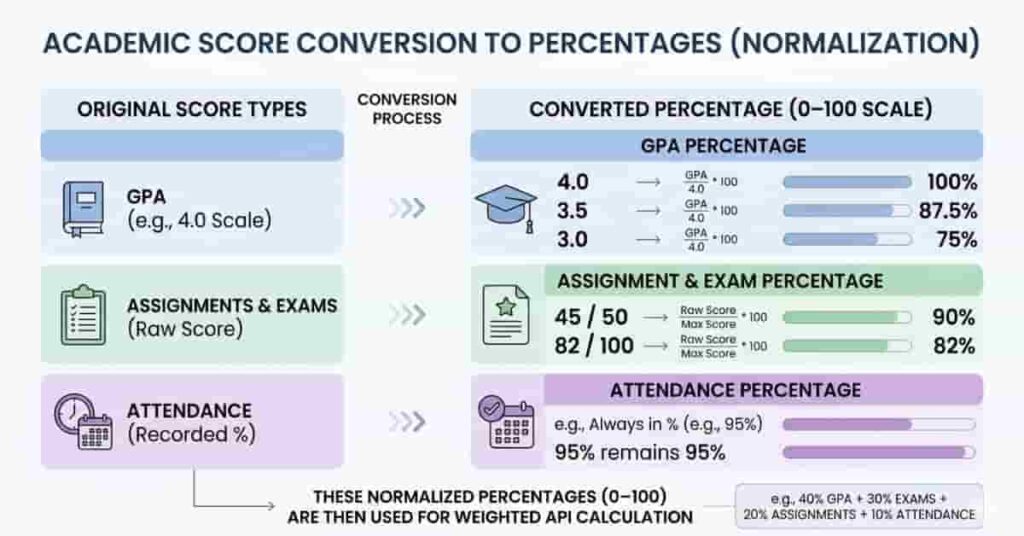
Convert all scores to a common scale, typically 0–100%. For example:
- GPA 3.5/4.0 → 87.5%
- Attendance 95% stays as is
Normalization makes it easier to apply weights consistently.
Step 3: Apply Weighted Formula
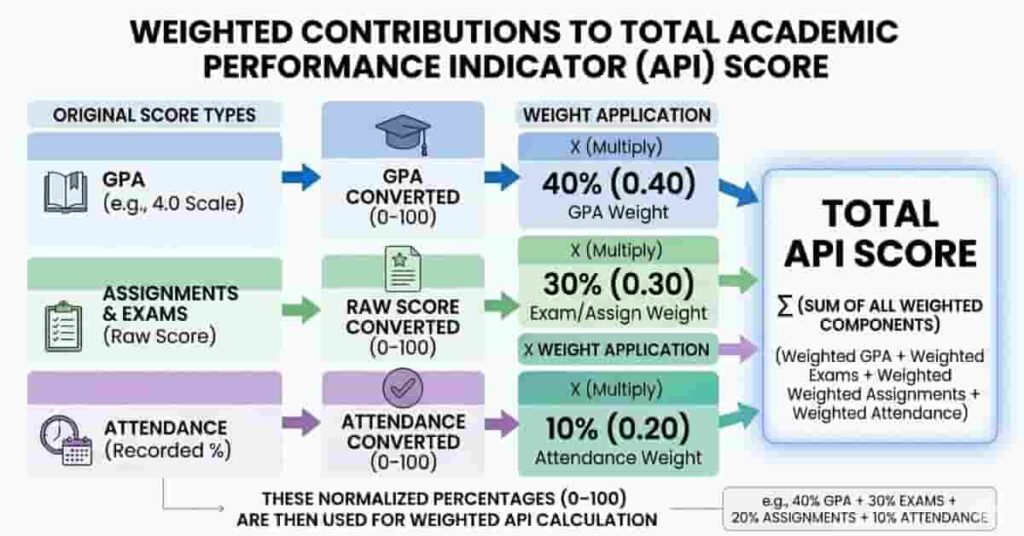
Multiply each component by its assigned weight. Example weights:
- GPA 40%
- Exams 30%
- Assignments 20%
- Attendance 10%
Weighted contribution = Score × Weight
Step 4: Calculate Total API Score
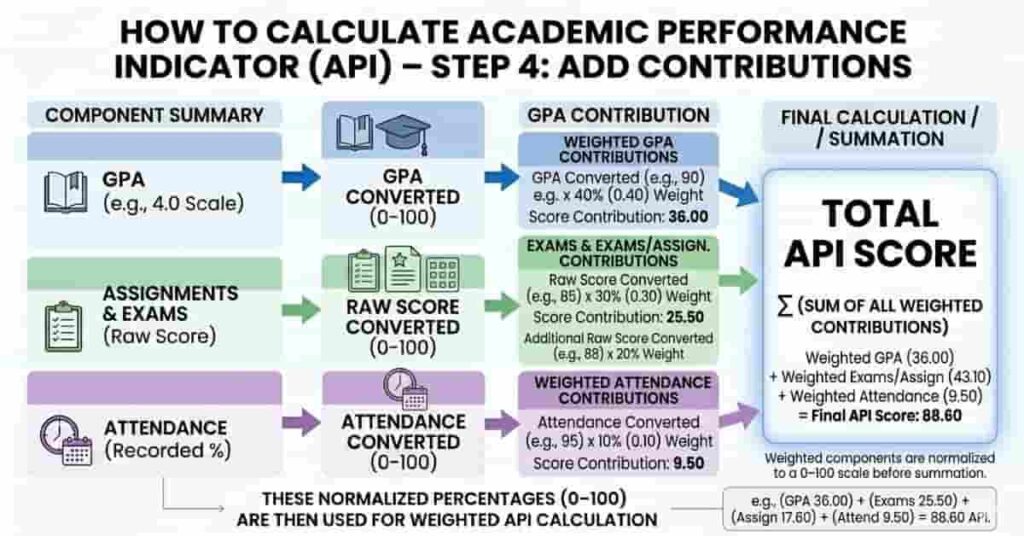
Add all weighted contributions to get your total score:
API Score = (GPA × 0.40) + (Exams × 0.30) + (Assignments × 0.20) + (Attendance × 0.10)
This gives you a single number representing overall academic performance.
Step 5: Determine Performance Level
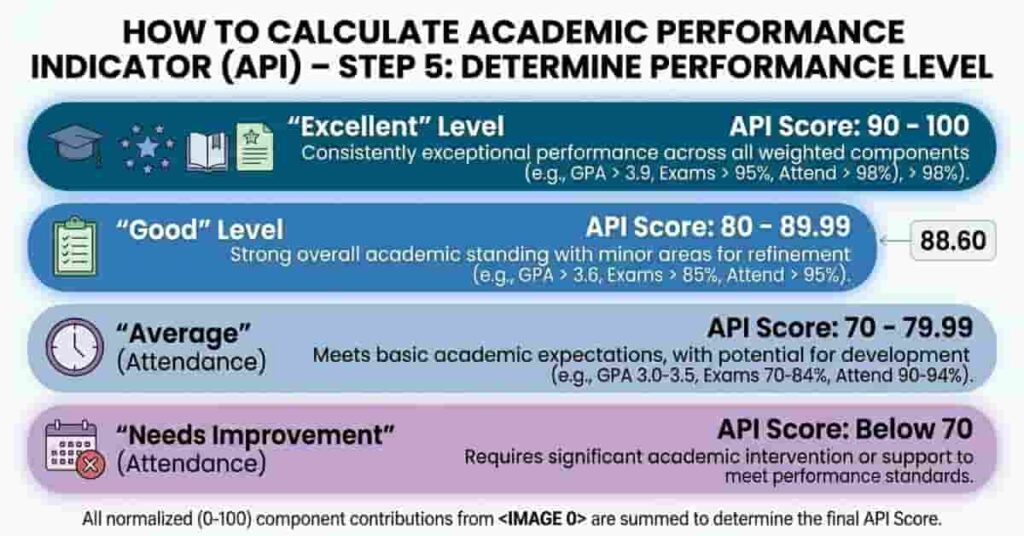
Compare your total API score with a standard scale:
- 90–100: Excellent
- 75–89: Good
- 60–74: Average
- Below 60: Needs Improvement
This step shows where you excel and where you need improvement.
Why the Academic Performance Indicator Is Important
Understanding your academic performance indicator can make a big difference for both students and educators. It’s more than just a number—it’s a tool for tracking growth and making smarter academic decisions.
Benefits for Students
- Track Strengths and Weaknesses: The API highlights areas where you excel and subjects that need extra focus.
- Set Improvement Goals: Knowing your weak spots lets you create actionable plans for better results.
- Predict GPA and Semester Outcomes: By tracking API scores over time, you can estimate your final grades and plan study strategies accordingly.
Benefits for Educators and Parents
- Identify Struggling Students: Teachers and parents can spot students who need help before grades drop.
- Plan Interventions: API data allows for targeted support, tutoring, or customized learning plans.
Using an academic performance indicator helps everyone stay informed and proactive. It complements traditional grades and GPA by offering a more complete picture of academic achievement.
💡 Pro Tip: Combine this with our Academic Performance Indicator Calculator to track your own scores and see how small improvements in assignments, exams, or attendance can boost your total API.
Practical Example of an Academic Performance Indicator
Let’s look at a real-world example to see how an academic performance indicator works in practice.
Student Scenario
Before Improvement:
- GPA: 3.0 / 4.0
- Exams: 70%
- Assignments: 75%
- Attendance: 80%
Using the standard API formula with weights (GPA 40%, Exams 30%, Assignments 20%, Attendance 10%):
| Component | Weight | Score | Contribution |
|---|---|---|---|
| GPA | 40% | 3.0 | 30/40 |
| Exams | 30% | 70% | 21/30 |
| Assignments | 20% | 75% | 15/20 |
| Attendance | 10% | 80% | 8/10 |
| Total API Score | 100% | – | 74/100 |
Performance Level: Average
After Improvement (3 months later):
- GPA: 3.5 / 4.0
- Exams: 85%
- Assignments: 90%
- Attendance: 95%
| Component | Weight | Score | Contribution |
|---|---|---|---|
| GPA | 40% | 3.5 | 35/40 |
| Exams | 30% | 85% | 25.5/30 |
| Assignments | 20% | 90% | 18/20 |
| Attendance | 10% | 95% | 9.5/10 |
| Total API Score | 100% | – | 88/100 |
Performance Level: Good → Excellent
Key Takeaways
- Improving high-weight components, such as GPA and exams, has the greatest impact.
- Consistent attendance and assignment completion can significantly improve your API.
- Using an interactive API calculator helps students visualize how small improvements affect the total score.
Tips to Improve Academic Performance

Raising your academic performance indicator score doesn’t have to be overwhelming. By focusing on key areas, you can quickly see measurable improvement. Here are some actionable tips:
1️⃣ Improve Exam Preparation
- Review past tests and identify weak topics.
- Break study sessions into short, focused blocks.
- Practice with sample questions to simulate real exams.
- Use your Academic Performance Indicator Calculator to see which subjects impact your score the most.
2️⃣ Track Assignments Consistently
- Keep a planner or digital tracker for homework, projects, and labs.
- Complete tasks before deadlines to avoid last-minute stress.
- Assignments often contribute a significant portion of your API score.
- Update your scores in the calculator to monitor progress over time.
3️⃣ Increase Attendance and Participation
- Regularly attend classes to avoid missing key lessons.
- Active participation can improve understanding and exam performance.
- Even small attendance improvements can boost your overall API score.
4️⃣ Monitor Your Progress
- Check your API score regularly using the calculator.
- Focus on components where you score lowest.
- Set monthly or semester goals based on your indicator results.
💡 Pro Tip: Small, consistent improvements in GPA, exams, assignments, or attendance often lead to the biggest gains in your academic performance indicator score.
Conclusion
In this guide, we explored what an academic performance indicator is, how to calculate it, and why it matters. You learned the step-by-step process, saw practical examples, and discovered tips to improve your score. This tool helps students track strengths, identify weaknesses, and plan academic goals more effectively.
Understanding your academic performance indicator gives a complete picture of your performance beyond just GPA. It shows where effort matters most and how small improvements can make a big difference. Educators and parents also benefit by spotting areas needing support early.
Ready to see your own results? Try our Academic Performance Indicator Calculator now and discover how you can boost your total score. Start tracking, improving, and taking control of your academic success today!

Team ClassRank builds smart, student-friendly calculators to make grade and rank tracking simple and accurate. For questions or feedback, contact us at classrankcalculator@gmail.com.