


Introduction
Ever wondered where you truly stand in your class — top 10%, top 25%, or somewhere between? 🎓
 Understanding your position isn’t just about curiosity; it can play a significant role in college admissions and scholarship opportunities. Many students in the U.S. struggle to figure out their exact standing because schools often report ranks differently. That’s where a class rank percentile calculator becomes your best friend. It turns confusing numbers into precise, easy-to-understand results — showing exactly how you compare with your classmates.
In this guide, we’ll walk you through everything you need to know — from how to calculate class rank percentile manually to using a percentile class rank calculator for instant, accurate results. You’ll also learn common mistakes to avoid, real-world examples, and why colleges care about percentiles in the first place.
By the end, you’ll not only understand your class rank percent calculator results but also know how to use them strategically for college applications and goal-setting. Let’s get started and find out where you really stand!
What Is Class Rank Percentile?
When students check their standing in school, many turn to a class rank percentile calculator for quick clarity.
It shows how your position compares to others in your grade, not just your raw rank number. This helps you understand whether you’re near the top, middle, or lower end of your class. Colleges often consider the percentile because it’s easier to compare students from different schools.
Here’s how to understand what class rank percentile really means:
Definition in Simple Terms
Class rank percentile shows the percentage of students who scored below your position in class.
Instead of saying “Rank 15 out of 200,” it tells you what portion of your classmates you outperformed.
For example:
- A 90th percentile means you did better than 90% of students.
- A 50th percentile means you’re right in the middle.
It’s a simple way to see how your rank translates into performance. You can use a percentile class rank calculator to find this instantly without doing the math yourself.
Example: Understanding the 90th Percentile
Let’s say your rank is 20 out of 200.
When you use a class rank percent calculator, it might show you’re in the 90th percentile.
That means:
- 180 students are ranked below you.
- You’re in the top 10% of your class.
This score looks strong on transcripts and scholarship forms because it reflects consistency and achievement.
💡 Pro Tip: Save your rank and total students before using any class rank percentile calculator—you’ll get instant, accurate results every time.
Difference Between Percentile and Percentage
Students often confuse percentile with percentage, but they measure different things.
TermWhat It MeasuresExample
Percentage: Your score or marks out of 100. You scored 85% in math.
Percentile: Your position compared to others. You’re in the 90th percentile of your class.
A percentage reflects how much you scored.
A percentile shows how you rank among your peers.
When learning how to calculate class rank percentile, remember this difference—colleges care more about your percentile because it reflects relative performance, not just grades.
“When Emily saw her class rank drop from 15 to 25, she panicked — until she realized her percentile hadn’t changed much. That insight changed how she viewed academic progress.”
Formula to Calculate Class Rank Percentile
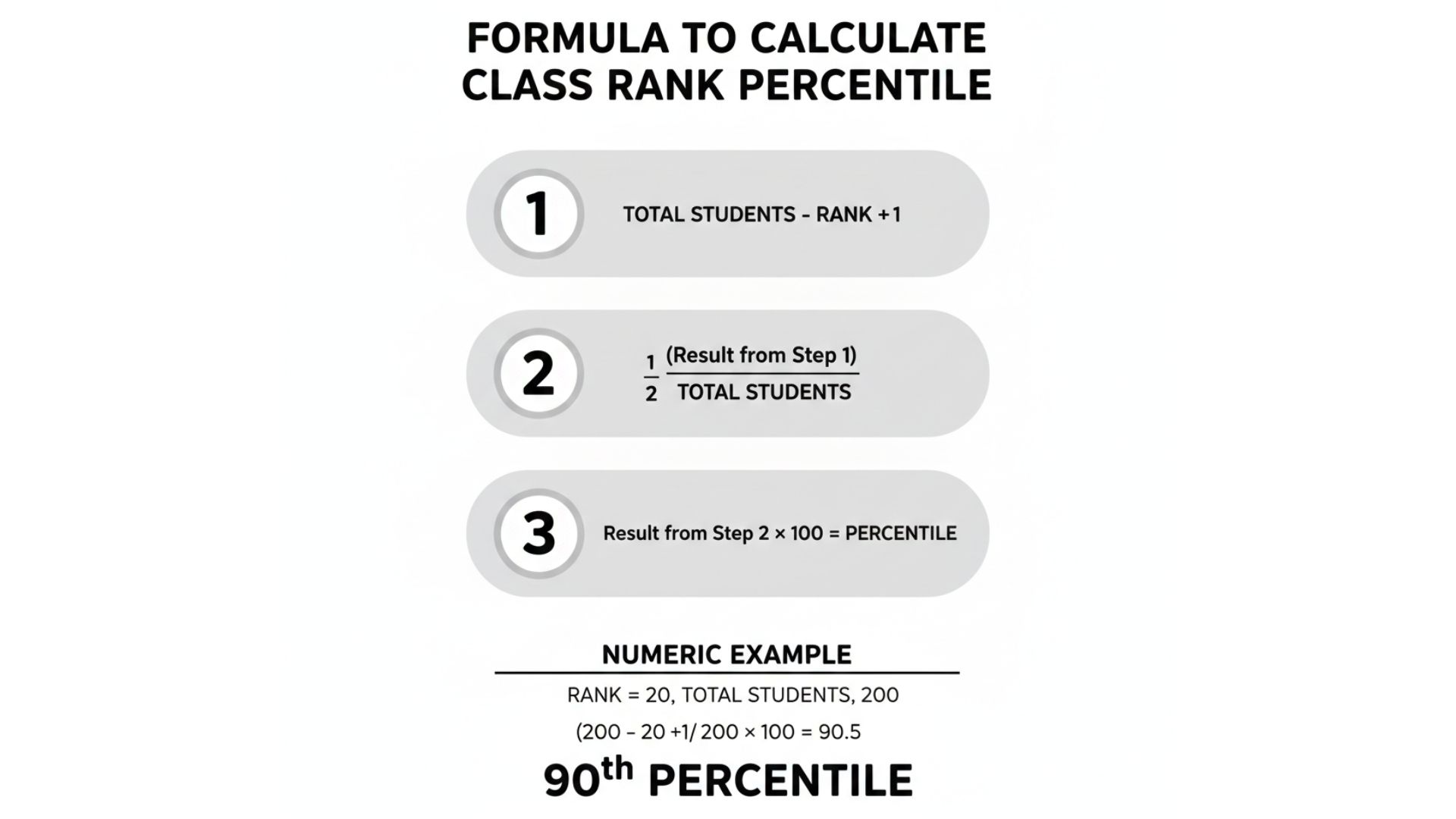
A class rank percentile calculator uses a simple formula to turn your rank and class size into a percentile. This helps you compare students from different schools and class sizes. The formula is easy to apply by hand or in a quick online tool.
Here’s how to apply this effectively:
Formula Explained
Use this formula to calculate class rank percentile:
- Percentile=(Total Students−Rank+1) Total Students × 100\text{Percentile} = \frac{(\text{Total Students} – \text{Rank} + 1)} {\text{Total Students}} \times 100 Percentile=Total Students(Total Students−Rank+1)×100 Total Students = number of students in the class or grade.
- Rank = your class rank (1 = top student).
- The formula converts your rank into the percentage of students you outperformed.
- You can plug these values into a percentile class rank calculator or do the math manually. This method standardizes rank so colleges can compare students across schools.
Examples & Step-by-Step Method
Follow these steps to manually calculate your percentile or check an online class rank percent calculator:
- Write down your rank and the total number of students.
- Subtract rank from total, then add 1.
- Divide that result by the total number of students.
- Multiply by 100 and round as needed.
Example 1—Rank 20 out of 200:
- Step 1: 200 − 20 + 1 = 181.
- Step 2: 181 ÷ 200 = 0.905.
- Step 3: 0.905 × 100 = 90.5 percentile.
Example 2—Rank 150 out of 600:
- Step 1: 600 − 150 + 1 = 451.
- Step 2: 451 ÷ 600 = 0.751666…
- Step 3: 0.751666… × 100 = 75.17% → round to 75.2 percentile.
💡 Tip: Decide how many decimals to show (one decimal is standard). Use a percentile class rank calculator for fast, error-free results.
Since class rank percentile is often based on GPA, learning how to calculate class rank with GPA helps you understand where your rank comes from. Knowing how to calculate class rank with GPA can clarify why small GPA changes impact your percentile.
How to Calculate Class Rank Percentile Manually
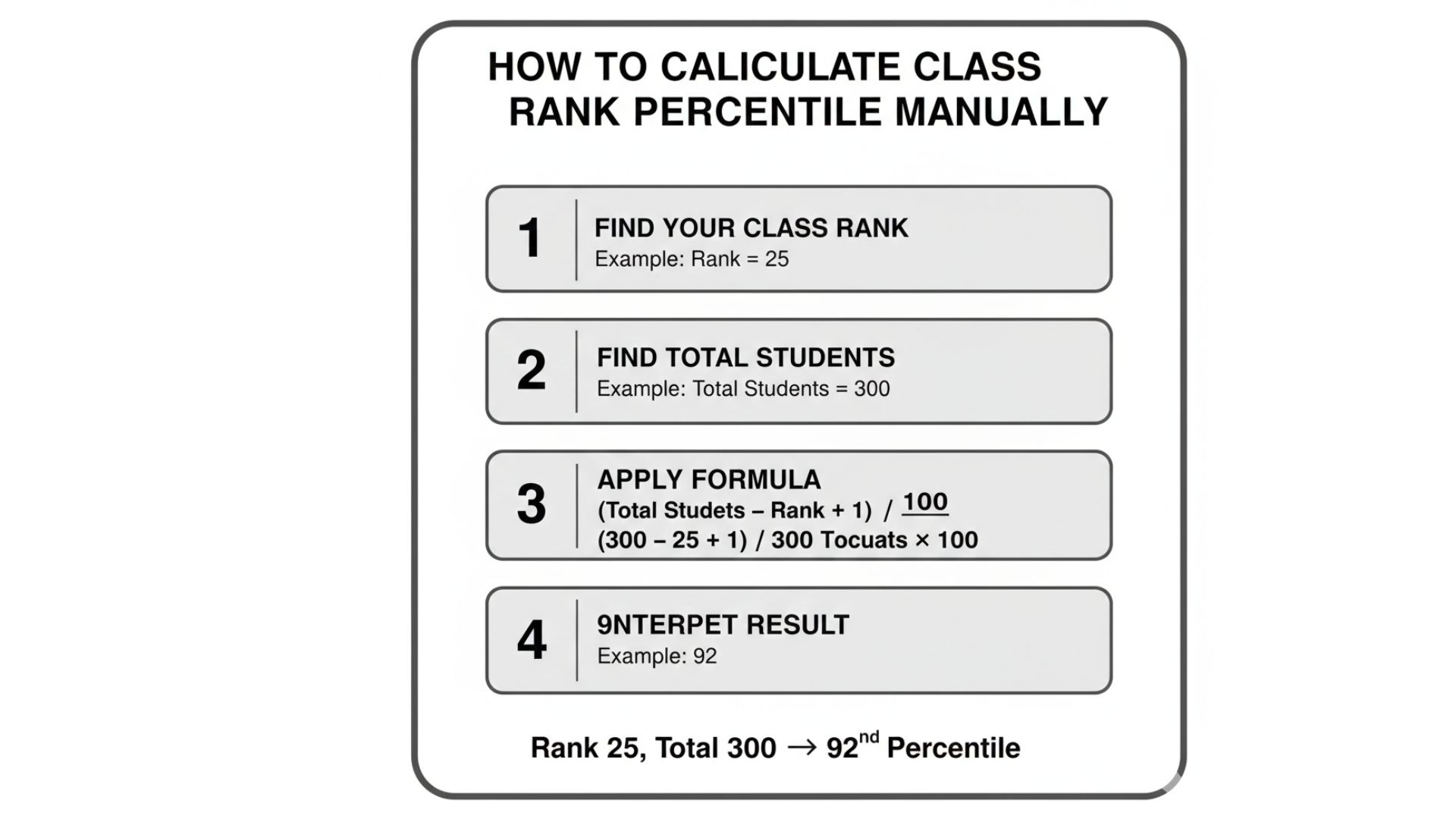
If you don’t have access to an online class rank percentile calculator, you can still find your percentile using a straightforward method. Manual calculation helps you understand how your position changes with class size. It’s also useful when verifying results from an online class rank percent calculator.
Here’s how to apply this effectively:
Step 1: Find Your Class Rank
Start by noting your official class rank from your school transcript or counselor.
This number shows your standing compared to other students.
For example, if your report says Rank 25 out of 300, then “25” is your rank.
✅ Tip: Make sure you use the most recent and accurate rank, mainly if your school updates rankings each semester.
You’ll need this number to calculate class rank percentile correctly in later steps.
Step 2: Find Total Students
Next, check the total number of students in your graduating class or grade level.
This number helps convert your rank into a fair comparison.
You can usually find it:
- In your school’s academic profile or transcript.
- By asking your counselor or registrar.
A percentile class rank calculator also requires this value, so keep it ready before calculating manually.
Step 3: Apply the Formula
Now use the formula to calculate class rank percentile:
Percentile=(Total Students−Rank+1)Total Students×100 \text{Percentile} = \frac{(\text{Total Students} – \text{Rank} + 1)} {\text{Total Students}} \times Percentile = Total Students (Total Students − Rank + 1) × 100 Plug your numbers into this formula.
For example, Rank 25 out of 300 → (300 − 25 + 1) ÷ 300 × 100 = 92.0 percentile.
You can double-check this using a class rank percent calculator online to confirm accuracy.
Step 4: Interpret the Result
Your final number is your class rank percentile—the higher it is, the better your standing.
- 90th percentile → top 10% of your class.
- 75th percentile → top 25%.
- 50th percentile → average position.
A higher percentile means stronger academic performance compared to peers.
Now you know exactly how to calculate class rank percentile manually and understand what it represents.
Using a Class Rank Percentile Calculator Online
A class rank percentile calculator helps students quickly find where they stand without doing any math. It’s ideal for checking your percentile before sending college applications or scholarship forms. These calculators use the same formula you’d apply manually, but produce results instantly and with zero errors.
Here’s how to apply this effectively:
Advantages: Speed and Accuracy
An online percentile class rank calculator gives instant and accurate results.
It eliminates manual calculation mistakes and saves time during busy application seasons.
Main benefits include:
- ✅ Speed: Enter your rank and class size, and get results in seconds.
- ✅ Accuracy: Built-in formulas prevent human errors.
- ✅ Convenience: Works on any device—no spreadsheet needed.
- ✅ Consistency: Same formula used by schools and counselors.
💡 Pro Tip: If you’re also tracking grades or GPA in Canvas, try the Canvas Grade Calculator. It helps you see your current grade, predict final results, and plan what scores you need on upcoming assignments.
When to Prefer the Calculator vs the Manual Method
Both manual and online methods show how to calculate class rank percentile, but each suits different needs.
Use a calculator when:
- You’re short on time.
- You need multiple results quickly.
- You want precise rounding and accuracy.
Use manual calculation when:
- You’re learning the formula.
- You don’t have internet access.
- You want to double-check calculator results.
A percentile class rank calculator is best for fast, verified results, while manual math helps build understanding.
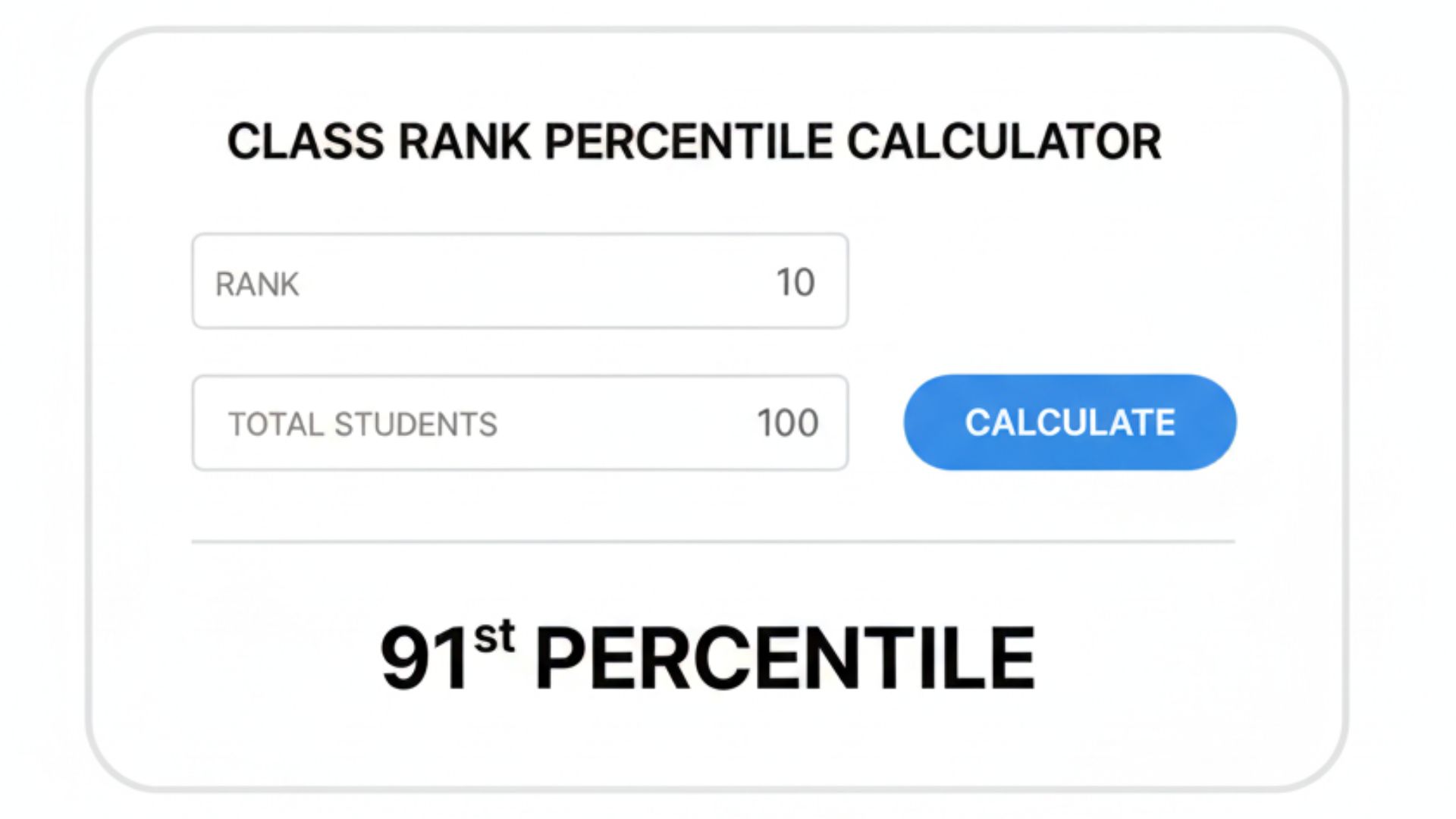
Demo Example: Rank 10 out of 100
Let’s test a real example using a class rank percentile calculator.
Input:
- Rank = 10
- Total Students = 100
Calculation:
[
(100 – 10 + 1) \div 100 \times 100 = 91
]
✅ Result: 91st percentile → You performed better than 91% of your classmates.
That’s how easy it is to calculate class rank percentile online—fast, clear, and accurate every time.
Pro Tip: Always double-check your total student count before using a percentile class rank calculator. Even small errors can change results noticeably.
Class Rank Percentile vs Class Rank Percentage
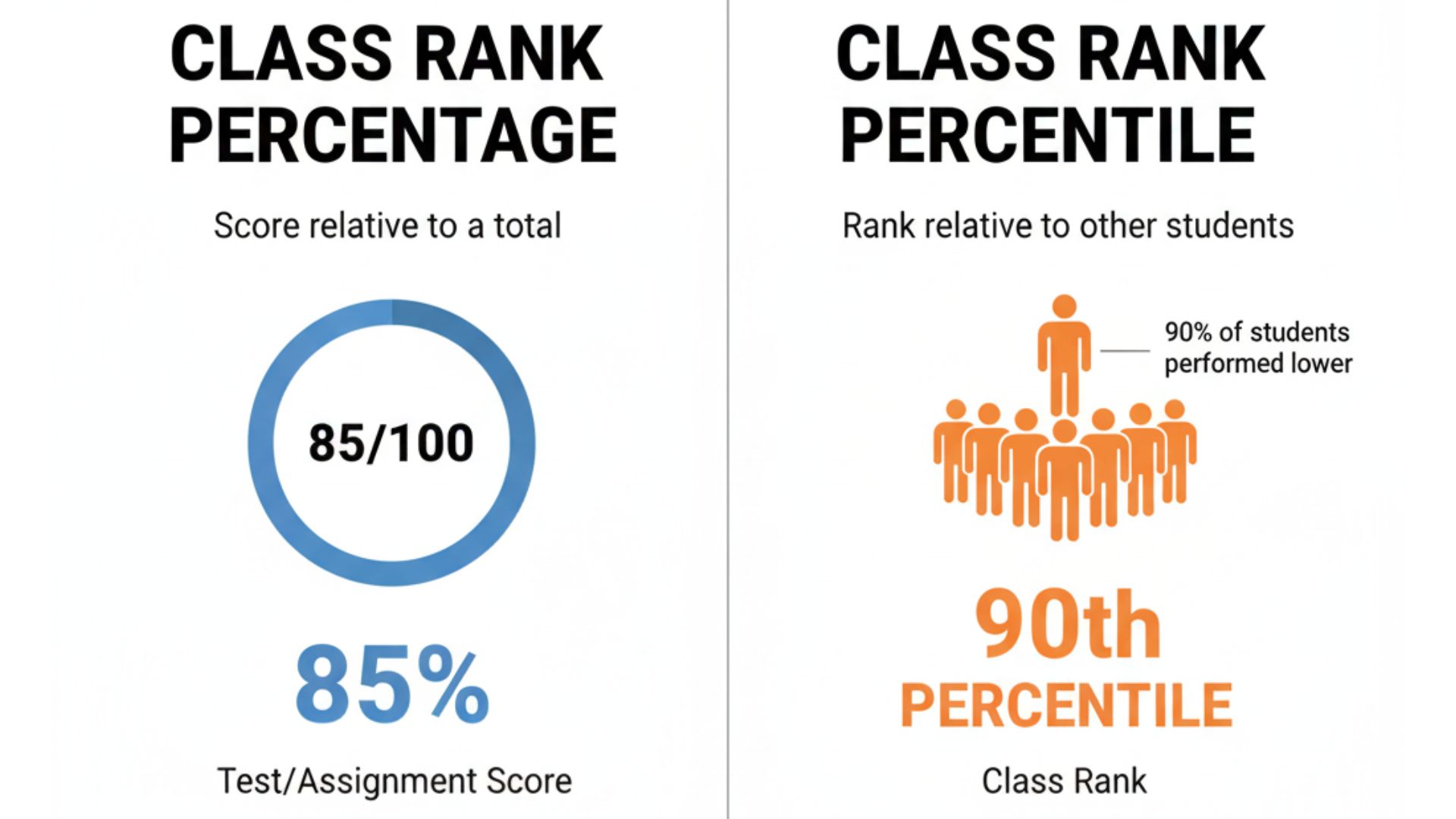
Many students using a class rank percentile calculator often confuse percentile with percentage. While the two terms sound similar, they measure different things. Understanding the difference helps you read your results correctly and present them accurately on applications.
Here’s how to apply this effectively:
Side-by-Side Comparison
A percentile tells you how many students you outperformed, while a percentage shows your score compared to the total possible points.
Colleges usually look at percentiles because they reveal how your rank compares within your class size.
Term What It Measures Example Meaning
Percentage: Your score out of 100 is 85% in math. You scored 85 marks out of 100
Percentile: Your position among peers is the 90th percentile. You performed better than 90% of your classmates.
You can easily confirm your standing using a class rank percent calculator or by learning how to calculate class rank percentile manually.
Understanding the Difference
Think of it this way:
- Percentage = performance in a subject or test.
- Percentile = your standing compared to others.
For example, if your rank is 20 out of 200, your
- Percentage rank = (20 ÷ 200) × 100 = 10%
- Percentile = (200 − 20 + 1) ÷ 200 × 100 = 90.5
So, your class rank shows you’re in the top 10%, but your percentile tells you you outperformed 90% of students.
A percentile class rank calculator helps visualize both quickly without confusion.
Why Colleges Care About Percentiles
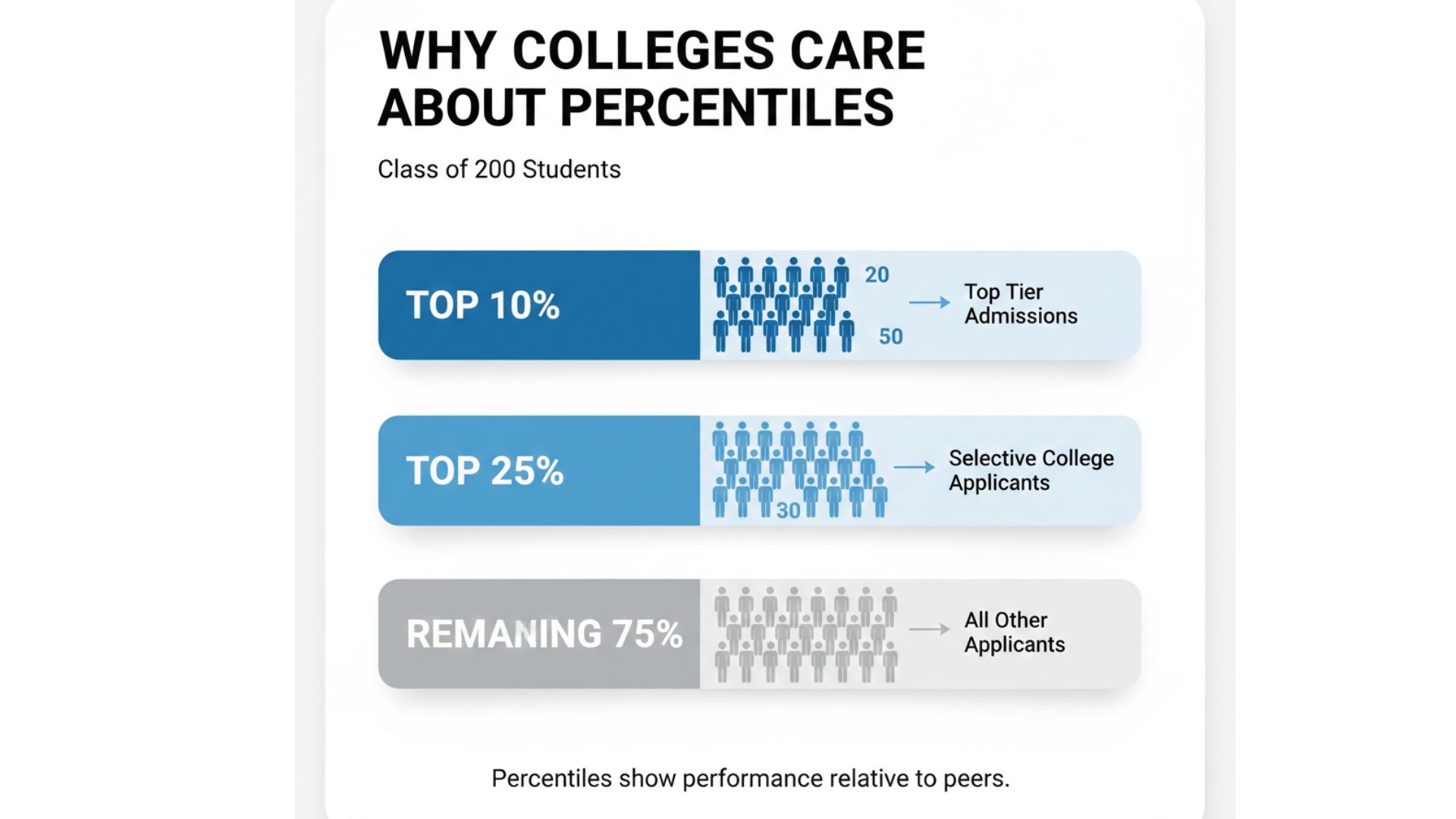
When reviewing student applications, many colleges prefer class rank percentiles over raw ranks. A class rank percentile calculator makes it easier to show your academic position clearly. Percentiles help admissions officers compare students from schools of different sizes, grading scales, and ranking systems.
Practical Example : The University of Texas automatically admits students in the top 10% percentile of their class. This policy helps identify high achievers across schools of different sizes.
Here’s how to apply this effectively:
Some Universities Ask for a Percentile Rank Instead of a Raw Rank
Not all schools list both rank and percentile on transcripts, but colleges often ask for percentile because it’s standardized.
A percentile shows how well you performed compared to peers, no matter your school’s grading system.
For example:
- A student ranked 15 out of 150 may be in the top 10%, or roughly the 90th percentile.
- That’s easier to understand than just saying “Rank 15.”
💡 Pro Tip: Use a percentile class rank calculator to include accurate percentile data in college applications or scholarship forms.
Top 10 Percentile = Automatic Admission in Some States
In some U.S. states, like Texas, students in the top 10th percentile of their class qualify for automatic admission to certain public universities.
This rule helps reward consistent academic performance rather than test scores alone.
Knowing how to calculate class rank percentile can make a big difference if your target school follows similar admission policies.
Even a slight percentile improvement can open doors to scholarships and honors programs.
Helps Standardize Rankings Across Different Class Sizes
A percentile system levels the playing field for students from large and small schools.
For example, ranking 10th in a class of 500 means something different from 10th in a class of 50.
By using percentiles, colleges can fairly compare both.
That’s why using a class rank percent calculator gives a clearer, more accurate reflection of your performance across varying class sizes.
Common Mistakes When Calculating Class Rank Percentile
Even with a class rank percentile calculator, students often make simple errors that lead to wrong results. These mistakes can change your reported percentile and affect how colleges view your academic standing. The good news? They’re easy to avoid once you know what to check.
Here’s how to apply this effectively:
Confusing Percentile with Percentage
One of the most common errors is mixing up percentile and percentage. They sound similar but measure different things.
- The percentage shows how many points you scored out of 100.
- The percentile shows how many students scored below you.
For example, a 90th percentile means you outperformed 90% of your class, not that you scored 90 marks.
If you’re unsure, use a percentile class rank calculator to double-check. It instantly clarifies the difference and helps you report accurate results.
Not Adjusting Formula Correctly
When calculating manually, students often skip a step or misplace a number in the formula.
The correct formula to calculate class rank percentile is
Formula:
Percentile = ((Total Students – Rank + 1) / Total Students) × 100
Tip: Always include the “+1”. Missing it or dividing incorrectly can change your percentile by a few points.
Always review your math or verify results using a class rank percent calculator to stay consistent.
In states like Texas, class rank percentile can directly affect college admissions decisions. Understanding how class rank in Texas high schools works helps explain why percentile cutoffs are so important for automatic admissions policies.
Using Unweighted GPA Rank
Another mistake is using the wrong class rank type—especially unweighted GPA ranks.
Weighted ranks consider honors or AP courses, while unweighted ranks treat all classes equally.
If your school uses weighted GPAs, using the unweighted version will make your class rank percentile look lower than it should.
Before learning how to calculate class rank percentile, confirm which rank your school uses. Then, check your result with a percentile class rank calculator for accuracy.
conclusion
You’ve now learned precisely how to interpret your academic standing—from calculating percentiles manually to using a class rank percentile calculator for quick and accurate results. We also explored how colleges use these numbers and common mistakes to avoid when figuring out your rank.
Whether you’re applying to college or simply tracking progress, a percentile class rank calculator makes the process simple and stress-free. It helps you understand where you stand—and where you can improve.
Ready to take the next step? Try calculating your own percentile today and see your position in just seconds. 🚀
If this guide helped, share it with classmates or drop a comment below about your experience—your journey might inspire others, too!
💬 Your turn: Try the class rank percentile calculator, then share your percentile or questions in the comments — we’d love to hear how it helped you!
📊 Along with the Class Rank Percentile Calculator, the Canvas Grade Calculator is another handy tool for students. It helps you calculate grades and GPA within Canvas LMS, making academic planning even easier.
 FAQs :
 FAQs :
Team ClassRank builds smart, student-friendly calculators to make grade and rank tracking simple and accurate. For questions or feedback, contact us at classrankcalculator@gmail.com.