


Introduction
Ever wondered how your GPA really stacks up against your peers? Many college students in the USA focus on grades but overlook class rank. Knowing your standing can open doors to scholarships, honors, and graduate programs.
In this guide, we’ll show you how to calculate class rank in college step by step. You’ll learn which GPA details matter, how credit hours affect your standing, and how to estimate your percentile even if your school doesn’t publish official ranks.
We’ll also explore differences between high school and college rankings, explain why top students still track their rank, and share practical tips to improve your standing. By the end, you’ll understand exactly where you stand and how to make strategic choices to boost your academic profile.
Whether you’re aiming for graduate school, merit scholarships, or want to track progress, this guide will give you the clarity and tools you need. Plus, we’ll highlight simple calculators and methods to make the process easy for beginners in the USA.
Why Class Rank Still Matters in College

Many students think class rank ends after high school. It doesn’t. In college, class rank can still shape academic and career opportunities.
If you’re learning how to calculate class rank in college, you should also know why it matters. Ranking helps schools and programs quickly compare students. It adds context to your GPA. A 3.8 GPA in a competitive major may rank differently than a 3.8 in a smaller program.
Colleges may not always publish a rank. Some provide percentiles or honors tiers instead. Even then, your relative standing still matters for:
- Graduate school admissions
- Competitive scholarships
- Academic honors
- Select programs within your university
Understanding your position helps you plan. It also shows whether improving one course could move you into a higher percentile.
Graduate School, Scholarships, and Honors Societies
Graduate programs often review GPA first. But GPA alone doesn’t reflect the level of competition. Class rank or percentile gives extra context.
For example:
- Law, medical, and doctoral programs may value top-10% or top-20% standing.
- Merit-based scholarships sometimes require a minimum percentile.
- Honors societies may invite only top-performing students in each cohort.
Some universities award Latin honors such as cum laude, magna cum laude, or summa cum laude based on GPA cutoffs or percentile thresholds. These distinctions often reflect class rank indirectly.
If your college doesn’t publish a rank, check whether it provides GPA quartiles or honors eligibility rules. Those numbers act as ranking signals.
Pro Tip: Track your GPA each semester. A small increase in a high-credit course can move you up several percentile points.
For a detailed approach, refer to How to Calculate Class Rank with GPA to see examples of credit-weighted calculations.
High School Rank vs. College Rank
High school class rank often affects college admissions. In college, the focus shifts.
Key differences:
- High school rank helps you get into college.
- College rank can help you get into graduate school.
- High school rank is often public and structured.
- College rank may be optional or unpublished.
In college, ranking is usually program-specific. You may rank within your major rather than your entire graduating class. That makes competition more specialized.
Because of this, knowing how to calculate your class rank in college becomes more practical than theoretical. It helps you compare yourself with others in your field.
Employers vs. Academic Programs: Who Cares More?
Academic programs care more about class rank than most employers.
Graduate schools look for:
- Academic consistency
- Performance within competitive cohorts
- Honors or distinctions
Most employers focus on:
- GPA
- Skills
- Internships
- Projects and leadership
Some fields, such as law or academia, may place greater weight on a high rank. Other industries rarely ask for it.
If your goal is graduate study, understanding your university class rank is important. If your goal is industry work, GPA and experience often matter more.
Takeaways
- Class rank still matters in college, especially for academic paths.
- Graduate schools and scholarships may use percentile standing.
- Employers usually prioritize skills over rank.
- Tracking your GPA helps you protect or improve your standing.
If you don’t know your rank, the next step is learning how to calculate it accurately using your GPA and total class size.
Key Inputs Needed to Calculate College Class Rank
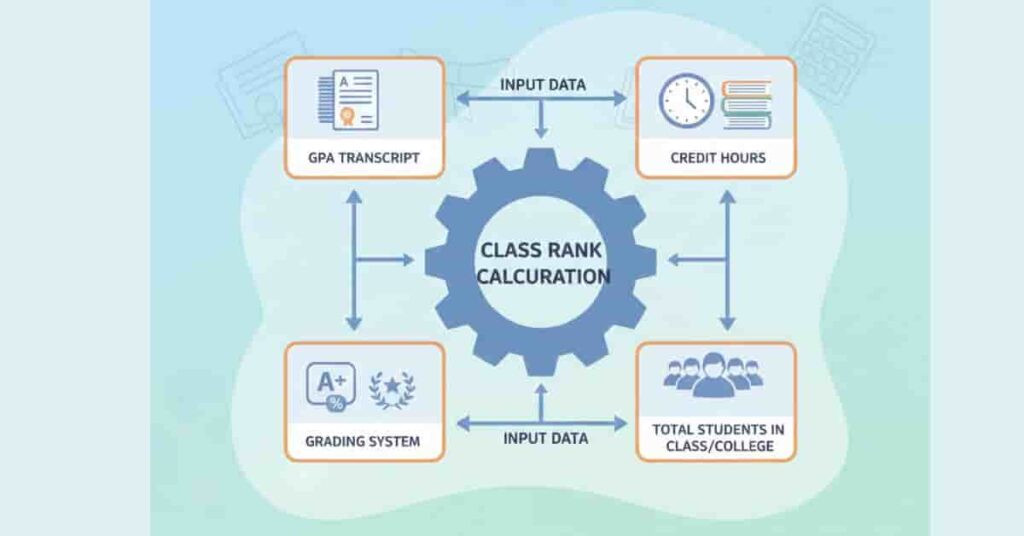
If you want to learn how to calculate class rank in college, you need the right inputs first. Many students try to guess their rank without full data. That leads to wrong estimates.
To calculate your university class rank accurately, gather these four things:
- Total number of students in your class, year, or major
- Your GPA (weighted by credit hours)
- Your university’s grading scale
- Any official percentile or distribution data
Let’s break each one down.
Total Number of Students in Your Class or Major
Class rank always depends on comparison. You can’t rank yourself without knowing how many students are in the group.
Your rank may be calculated within:
- Your graduating class
- Your academic year (junior, senior, etc.)
- Your specific major or department
Many colleges rank students within their program, not the entire university. A biology major competes with biology students. An economics major competes within economics.
If your school does not publish rank, ask the registrar’s office whether they provide:
- GPA distribution charts
- Percentile ranges
- Top 10% or Top 25% thresholds
Pro Tip: Even if the official rank is unavailable, knowing total enrollment helps you estimate your percentile manually.
Your GPA (Weighted by Credit Hours)
Your GPA is the core factor in college class rank. But not all GPAs are equal.
Most universities use a credit-weighted GPA. That means:
- A 4-credit course impacts your GPA more than a 1-credit elective.
- A poor grade in a high-credit course lowers your standing more.
For example:
If you earn:
- A in a 4-credit course
- B in a 1-credit course
The A influences your GPA more because of the credit weight.
When calculating your college class rank, always use your official cumulative GPA from your transcript. Do not use rough semester averages.
If you want a more precise estimate, calculate your GPA using credit hours before comparing yourself to peers.
Your University’s Grading System
Not all colleges use the same grading scale.
Common systems include:
- 4.0 scale (most U.S. universities)
- 5.0 weighted systems (less common in college)
- Percentage-based systems
- Honors/pass-fail hybrid systems
Before estimating your university class rank, confirm:
- Is your GPA capped at 4.0?
- Are plus/minus grades included?
- Are repeated courses averaged or replaced?
These policies directly affect rank calculations.
If policy details are unclear, use [placeholder] and verify through your official academic handbook.
Example: University of North Carolina at Greensboro
At institutions like the University of North Carolina at Greensboro (UNCG), GPA is calculated on a 4.0 scale using credit-weighted averages. Individual departments may assess academic standing within programs.
Policies can change over time. Always check the official registrar page for:
- GPA calculation method
- Honors criteria
- Rank or percentile availability
Do not assume all universities calculate rank the same way.
Takeaways
- You need the total number of students, their GPAs, the grading scale, and policy details.
- Credit hours heavily influence your ranking.
- Class rank may be major-specific rather than university-wide.
- Always verify grading rules before estimating the percentile.
Once you gather these inputs, you’re ready to calculate your college class rank step by step.
Understanding the difference between weighted and unweighted scores is critical; see How to Calculate Weighted Class Rank vs Unweighted for clarity.
Step-by-Step Calculation of Class Rank in College
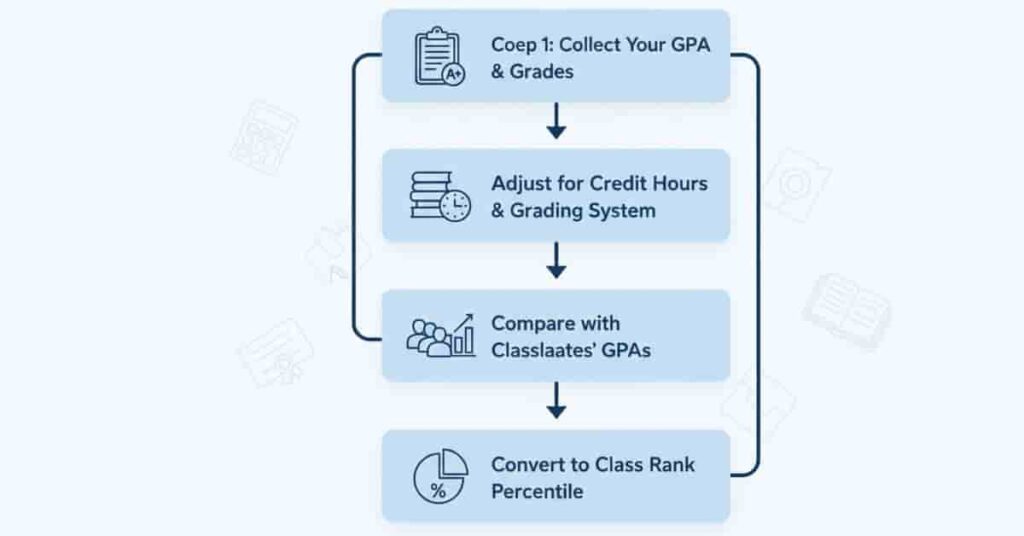
Now, let’s walk through how to calculate class rank in college step by step. You don’t need complex software. You need accurate data and a clear formula.
If your university does not publish official ranks, you can estimate your percentile using your GPA and the total class size.
Follow these steps carefully.
Step 1: Collect Your Official GPA
Start with your official cumulative GPA from your transcript. Do not guess.
Log in to your student portal and check:
- Cumulative GPA
- Total credit hours completed
- Grading scale (usually 4.0)
If you’re learning how to calculate your class rank in college, accuracy matters. Even small GPA differences can shift percentile positions.
Use your most recent updated GPA. Avoid using projected or “what-if” numbers unless you’re estimating future rank.
Step 2: Confirm Credit-Weighted GPA
Most colleges already calculate GPA using credit hours. That means your transcript GPA is credit-weighted.
If you are calculating manually, use this method:
- Multiply each course grade by its credit hours.
- Add all quality points.
- Divide by total credit hours.
This gives you a true weighted GPA.
If your university replaces repeated grades instead of averaging them, confirm the rule before calculating. Policies differ by institution.
Pro Tip: High-credit courses have a greater impact on rank. Improving one 4-credit course can significantly improve your percentile.
Step 3: Compare with the GPA Distribution of Peers
This is the comparison step. Rank is relative.
Ask your registrar or department if they provide:
- GPA distribution charts
- Percentile ranges
- Top 10% or Top 25% thresholds
If distribution data is available, find where your GPA falls.
Example:
- Top 10% GPA cutoff: 3.85
- Top 25% GPA cutoff: 3.70
If your GPA is 3.88, you are likely within the top 10%.
Suppose exact rank numbers are available; even better. Some departments publish rank positions internally.
If no data is provided, use [placeholder] until you verify official numbers.
Step 4: Convert Rank into Percentile
If you know your rank position, use this formula:
Percentile = (Rank ÷ Total Students) × 100
Now let’s apply it.
Example: 500 Students in a Program
Suppose:
- Total students = 500
- Your rank = 25
Calculation:
(25 ÷ 500) × 100 = 5
That means you are in the top 5% of your program.
Lower percentile = higher standing.
If your rank is 100 out of 500:
(100 ÷ 500) × 100 = 20
You are in the top 20%.
This method works whether you are estimating your university class rank at UNCG or any other institution.
Takeaways
- Always use your official cumulative GPA.
- Confirm grading and credit policies first.
- Compare your GPA to distribution data when possible.
- Use the percentile formula for a clear ranking context.
If manual calculations feel confusing, a class rank calculator can instantly estimate your percentile based on your GPA and total class size.
Weighted GPA and Credit Hour Impact
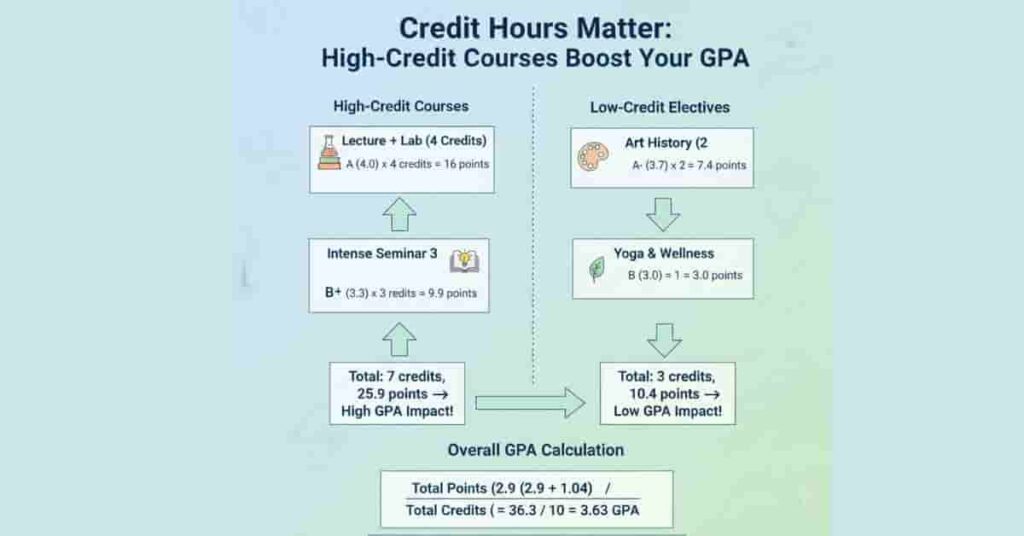
When learning how to calculate class rank in college, many students overlook credit hours. Credit weight changes everything.
In college, GPA is usually credit-weighted. That means courses with more credits affect your GPA more than low-credit classes. A strong grade in a high-credit course can raise your standing. A weak grade can quickly bring it down.
Understanding this helps you protect and improve your university class rank.
Why a 4-Credit Science Class Impacts GPA More
Not all classes carry equal weight.
A 4-credit science course has four times the impact of a 1-credit elective. The GPA formula multiplies your grade points by credit hours. More credits mean more influence.
Example:
- A in a 4-credit class = strong GPA boost
- B in a 1-credit seminar = small GPA change
If you earn a C in a 4-credit course, the drop will be noticeable. That single class may shift your percentile ranking.
This is why core courses matter more than short electives. When calculating your college class rank, always use your official cumulative GPA. It already reflects credit weighting.
Pro Tip: If you want to improve your rank, focus your effort on high-credit-required courses first.
How Labs, Projects, and Seminars Affect Rank
Labs and project-based courses often carry separate credit values. Some science courses include:
- 3 credits lecture
- 1 credit lab
Even though the lab feels smaller, it still affects GPA.
Seminars or pass/fail workshops may have a limited impact on GPA. However, policies vary. Some colleges exclude certain courses from GPA calculation. Others include everything except pass/fail grades.
Before estimating your class rank:
- Check whether labs are graded separately.
- Confirm how repeated courses are handled.
- Verify if internships count toward GPA.
If details are unclear, use [placeholder] and confirm through your academic handbook.
GPA vs. “Credit-Adjusted GPA”
Some students calculate a simple average of grades. That is not accurate.
A simple GPA average ignores credit weight. A credit-adjusted GPA multiplies grades by credit hours before dividing by total credits.
Most universities already use credit-adjusted GPA on transcripts. That number determines class rank.
If you are estimating your percentile manually, always use the official cumulative GPA. Do not use a basic average.
Takeaways
- High-credit courses influence class rank more.
- Labs and required core courses often have a stronger impact.
- Simple averages are inaccurate for ranking.
- Always rely on your official credit-weighted GPA.
Understanding credit weight gives you control. One strategic improvement in a high-credit class can shift your position within your program.
Honors & Distinctions Linked to College Class Rank

College class rank often connects to academic honors. Even if your school does not publish exact rank numbers, distinctions still reflect relative performance.
When learning how to calculate class rank in college, it helps to understand how rank appears on transcripts and diplomas.
Colleges usually recognize top students through:
- Latin honors
- Dean’s List
- Percentile-based distinctions
- Graduation honors by GPA tier
These honors signal your standing without always stating a numerical rank.
Latin Honors: Cum Laude, Magna Cum Laude, Summa Cum Laude
Many universities award Latin honors based on GPA thresholds or percentile cutoffs.
Common distinctions include:
- Cum laude – high academic achievement
- Magna cum laude – higher distinction
- Summa cum laude – highest honor
Some colleges tie these directly to the percentile. Others use fixed GPA cutoffs, such as [placeholder], depending on policy.
For example:
- Top 20% may qualify for cum laude
- Top 10% for magna cum laude
- Top 5% for summa cum laude
Policies vary by institution and year. Always confirm requirements through your official academic catalog.
Pro Tip: If your GPA is near an honors cutoff, improving one high-credit course could change your graduation distinction.
Dean’s List vs. Top 10% Rankings
Dean’s List and class rank are not the same.
Dean’s List usually recognizes students who meet a semester GPA requirement. It does not always compare students against peers.
Class rank or percentile, however, compares you directly to others in your program.
Key difference:
- Dean’s List = fixed GPA threshold
- Top 10% = relative standing within cohort
You can make the Dean’s List without being in the top 10%. Likewise, you could rank highly in a competitive program without hitting a semester GPA cutoff in a specific term.
If your goal is graduate school, percentile standing often carries more weight than a single Dean’s List semester.
How Colleges Phrase Class Rank
Colleges may avoid giving exact rank numbers. Instead, they use percentage-based language such as:
- “Top 15% of Graduating Class”
- “Graduated with High Distinction”
- “Ranked in the Upper Quartile”
These phrases signal relative performance without revealing precise positions.
If you are estimating your university class rank, convert your position to a percentile. Graduate programs understand the percentile clearly.
Takeaways
- Latin honors often reflect percentile or GPA tiers.
- Dean’s List is based on GPA, not direct rank.
- Colleges may state rank using percentage language.
- The percentile format makes your standing easier to communicate.
Knowing how honors connect to rank helps you set clear academic targets before graduation.
Variations by University
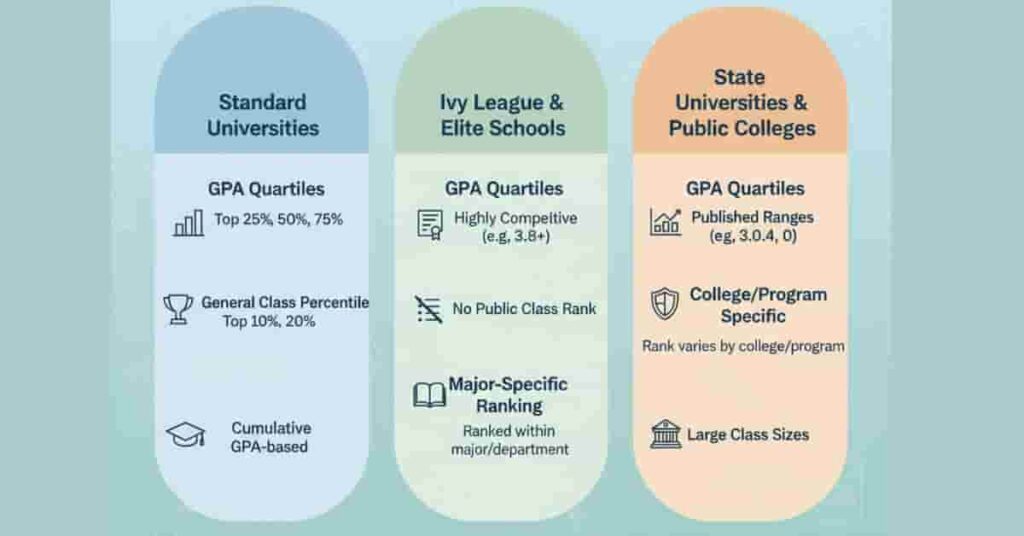
Class rank policies are not universal. Each university decides how, or whether, to calculate rank.
If you are learning how to calculate class rank in college, always check your school’s official policy first. Two students with the same GPA at different universities may face very different ranking systems.
Some colleges publish exact rank numbers. Others provide percentiles or honors tiers. A few do not calculate rank at all.
Let’s look at common variations.
Example: University of North Carolina at Greensboro (UNCG)
At institutions like the University of North Carolina at Greensboro (UNCG), GPA is calculated on a 4.0 credit-weighted scale. Departments may evaluate academic standing within specific programs.
Some universities calculate rank:
- Within a major
- Within a graduating class
- Within an academic year
Policies can change. Always confirm through the registrar’s office or official academic catalog.
If UNCG does not publish exact rank numbers, students may rely on:
- GPA distribution data
- Latin honors thresholds
- Department-specific distinctions
If official data is unclear, use [placeholder] and verify before making assumptions.
Pro Tip: When searching “how to calculate your university class rank UNCG,” check both university-wide and department-level policies.
Ivy League vs. State Universities
Ranking practices differ across institutions.
Many Ivy League schools choose not to publish class rank. They focus on GPA, narrative transcripts, and honors rather than on the content of the courses. The goal is to reduce competition and promote holistic evaluation.
State universities are more likely to:
- Publish class rank
- Provide percentile standings
- Use clear GPA-based honors tiers.
However, this is not universal. Each school sets its own rules.
If your university does not publish a rank, do not assume you cannot estimate your standing. Percentile and GPA comparison methods still work.
Colleges That Do Not Publish Rank
Some colleges avoid ranking altogether. Instead, they offer alternatives such as:
- GPA quartiles (top 25%, upper half, etc.)
- Latin honors categories
- Graduation distinctions
- Academic excellence awards
In these cases, you can estimate your relative position using:
- GPA distribution charts
- Honors cutoff data
- Percentile conversion formula
Even without an official number, understanding where your GPA stands helps you plan for graduate school or scholarships.
Tools & Calculators for College Students
You don’t have to calculate everything by hand. Many tools can help you estimate your GPA and class rank more quickly.
If you’re learning how to calculate class rank in college, the right calculator can save time and reduce errors. Just make sure you understand what data the tool requires.
Let’s look at your options.
University-Provided GPA or Rank Tools
Some colleges offer built-in GPA calculators inside student portals. These tools often:
- Pull real transcript data.
- Apply official grading rules.
- Reflect credit-weighted averages
- Show honors eligibility
If your university publishes class rank, it may appear in:
- Academic Records Section
- Degree audit reports
- End-of-semester summaries
Always check your registrar’s website first. Official tools follow your institution’s grading scale and repeat-course policy.
If no rank appears, look for:
- GPA distribution charts
- Honors cutoff tables
- Percentile ranges
These details help you accurately estimate your standing.
Pro Tip: University tools are most accurate for GPA. For percentile estimation, you may still need manual comparison.
Online Calculators for GPA Percentile Conversion
If your school does not publish a rank, you can estimate your percentile using a formula:
Percentile = (Rank ÷ Total Students) × 100
Online calculators simplify this process. You usually enter:
- Your GPA
- Total number of students
- Estimated or known rank
These tools are helpful when calculating your university class rank for applications or planning.
Be careful, though. Online calculators cannot access official GPA distributions unless you provide accurate numbers. Always verify input data.
Using “Course Details Mode” or “Current Rank Mode”
If you’re tracking performance across semesters, advanced calculators offer extra features.
Course Details Mode allows you to:
- Enter individual courses
- Add credit hours
- Simulate grade changes
- See GPA impact instantly.
This helps you understand how one high-credit course can shift your percentile.
Current Rank Mode focuses on:
- Your cumulative GPA
- Total students in your program
- Estimated rank position
- Percentile output
These modes are useful for students planning graduate school applications. You can test “what-if” scenarios before final exams.
Takeaways
- Start with your university’s official GPA tools.
- Use online calculators for percentile estimates.
- Always enter accurate credit-weighted GPA data.
- Simulation tools help you strategically plan GPA improvements.
The right tool does not replace understanding. It supports it. When you know your numbers, you can protect and improve your class standing with confidence.
How to Improve Your Class Rank in College

Improving your college class rank is not just about studying harder—it’s about strategic planning. Even small changes can move you up several percentiles, especially if you focus on high-impact areas.
Here’s how to boost your standing.
Focus on High-Credit Courses
High-credit courses affect your GPA more than low-credit electives. A strong grade in a 4-credit science class can improve your rank more than multiple A’s in 1-credit seminars.
Tips:
- Prioritize studying for core courses with higher credit counts.
- Track your GPA after each high-credit course to see its impact.
- Use “what-if” simulations to plan improvements before final exams.
Pro Tip: Improving one high-credit course by a single grade step can sometimes raise your class percentile by multiple points.
Retake or Replace Poor Grades
Many colleges allow grade replacement if you retake a course. This can significantly improve your cumulative GPA and, in turn, your class rank.
Things to consider:
- Only retake courses that carry enough credit to affect GPA.
- Confirm your university’s repeat policy (some average grades instead of replacing)
- Balance effort vs. potential rank improvement
Retaking a low-grade, high-credit course is often more effective than trying to excel in multiple low-credit electives.
Plan Electives Smartly
Electives can help your GPA if chosen carefully. Think about:
- Credit value vs workload
- Potential for high grades
- Interest and motivation (engaged students perform better)
Strategically selecting electives lets you maximize GPA gains without burning out.
Pro Tip: Light electives with high grades may add small boosts. Pair them with required high-credit courses for maximum impact.
Consider Non-GPA Factors
Some universities don’t publish a rank. In that case, focus on alternative ways to stand out:
- Internships and research projects
- Leadership roles in student organizations
- Academic competitions or honors programs
These factors don’t affect your official percentile, but they make your transcript more competitive for graduate school or scholarships.
Conclusion
In this guide, we explored the key steps and inputs needed to calculate your college class rank. You learned how GPA, credit hours, and university grading systems influence your standing. We also covered honors, percentile estimation, and practical tips to improve your rank strategically.
By following these steps, you now understand how to calculate class rank in college accurately, even if your school does not publish official rankings. You can track your progress, plan courses, and make informed decisions for scholarships or graduate school applications.
Ready to take control of your academic standing? Try using a GPA or class rank calculator today, and share your experience or questions in the comments below. Your journey to understanding your rank starts with one step.

Team ClassRank builds smart, student-friendly calculators to make grade and rank tracking simple and accurate. For questions or feedback, contact us at classrankcalculator@gmail.com.