


Introduction
Have you ever wondered how your law school class rank affects your career chances? For many students in the USA, class rank can determine eligibility for prestigious internships, law review, and clerkships. Even strong grades may not be enough if your rank doesn’t reflect your performance relative to peers.
Law school class rank isn’t just a number—it’s a measure of how you compare with your classmates. Schools use GPA, credit hours, and grading curves to assign ranks, which can vary widely between institutions. Understanding your rank early helps you make smarter decisions about courses, study strategies, and career planning.
Fortunately, class rank calculators make this process easier. By entering your GPA, class size, and course credits, you can estimate your percentile and get a clear picture of where you stand. While estimates aren’t official, they give beginners a practical guide for setting goals, tracking progress, and preparing for competitive opportunities.
In this guide, you’ll learn what class rank means, how it’s calculated, and step-by-step methods to estimate your standing. By the end, you’ll have the tools to navigate grading curves, GPA impact, and career planning with confidence.
What Is Law School Class Rank?
Understanding your law school class rank is essential for planning your legal career. Your rank shows how your academic performance compares to that of your classmates. While GPA reflects your grades, class rank puts those grades into perspective within your school.
Class rank helps students see where they stand, which can influence opportunities like law review, internships, and clerkships. Some schools publish exact ranks, while others provide percentile ranges. Knowing your approximate position gives you a realistic sense of competition and performance expectations.
Here’s how class rank works and why it matters:
Definition of Class Rank in Legal Education
Class rank is a measure of your academic standing compared to other students in your law school. Schools usually calculate it using GPA, credit hours, and grading curves. For example, a student with a 3.8 GPA in a highly competitive first-year class may rank in the top 10%. Rank reflects your relative performance, not just grades in isolation.
Difference Between Class Rank and School Prestige Ranking
Class rank is personal; school prestige is institutional.
- Class rank shows how you perform in your school.
- School prestige reflects how the institution is viewed externally.
For instance, a top student at a mid-tier school may still rank higher in their class than a middle-tier student at a top-ranked law school. Both metrics are useful, but they serve different purposes.
Why Knowing Your Rank Matters for Career Planning
Understanding your rank helps guide strategic decisions:
- Law review eligibility: Often limited to top-ranked students.
- Internship applications: Big Law and federal clerkships consider rank heavily.
- Course planning: Adjust workload and electives to protect or improve your rank.
Even if exact ranks aren’t published, estimating your standing early helps you set realistic goals. This awareness ensures you can take proactive steps to maximize opportunities.
How Law Schools Calculate Class Rank
Your law school class rank depends on a combination of GPA, credit hours, and grading curves. Schools use these factors to compare students fairly within their cohort. Understanding how your rank is calculated helps you set realistic goals and track your progress effectively.
Even if your school doesn’t publish exact ranks, you can estimate your percentile to gauge where you stand. Here’s how law schools determine class rank:
Role of GPA, Grading Curves, and Credit Hours
GPA is the primary factor in class rank, but schools weigh courses differently. Credit hours matter because a 4-credit class affects your GPA more than a 2-credit elective.
Grading curves limit the number of high grades per class. Most law schools apply curves to maintain consistency and fairness. For example, only a small percentage of students may earn an A or A+.
- Weighted GPA = sum of (grade × credit hours) ÷ total credits
- Curves adjust for class difficulty and distribution.
- Core courses often carry more weight than electives.
This system ensures students are ranked relative to peers, not just by raw grades.
You can also explore detailed methods using a class rank percentile calculator to understand your standing more precisely.
Mandatory Curves: 1L vs Upper-Year Differences
Many law schools enforce a B+ median curve for first-year students (1L). This means the average grade centers around a B+, limiting how many students earn A-level grades.
Upper-year courses (2L/3L) often have looser curves, giving more flexibility for high grades. Still, competitive courses and popular electives may remain tightly curved.
Understanding these differences helps you plan your workload and course choices strategically.
Variation of GPA Cutoffs Across Schools
GPA thresholds for top ranks vary widely. For example:
These ranges differ by institution, grading culture, and cohort performance. Knowing typical cutoffs can help you estimate your standing even if your school doesn’t release official ranks.
Unofficial Ranks and Percentile Estimates
When schools don’t publish exact ranks, students can use percentile estimates:
- Collect your GPA and class GPA distribution (if available).
- Rank yourself relative to peers’ GPAs.
- Convert to percentile: (Class Size – Estimated Rank) ÷ Class Size × 100.
This approach gives a reasonable estimate of your standing and helps with planning for law review, clerkships, or job applications.
Understanding Law School Grading Curves
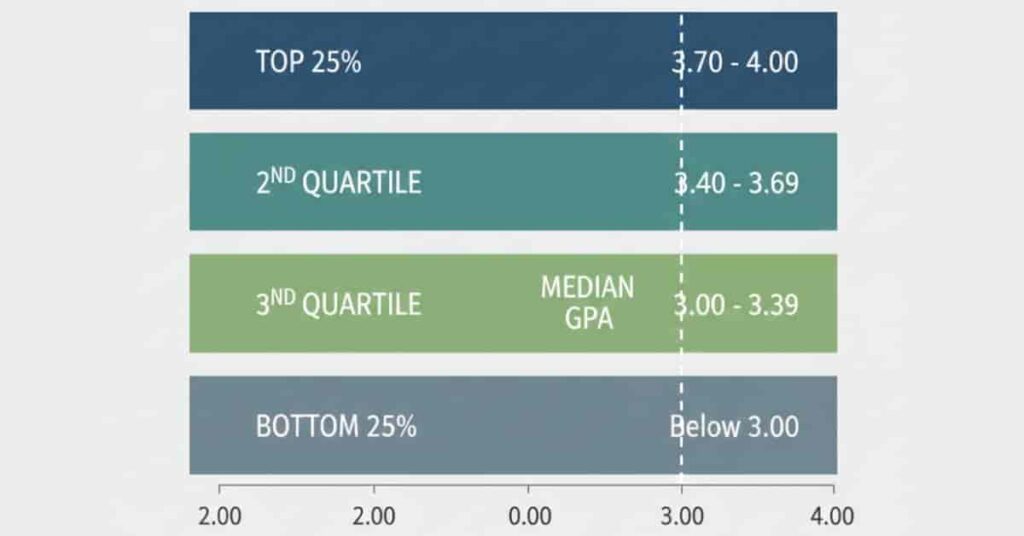
Grading curves are a key factor in your law school class rank. They ensure fair comparison among students in the same class, especially when exams and courses vary in difficulty. Without curves, one tough exam could unfairly lower a student’s standing, while an easy exam could inflate another’s grades.
Curves also set expectations for GPA distribution, helping schools maintain consistent academic standards. Understanding how they work gives you insight into your rank and how your GPA translates to percentiles.
What a Grading Curve Is and Why It Exists
A grading curve is a method schools use to adjust grades so that performance is relative, not absolute. It accounts for differences in exam difficulty and class performance.
- Ensures fairness among students taking the same course.
- Prevents grade inflation across semesters.
- Helps law schools maintain a predictable distribution for rank-based programs like law review.
Curves reward top performers while keeping average grades consistent.
Typical 1L vs 2L/3L Curve Differences
First-year (1L) courses usually have strict curves, often with a B+ median. Only a small percentage of students earn A-level grades, while a few may fall below B.
Upper-year courses (2L/3L) often have more flexible curves, giving students a chance to improve their GPAs. Electives and seminars may allow more high grades, but competitive or required courses still often follow a traditional curve.
Knowing these differences helps you plan which courses to take and when to challenge yourself with high-credit classes.
How Curves Limit the Number of High Grades
Curves ensure that top grades are rare. Even if multiple students score near-perfectly, only a set percentage can receive As or A-s. This means your rank isn’t just about your raw scores—it’s about relative performance.
- Example: In a 100-student class, perhaps only 15–20% can earn an A.
- Middle-range students cluster around the median (B+).
- Lower grades fill the bottom quartile.
This system encourages consistent effort and distinguishes exceptional performance.
Example: GPA Distribution and Quartile Placement
Here’s a typical distribution for a 1 L class of 100 students:
This illustrates how curves concentrate most students near the middle and limit the number of top grades.
Step-by-Step Guide to Calculating Your Class Rank
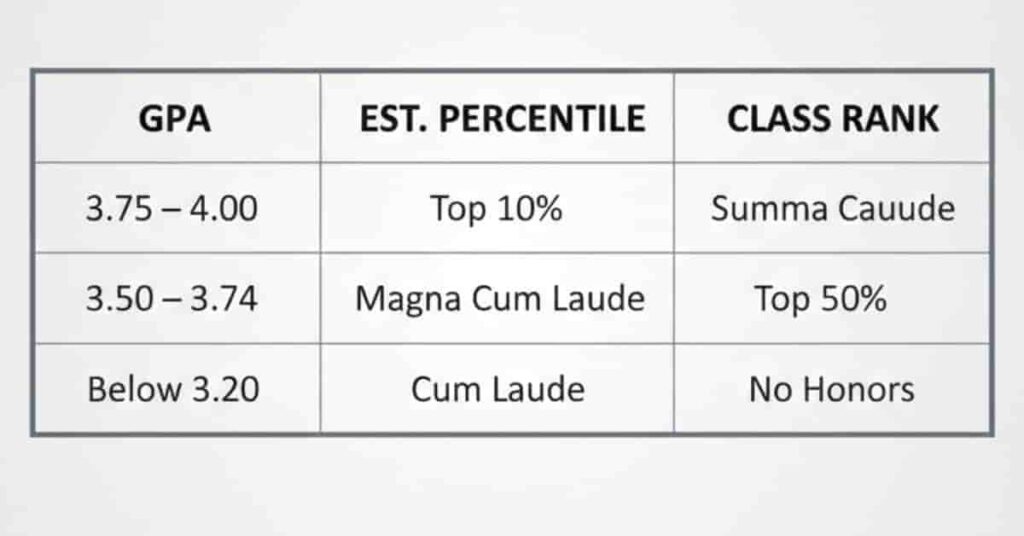
Calculating your law school class rank might seem tricky, but breaking it into clear steps makes it manageable. Your rank depends on GPA, credit hours, and how your performance compares to classmates. Even if your school doesn’t release official ranks, you can estimate your percentile with this method. Here’s how to apply it effectively:
Step 1 – Determine Your Weighted GPA
Weighted GPA accounts for credit hours, so courses with more credits impact your GPA more than smaller electives. For example:
- A 4-credit constitutional law course influences your GPA twice as much as a 2-credit seminar.
- Core doctrinal courses often carry higher credit weight than electives, reflecting their importance in law school evaluation.
To calculate weighted GPA:
- Multiply each course grade by its credit hours.
- Sum all weighted grades.
- Divide by total credit hours.
This gives a GPA that accurately reflects your overall performance relative to course weight.
Step 2 – Compare GPA to Class Distribution
Next, see how your GPA compares to your class. Use published GPA ranges or percentile charts if your school provides them.
- If exact ranks aren’t published, you can estimate by comparing your GPA to the class median and top quartile.
- Pay attention to core course performance—it often weighs more heavily in unofficial ranking estimates.
This step helps you understand where you stand relative to peers.
Step 3 – Convert to Percentile
Percentiles show your position in the class as a percentage. The basic formula:
Percentile Calculation Formula
Example
Class Size: 200
Estimated Rank: 40
Percentile = (200 − 40) ÷ 200 × 100 = 80%
- Example: Rank 20 in a 200-student class → (200 – 20)/200 × 100 = 90th percentile.
- Note: Estimated percentiles may differ from official school reports, but they provide a useful benchmark.
Percentiles help you understand eligibility for law review, clerkships, or competitive internships.
Step 4 – Example Calculation
Suppose your class has 200 students and your weighted GPA is 3.65. Using the class GPA distribution:
Here, a 3.65 GPA roughly places you in the top 15% of your class. Even without official ranks, this calculation gives a reliable estimate of standing.
Beginners may find it useful to follow a step-by-step guide on how to calculate class rank with GPA.
Using Class Rank Calculators
Class rank calculators help you estimate your law school standing quickly and easily. Rather than comparing GPAs and percentiles by hand, these tools give you a fast look at your likely rank. They are useful if you want to track your progress, plan your courses, or check if you qualify for law review or internships.
Although calculators are convenient, they are not a substitute for official school reports. Use them as tools to guide your decisions. Here is how they work and what you can expect:
Benefits of Online Calculators for Law Students
A class rank calculator saves you time and helps prevent mistakes.
- Quickly estimate your percentile and relative rank.
- Identify where you stand among peers without waiting for official ranks.
- Plan strategic course selection to improve standing.
- Track progress semester by semester.
These benefits help you set goals and decide on electives, heavier course loads, or ways to improve your GPA.
Inputs Needed
To get accurate results, you usually need the following:
- GPA: Weighted GPA including credit hours.
- Class size: Total number of students in your cohort.
- Credit weighting: Number of credits per course if the calculator adjusts for them.
Providing correct input. Entering the right information helps the calculator show your performance accurately. The Percentile and Rank
Most calculators show you the following:
- Estimated class rank (e.g., 25th out of 200 students)
- Percentile (e.g., top 12%)
This he This helps you see how your GPA compares to others in your class. Some tools also give you a chart to show your place in the group.
- Calculators do not replace official rankings.
- They assume everyone is graded the same way and may not account for strict grading curves.
- Estimates vary if the class GPA distribution isn’t publicly availaUse the results as a guide, not as your final rank.
Short Demo / Example
Suppose you enter:
- GPA: 3.65
- Class size: 200
- Credit weighting: standard
Calculator output:
- Estimated rank: 30/200
- Estimated percentile: 85th
This matches what you would get by calculating by hand and gives you a quick way to check if you qualify for law review or internships.
Class Rank Percentiles and Career Impact

Knowing your law school class rank percentile is important for planning your career. Percentiles show how you compare to your classmates and often affect your chances for competitive programs, internships, and jobs. A strong GPA alone may not show your true standing, but percentiles give helpful context.
Below is a summary of common percentile ranges and what they mean for your career planning.
Top 5%, 10%, 25%, and Top Half Explained
- Top 5%: This is an outstanding achievement and often qualifies you for law review, top clerkships, and competitive BigLaw positions.
- Top 10%: Strong standing; eligible for most honors programs, clerkships, and competitive internships.
- Top 25%: This shows above-average performance and may still give you access to law review and some high-profile opportunities.
- Top Half: Solid performance; opens doors to many firms and public interest positions, but highly competitive programs may favor top quartile students.
Percentiles help you honestly assess your options and set career goals early on.
Implications for Law Review, BigLaw, and Clerkships
Employers and law schools often look at class rank as a key factor when evaluating candidates:
- Law Review: Many schools reserve spots for top-ranked students (top 10–15%).
- BigLaw Recruitment: Large law firms look at class rank along with GPA, interviews, and extracurricular activities.
- Clerkships: Federal and appellate clerkships place a high value on candidates in the top percentiles.
- Public Interest Work: Your rank may be less important here, but strong academic performance still helps with competitive programs.
Knowing your rank helps you plan which opportunities to go after in a smart way.
How Employers Interpret Rank vs. GPA
Employers often care more about how you perform compared to your classmates than about your exact GPA:
- Two students with the same GPA might have different class ranks at their schools.
- Being in the top 10% at a mid-tier school can make you as competitive as students in the middle of the class at elite schools.
- Rank provides your class rank, which shows how competitive and consistent you are within your school’s grading system. An early percentile allows you to tailor applications and highlight your strengths effectively.
Special Situations Affecting Class Rank
Your law school class rank can be affected by more than just your GPA and credit hours. For example, transferring schools or enrolling part-time can change how your rank is calculated. Knowing about these exceptions helps you set realistic goals and plan your studies.
Let’s look more closely at some common situations that can affect your class rank:
Transfer Students and Recalculated Rank
If you transfer to a new school, your class rank is usually recalculated using your transferred credits and your current GPA.
- Some schools count all your previous coursework, while others only consider the classes you take after you transfer.
- This can temporarily change your percentile until you have completed enough courses at your new school. Being aware of recalculation policies allows transfer students to anticipate changes in standing.
Part-Time vs Full-Time Programs
Part-time students often have a smaller group of classmates, which can affect how ranks and percentiles are figured out.
- Smaller class sizes can magnify differences in GPA.
- Some schools rank part-time and full-time students separately.
Understanding program structure ensures you interpret your rank correctly.
Pass/Fail or Experiential Credits
Courses graded pass/fail or experiential credits, like clinics, often do not count toward GPA.
- These courses may impact class rank indirectly by freeing up time for GPA-weighted courses.
- Knowing which credits contribute helps students prioritize for rank improvement.
Study Abroad / Visiting Student Credits
If you earn credits as a visiting student, they might not all transfer or be included when your class rank is calculated.
- Find out whether the GPA from your study abroad courses is included in your official class rank.
- Planning your courses with transfer policies in mind can help you avoid unexpected changes in your class rank.
Academic Probation Effects
Academic probation can have a big effect on your class rank:
- Probation usually means your performance is below the middle of your class.
- Continued low performance can lower percentile and affect opportunities like law review or clerkships.
Taking action early to deal with academic challenges can help you keep your class rank and protect your future career options.
Real-World Case Example
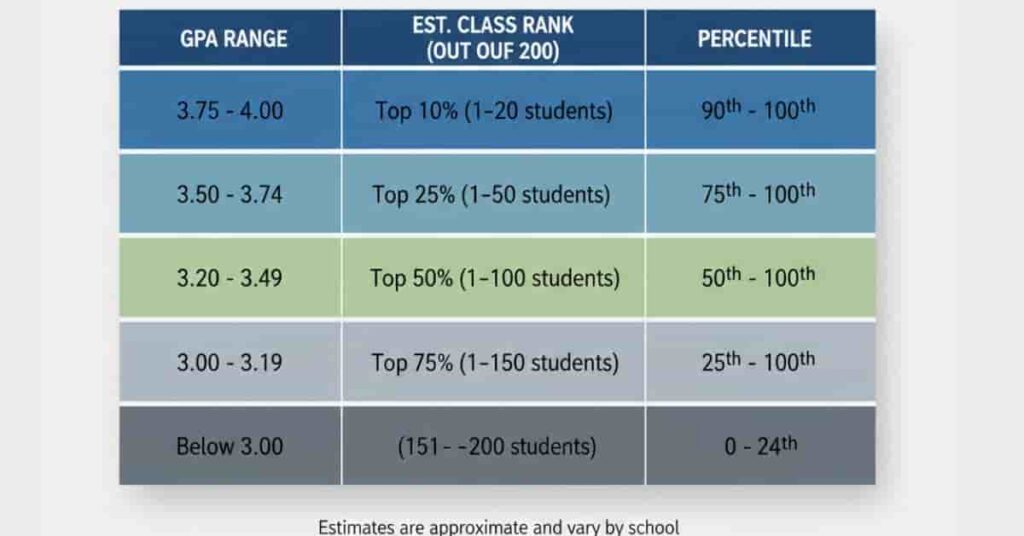
Seeing a practical example of law school GPA curves and class rank makes it easier to understand your standing. Different schools have varying curves, but the principles are similar: top students earn high GPAs and occupy top percentiles, while most cluster near the median.
Let’s look at a sample case based on a top law school (e.g., Emory Law) to illustrate typical rank placement.
GPA Curves and Typical Rank Placement
For a hypothetical class of 200 students, GPA ranges might translate to rank as follows:
This table shows how even a small GPA difference can affect percentile and rank.
Key Takeaways from the Example
- Top 10% GPAs are significantly higher, making rank-sensitive opportunities highly competitive.
- The median GPA (~3.4–3.5) represents the bulk of the class.
- Understanding your approximate percentile helps set realistic career goals and plan course selection strategically.
Conclusion
Knowing your law school class rank is important for planning your studies and career. This guide explained how ranks are figured out, how GPA and grading curves work, and how to estimate your percentile with calculators.
If you keep track of your grades and use online tools, you can set realistic goals for law review, internships, and clerkships. Knowing your rank early helps you choose courses wisely and stay competitive.
Keep in mind that calculators only give estimates, so always double-check with your school’s official data. Watching your rank during law school helps you adjust your plans before it’s too late.
Take charge of your academic path by using these tools, keeping track of your progress, and sharing your experiences in the comments. Being proactive about your class rank can help you find the best opportunities.

Team ClassRank builds smart, student-friendly calculators to make grade and rank tracking simple and accurate. For questions or feedback, contact us at classrankcalculator@gmail.com.