


Introduction
Wondering how your GPA compares to your classmates? Understanding your academic standing can feel confusing, especially with so many ranking systems like quartiles, deciles, and top 10% lists. For students in the USA, knowing your class rank is more than just numbers—it affects scholarships, college admissions, and goal setting.
A quartile, decile & tenth class rank calculator simplifies this process by providing a clear breakdown of your class standing. Rather than relying on guesswork, these calculators show your exact position so you can identify strengths and areas for improvement, make informed decisions about college applications, and set realistic academic goals. Tools like a class rank decile calculator or class rank quartile calculator are especially helpful for beginners who want a fast, accurate way to track academic progress and plan next steps.
In this guide, we’ll explain how quartiles, deciles, and the top 10% ranks work, show how to calculate class rank quartiles, and give examples using real classroom scenarios. By the end, you’ll know which ranking system suits your goals and how to use online calculators to monitor your GPA, class rank, and percentile effectively.
Whether you’re aiming for the top of your class or just want to understand your standing, this article breaks it down clearly and practically. Start using the calculator today and take control of your academic journey.
Introduction to Class Rank Segments
Class rank segments, such as quartiles and deciles, reveal a student’s standing in their class using clear groupings. A Quartile, Decile & Tenth Class Rank Calculator lets you discover your position quickly, without having to calculate it yourself. These segments divide large groups of students into smaller categories, making it easier to compare performance across classes, grades, and schools.
In addition to making group comparisons easier, class rank segments also help you track progress over time. Tools like a quartile class rank calculator or class rank decile calculator can show how close you are to the next level. They’re simple, quick, and useful when planning for college admissions.
Here’s how to apply this effectively:
Why Schools and Universities Use Quartiles, Deciles, and Tenths
Schools use these segments to group students into fair and easy-to-read categories: quartiles divide the class into four parts, deciles split it into ten, and tenths single out the highest-performing 10%. Each approach presents academic standing in a clear, balanced way.
These ranking groups help colleges compare students from different schools, while they also support decisions about honors, awards, and scholarships. A class rank quartile calculator or class rank tenth calculator provides students with a quick idea of their standing.
Benefits of these segments:
- Make ranking easy to understand
- Reduce the pressure of exact rank numbers.
- Help identify academic strengths.
- Support scholarship and admission evaluations.
Difference Between Percentile and Quartile/Decile-Based Ranking
Percentile provides a precise position, such as “You scored higher than 88% of students,” whereas quartiles and deciles place you within a range; for instance, the top 25% is the first quartile, while deciles split students into ten blocks, each representing 10%.
Percentiles show exact placement, while quartiles and deciles simplify large data sets. This is why many schools use a class rank quartile calculator to place students in broader categories. If you’re learning how to calculate a class rank quartile, this difference is important.
Quick comparison:
- Percentile: Exact placement
- Quartile: 4 broad groups
- Decile: 10 narrower groups
Both methods help students understand class performance, but in different levels of detail.
What Is a Quartile in Class Rank?
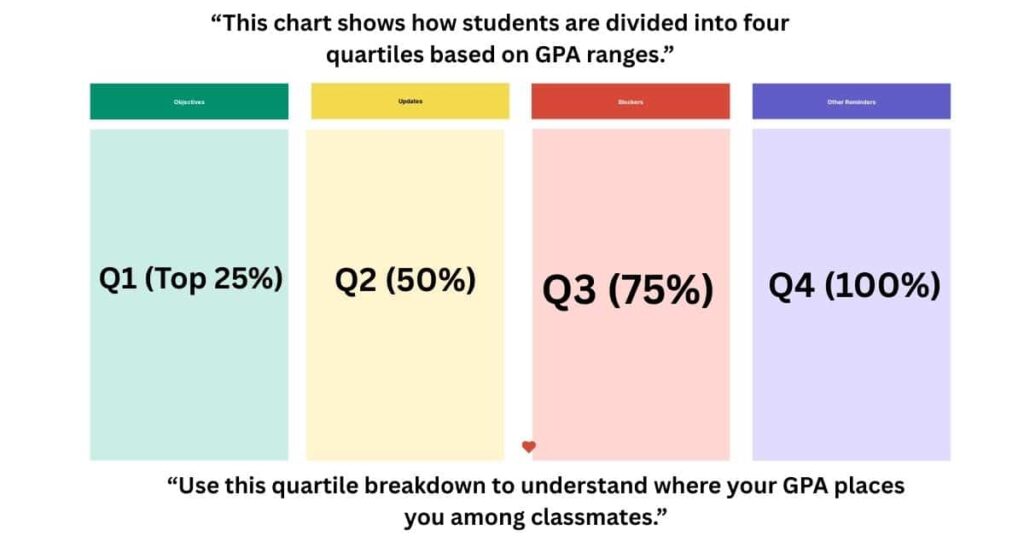
Schools use quartiles to divide students into four equal groups based on performance, giving a simple view of class standing and how your GPA compares to others.
Each quartile represents 25% of the class, making them easy to understand and useful for tracking progress. Many colleges also use quartile ranking for application review.
Definition of Quartile in Academic Ranking
A quartile is one of four equal groups in class ranking. The first quartile includes top-performing students, while the fourth includes the lowest 25%. This shows academic standing without exact ranks.
Schools use quartiles because they’re simple and fair. A calculator can show which of the four groups you’re in. To calculate your class rank quartile, start by understanding this breakdown.
Quartile breakdown:
- Q1: Top 25%
- Q2: 26–50%
- Q3: 51–75%
- Q4: 76–100%
Example: Top 25% of Students → First Quartile
The first quartile represents the top 25% of students in a class. For example, if a class has 200 students, the first 50 students fall into Q1. This doesn’t mean they all have the same GPA. It only shows that their performance ranks among the highest.
This method helps schools compare large groups easily. Tools like a calculator simplify these steps for students. You can check your GPA and rank to see if you’re moving up a quartile.
Simple example:
- Total students: 200
- 25% of 200 = 50
- Top 50 students = First quartile
Visual Chart Representation (Quartiles Explained with GPA/Rank Table)
A visual chart illustrates how quartiles relate to GPA and rank. You can gauge your position relative to others. Quartiles are easier to track than precise rank numbers.
Below is a simple sample structure you can use for guidance:
| Q1 (Top 25%) | 1–50 | 3.7–4.0 |
| Q2 | 51–100 | 3.3–3.6 |
| Q3 | 101–150 | 2.9–3.2 |
| Q4 | 151–200 | 2.0–2.8 |
A calculator tool helps you compare these groups quickly. For accuracy, use your actual school data.
Using a Quartile Class Rank Calculator
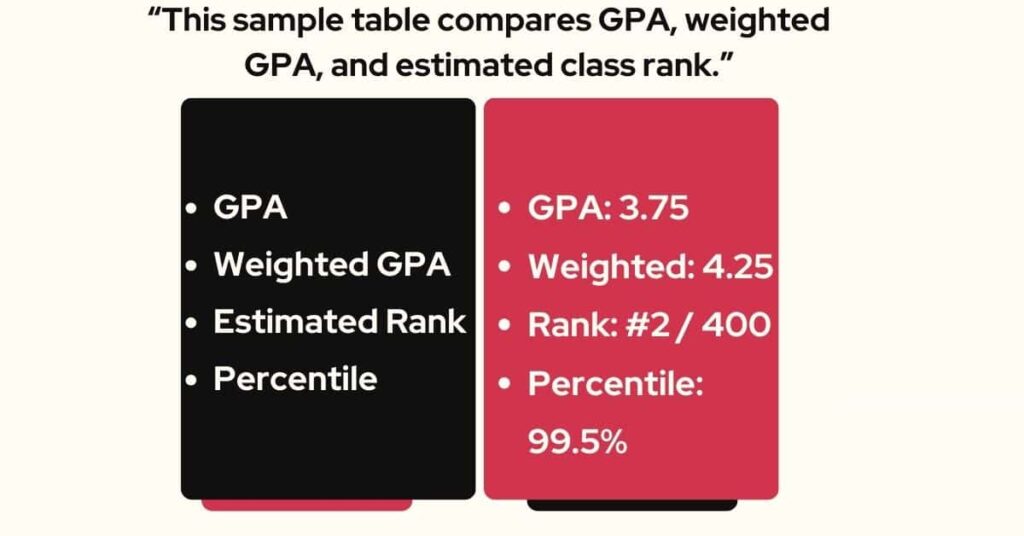
A quartile tool shows where you fall within the four class ranking groups. When paired with a class rank calculator, it helps you quickly understand your standing compared to classmates, saving time and reducing the stress of manual calculations.
Many students use a quartile class rank calculator or a class rank quartile calculator to check progress before exams or college applications. The steps are simple, and you only need your total class size and your rank.
My take: Always start with accurate inputs like your total students, GPA, and weighted adjustments. Double-check your grades before entering them. Using the “what-if scenario” feature helps you see how small improvements can change your quartile or percentile. This approach saves time and gives a realistic picture of your academic progress.
“Check your exact GPA, class rank, and percentile instantly using our free Class Rank Calculator—see where you really stand!”
How Quartile Rank Is Calculated
Quartile rank is based on dividing your class into four equal groups. Each group holds 25% of the students. Your quartile depends on your position in that list. If you’re learning how to calculate class rank quartile, this split is the key idea.
A calculator uses two inputs:
- Total number of students
- Your current class rank
It then determines your quartile group. Students often check quartiles to see if they’re close to moving up. These tools make the process clear and quick.
Manual Calculation Method (Total Students ÷ 4)
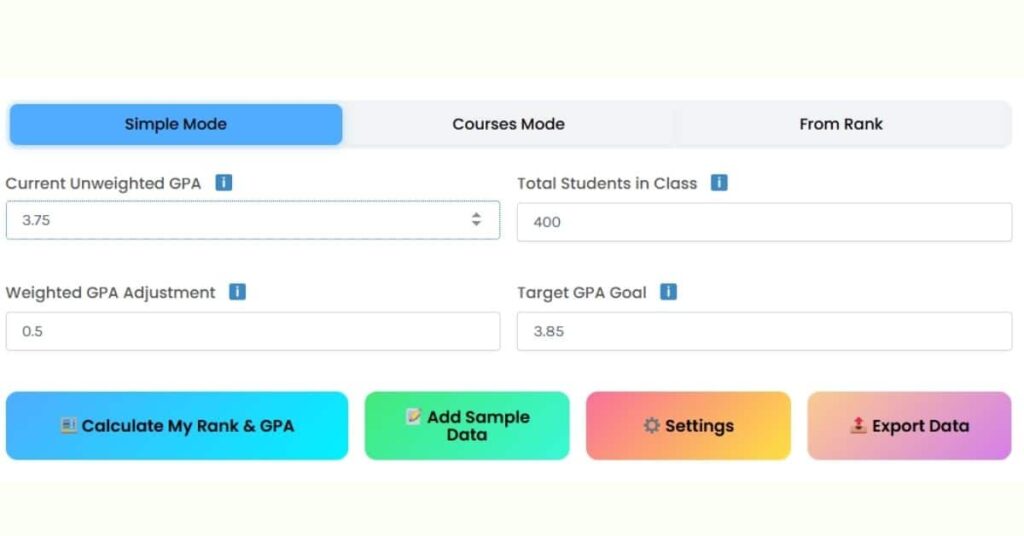
You can calculate quartiles by dividing the total number of students by four to get how many students fit in each group. This method is simple but requires careful counting to avoid mistakes, which a calculator eliminates.
Steps:
- Find the total number of students in your class.
- Step 2: Divide that total number by 4 to determine how many students are in each quartile.
- Step 3: Mark out the range of ranks for each quartile using the result from step 2.
- Step 4: Compare your individual class rank with these quartile ranges to see where you fall.
This method helps you understand how quartile groups form. A tenth-class rank calculator works in a similar way but focuses on the top 10%.
Example: 200 Students → Each Quartile = 50 Students
To illustrate, let’s use a clear example. If your class has 200 students, dividing 200 by 4 gives 50. That means each quartile holds 50 students. Your quartile depends on where your rank falls inside these ranges, which makes the process more tangible.
Quartile breakdown for 200 students:
- Q1: Ranks 1–50
- Q2: Ranks 51–100
- Q3: Ranks 101–150
- Q4: Ranks 151–200
A quartile class rank calculator can place you in the correct group in seconds. This helps you track progress and understand competition more clearly.
Understanding Decile Class Rank
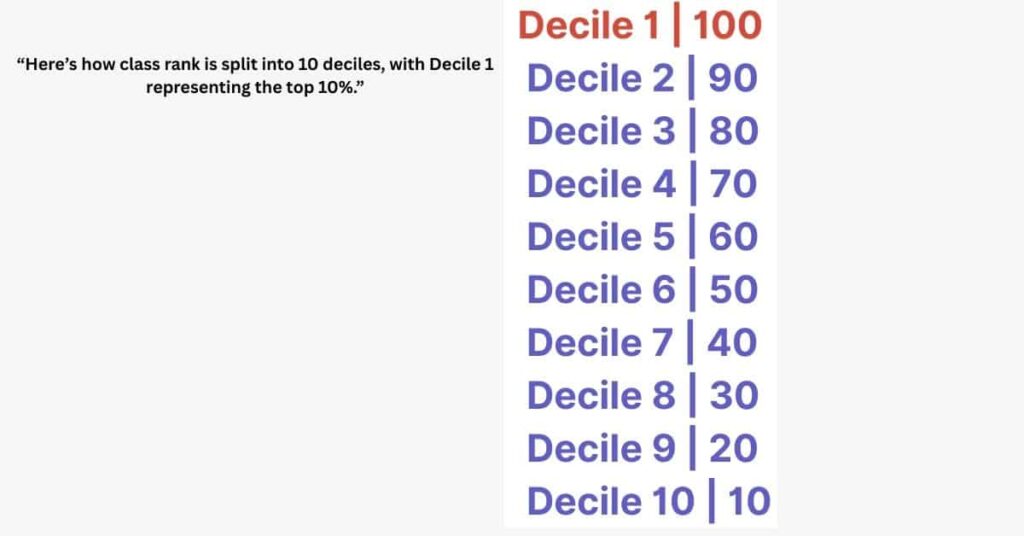
Deciles split a class into ten equal groups, offering a more precise ranking than quartiles. With a Decile & Tenth Class Rank Calculator, students get clearer, more detailed placement.
Students use class rank decile calculators to gauge progress for college or scholarships. It’s an easy way to track growth and see if you’re near a higher group.
Here’s how to apply this effectively:
Definition of Deciles (Splitting Into 10 Equal Parts)
Deciles split the class into ten parts, each with 10% of students. D1 is the top 10%; D10 is the lowest 10%. This offers finer precision than quartiles.
A class rank decile calculator uses your rank and class size to find your decile. Dividing by ten is more specific than quartiles. Comparing both helps students understand their performance.
Why Some Universities Prefer Decile Rankings
Universities prefer decile rankings for finer student distinctions. Two students in the same quartile may be in different deciles, highlighting small GPA gaps.
Schools use deciles to review honors, scholarships, and majors. Deciles show more detail than quartiles and help sort large applicant groups.
Benefits of decile ranking:
- Shows precise academic position
- Helps compare students across large classes
- Reduces ties and unclear ranking results
Example With Step-by-Step Numbers
For a 300-student class, divide by 10: each decile has 30 students. Your decile is based on your rank within these groups.
Decile breakdown for 300 students:
- D1 (Top 10%): Ranks 1–30
- D2: Ranks 31–60
- D3: Ranks 61–90
- Continue the pattern until D10: Ranks 271–300
A decile calculator quickly shows your class position. This example highlights deciles’ detail over quartiles.
If you’re tracking quartiles and deciles at the university level, a college class rank calculator can help estimate your overall academic standing. Using a college class rank calculator alongside quartile and decile rankings gives a clearer picture of your GPA position.
Decile Class Rank Calculator in Action
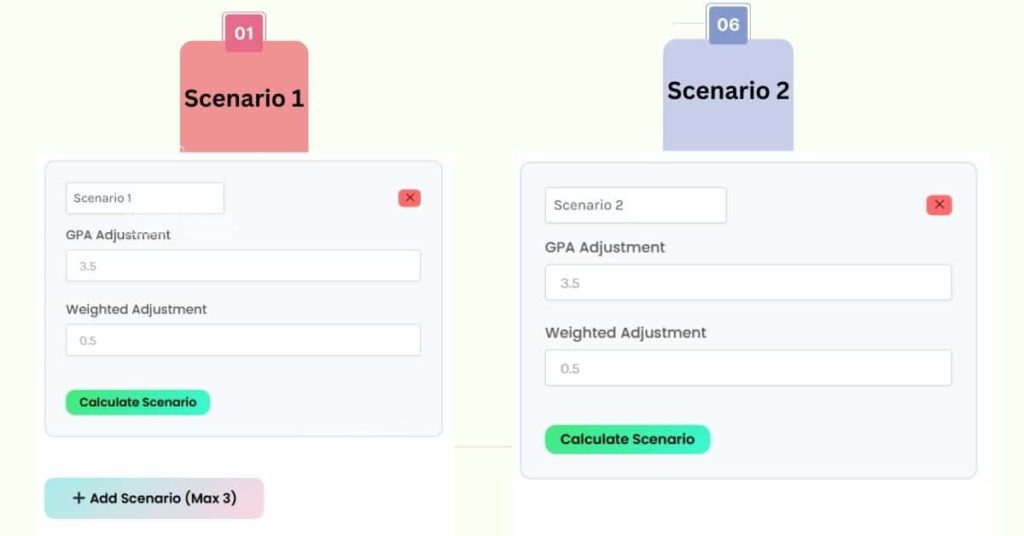
A decile calculator shows exactly which 10% group you fall into based on your class rank. When combined with a Quartile, Decile & Tenth Class Rank Calculator, it gives a detailed picture of your academic position. As a result, students use decile tools to check progress, plan goals, and compare performance with classmates.
A class rank decile calculator needs only two inputs: your rank and the total number of students. It then sorts you into one of ten groups, from the top 10% (D1) to the bottom 10% (D10).
Case study: A student in a class of 300 wasn’t sure if they were in the top 20%. By using a class rank decile calculator and entering GPA and rank data, they discovered they were in the 2nd decile. With this insight, they focused on improving grades in two key courses. By the next semester, their rank improved by 15 places, and they confidently targeted top scholarships.
“Curious about your quartile, decile, or top 10% rank? Try our Class Rank Calculator now and plan your next move.”
Formula and Online Tool Usage
The formula for calculating decile rank is simple: divide the total class size by ten. Each result represents one decile group. Conveniently, the calculator uses this formula automatically, so you don’t need to solve anything yourself.
How the tool works:
- Enter the total number of students.
- Enter your current class rank.
- The tool compares your rank with each decile cutoff.
- It reveals your exact decile group.
Similarly, a quartile class rank calculator or class rank quartile calculator splits the class into four parts instead of ten. If you’re familiar with how to calculate class rank quartile, picking up decile steps becomes easier.
Example: 300 Students → Each Decile = 30 Students
Let’s break down a simple example. With 300 students, divide 300 by 10. The answer is 30. That means each decile holds 30 students. Your decile depends on your position within these 30-student blocks.
Decile groups for 300 students:
- D1 (Top 10%): Ranks 1–30
- D2: Ranks 31–60
- D3: Ranks 61–90
- Continue until D10: Ranks 271–300
Therefore, using a class rank tenth calculator or decile tool helps you find your group instantly. This makes it much easier to track small changes in your academic standing.
What is the tenth (top 10%) class rank?
The tenth class rank, also known as the top 10% rank, shows whether a student falls within the highest-performing 10% of their class. Using a class rank calculator, students can see where they stand compared to classmates. It uses simple math but gives powerful insight into academic strength.
Schools use this metric to group students into performance bands, just as they do with quartiles or deciles. This ranking gives both schools and students a clear sense of academic placement and goal-setting.
Transitioning from understanding the metric to its practical use, knowing your tenth rank helps you better interpret your school report and college applications. Here’s how to apply this effectively:
Difference between “decile” and “tenth rank” (top 10%)
Many students confuse decile rank and tenth rank, but they represent different concepts. A “decile” divides the entire class into 10 equal groups, so each decile is a 10% segment of the class—the 1st decile is the top 10%, the 2nd decile is the next 10%, and so on.
The “tenth rank” (top 10%), by contrast, simply indicates whether a student is inside the highest-performing 10% of the class, regardless of which decile exactly. Every student in the 1st decile is considered “top 10%.” Schools often highlight this group for awards or honors.
Students often use tools like a class rank decile calculator or a class rank tenth calculator to see both positions clearly.
Importance in scholarships & college admissions
This top-10% distinction matters, as colleges and scholarship programs often use it as a key selection factor. Many universities give priority to these students, recognizing their academic consistency.
Here are the main benefits of a top-10% rank: You qualify for more merit scholarships, have a stronger chance in competitive admissions, may receive automatic admission at some schools, and stand out in programs that look at rank bands instead of GPA alone.
- You often get a stronger chance in competitive admissions.
- Some schools offer automatic admission to the top 10% of students.
- You stand out in programs that look at rank bands instead of GPA alone.
By using a quartile class rank calculator or class rank quartile calculator, students can see if they are approaching this group and set targeted improvement goals.
Example: 400 students → top 40 students = top 10%
The tenth rank becomes easy to understand with a quick example. Suppose a school has 400 students in a grade. To find the top 10%, you simply calculate:
10% of 400 = 40 students
This means the top 40 students hold the tenth (top 10%) rank. If your class rank is between 1 and 40, you fall inside this category. This simple method is the same one used in a class rank calculator. It makes ranking easier for students who want to track performance or understand how to calculate class rank quartile and decile positions.
Tenth Class Rank Calculator Explained
A Tenth Class Rank Calculator is a helpful way for students to quickly check if they’re in the top 10% of their class. When you use it alongside a Quartile, Decile & Tenth Class Rank Calculator, tracking your academic standing becomes much easier. Instead of manually doing the math, these tools give you instant results, saving you time (and maybe some stress, too).
These calculators complement each other well. By using both broad and detailed ranking tools, you can set academic goals confidently and monitor your progress over time.
My take: When tracking the top 10% rank, use both current GPA and weighted adjustments. Try different scenarios—like improving one course grade—to see its impact on rank. This helps you plan strategically rather than guessing your position. Always monitor trends, not just one semester’s numbers.
How to Find Your Rank in the Top 10%
Finding out if you’re in the top 10% is simple! First, find your total class size. Then, multiply that number by 10% (0.1). The answer shows you how many students are in the top 10%.
Here are the steps to calculate your status using a calculator or by hand:
- Enter your current class rank.
- Compare your rank with the top 10% cutoff.
- The tool confirms whether you fall inside this group.
A class rank tenth calculator does this automatically. It’s faster than manual calculation and reduces mistakes. If you know how to calculate a class rank quartile, this method will feel familiar, just with a smaller focus on the top 10%.
Worked Examples with GPA/Rank Table
Let’s say your class has 250 students. To check who’s in the top 10%, multiply 250 by 0.1. You get 25, so the students ranked 1 through 25 are in the top 10%.
Example Table:
| Rank | GPA (Example) | Top 10%? |
|---|---|---|
| 1 | 4.0 | Yes |
| 10 | 3.9 | Yes |
| 25 | 3.7 | Yes |
| 26 | 3.6 | No |
| 50 | 3.4 | No |
Using a class rank tenth calculator or a class rank decile calculator allows you to check multiple scenarios quickly. You can compare GPA ranges with rank to see exactly where you stand in the top 10%.
This approach makes planning goals and targeting improvements feel simple and doable!
To understand how quartiles and deciles are formed, it helps to first learn how to calculate class rank with GPA step by step. Knowing how to calculate class rank with GPA makes quartile and decile placement much clearer.
Quartile vs. Decile vs. Percentile: Which Is More Useful?
Have you ever wondered how your class rank is measured? Different systems give students different views of their progress. Try using a Quartile, Decile & Tenth Class Rank Calculator to see how these compare for you. Each method has its own benefits—quartiles help simplify large classes, deciles offer more detail, and percentiles give your exact rank. Which one would you find most useful?
Do you track your class rank? Many students use a class rank quartile calculator or class rank decile calculator along with percentile measures to see their progress. Understanding these differences can support your college applications, scholarships, and goals. What rankings matter most to you?
Case study: A high school student wanted to apply for a competitive college. Initially, they focused on quartiles but didn’t know how precise it was. After comparing quartile, decile, and percentile using online calculators, they realized percentile gave a clearer view of competition. Using this insight, they improved targeted courses and increased their percentile from 88% to 94%.
Comparison of These Ranking Systems
Quartiles sort the class into four equal groups, each containing 25% of the students. Deciles divide the class into ten equal groups, each representing 10%. Percentiles indicate your exact standing relative to your peers, such as “You are higher than 88% of your class.”
Quick comparison:
- Quartile: Broad overview, simple to understand.
- Decile: More detailed, smaller groups.
- Percentile: Precise rank, best for competitive comparisons.
Moreover, tools like a class rank decile calculator or a class rank tenth calculator help students easily compare both broad and precise rankings.
Universities’ Preference for Quartiles/Deciles
Many universities prefer quartiles or deciles because they show general performance without emphasizing tiny differences. Deciles are often used for competitive programs to compare top students more accurately. Quartiles are common for honors and award lists, giving a simple snapshot of performance.
Utilizing a quartile class rank calculator or class rank decile calculator with percentile data helps students understand their position in the admissions process.
Percentile = More Precise, Quartile/Decile = Broader Category
Percentiles tell your exact position, while quartiles and deciles group students in ranges. For example, the first quartile and first decile may contain students with slightly different ranks, but percentiles distinguish every individual.
Benefits:
- Percentile: Precise, useful for competitive scholarships.
- Decile: Shows fine differences, easy to track progress.
- Quartile: Simplified, quick comparison for large classes.
By recognizing these distinctions, you can choose the best tool for your needs. A class rank quartile calculator is great for quick checks, while a class rank tenth calculator or percentile analysis gives exact insight.
Common Mistakes in Calculating Quartiles & Deciles
Many students make simple errors when using a quartile, decile & Tenth Class Rank Calculator. These mistakes can give a false sense of rank and affect decisions about scholarships or college applications. Using a class rank quartile calculator or class rank decile calculator correctly can prevent these errors.
Common problems include misunderstanding cutoffs, confusing percentages, or using the wrong GPA weights. Being aware of these mistakes helps students get better results and plan ahead.
Here’s how to apply this effectively:
Misunderstanding Quartile Cutoffs
One frequent mistake is misidentifying where each quartile begins and ends. For example, some students think the first quartile only includes the single top-performing student, not the top 25% of the class.
Using a quartile class rank calculator ensures correct placement. Remember:
- Q1: Top 25% of students
- Q2: 26–50%
- Q3: 51–75%
- Q4: 76–100%
Take action by verifying your class size and rank every time. Being proactive reduces mistakes when calculating manually or when comparing results with others.
Mixing Up Deciles with Percentages
Students often confuse deciles with percentages. Each decile is 10% of the class, but rank within a decile shows relative position. Assuming “D1 = 10%” without recognizing rank ranges can be misleading.
A class rank decile calculator helps clarify this. Tips for accuracy:
- Identify the total class size first.
- Divide into ten equal groups.
- Compare your rank to each decile range.
Apply these strategies now to truly understand your academic standing and avoid overestimating performance. Take charge and make accurate calculations part of your process.
Incorrect GPA Weightage in Rankings
A common mistake is using the wrong GPA scale. Some use an unweighted GPA when a weighted GPA is needed, which can wrongly shift quartile placement.
To avoid this:
- Confirm if your school uses weighted GPA
- Use consistent GPA data with a class rank tenth calculator or decile tool.
- Double-check results against official class lists.
An accurate GPA ensures your quartile, decile, or tenth rank reflects true academic performance.tenth class rank calculator.
Tools & Resources
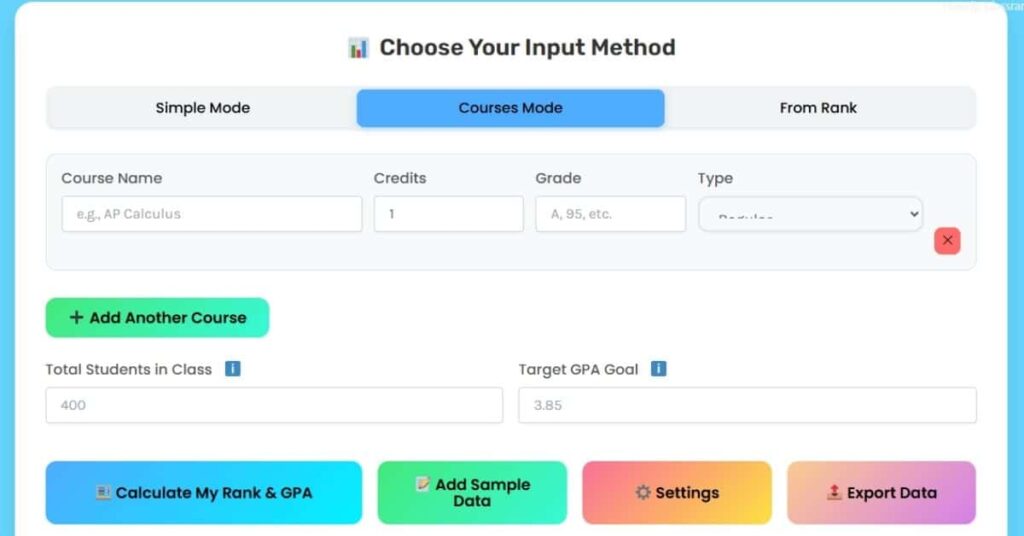
Understanding your academic standing is easier with the right tools. Our Class Rank Calculator helps students track GPA, rank, percentile, and improvement suggestions all in one place, saving time, reducing errors, and providing actionable insights.
Whether you want to explore quartiles, deciles, or the top 10% rank, compare reliable calculators to school-provided methods to evaluate which delivers the most accurate results. Here’s how to do this effectively:
Free Online Calculators for Quartiles/Deciles/Tenths
Use our free online Class Rank Calculator to simplify ranking. Start by selecting your input method: Simple Mode, Courses Mode, or From Rank.eighted & unweighted GPA support.
- Rank & Percentile: I estimate your class position and percentile instantly with the calculator. Test how improving grades affects rank.
- Academic Visualization can complement this tool for quick checks of quartiles, deciles, and the top 10% rank. Using them regularly ensures you know exactly where you stand.
Excel Formulas for Quartile & Decile Calculation
You can also calculate quartiles and deciles in Excel using simple formulas:
- Quartiles: =QUARTILE.INC(range, quart)
- Deciles: =PERCENTILE.INC(range, 0.1*decile)
Here, range is your Define your range as the list of student GPAs or ranks, and set quart or decile as the quartile or decile number. Use this approach for manual tracking or small datasets, then confirm your results with a class rank quartile calculator.ty Official Ranking Methods
Some schools and universities calculate class rank differently. They may:
- Include only GPA, or weighted GPA for honors/AP courses.
- Use official percentile cutoffs for the top 10% or deciles.
- Factor in total credits or course difficulty
Even with official methods, using a class rank decile calculator or a class rank tenth calculator helps students verify their standing and plan academic improvements. Combining school data with online tools gives the clearest picture of your performance.
Our Class Rank Calculator brings these ideas together, making it easy to track GPA, rank, and percentile while exploring what-if scenarios to improve academic standing.
Conclusion
In this guide, we explored how quartiles, deciles, and top 10% rankings work and how they impact your academic standing. You learned how to interpret your position, calculate quartile ranges, and use tools like a Quartile, Decile & Tenth Class Rank Calculator to track progress accurately.
Understanding your rank helps in planning for scholarships, college applications, and personal academic goals. Whether you use a class rank decile calculator, class rank tenth calculator, or quartile class rank calculator, these tools give clear insights into your performance, simplify complex calculations, and help you track your progress efficiently.
Take action now—choose a reliable calculator to pinpoint your ranking, set new goals, and drive your academic success. Share your strategies or tips in the comments, and empower fellow students to achieve their class rank aspirations.
“Don’t guess your rank—use our Class Rank Calculator to track progress and improve your GPA with real scenarios.”

Team ClassRank builds smart, student-friendly calculators to make grade and rank tracking simple and accurate. For questions or feedback, contact us at classrankcalculator@gmail.com.