


Table of Contents
introduction
What grade do I need to get an A on my final exam? This is one of the most common questions students face during exam season. Many students in the USA ask this when finals get close, and pressure builds. Your current grade can change quickly because most classes use weighted grading systems. One final exam often decides if you get an A or drop to a B.
This topic matters because even a small score change can impact your final result. If you do not understand weights, you may incorrectly guess your required score. In this guide, you will learn how to calculate the exact score you need for an A. You can also use a simple grade target calculator to get instant answers. Use the calculator below to find your required grade in seconds. This is especially true for competitive courses where every percentage point matters. Most students only realize this after checking their final grade too late.
Trying to figure out your target score? Use our Weighted Grade Calculator to calculate the exact grade you need on your final exam instantly.
What Grade Do I Need to Get an A?

If you are asking, “What grade do I need to get an A?” the answer depends on how your class is weighted. Most courses in the USA use a weighted grading system, where different parts of your course contribute different percentages to your final grade. That means your current grade alone is not enough to calculate your final result.
To find the exact score you need on your final exam, you must look at three key things. Your current grade shows your progress so far. The final exam weight shows how much your exam will impact your grade. Your target grade is the final result you want, usually an A like 90% or above.
When you combine these values, you can calculate the exact score needed on your final exam. This removes guessing and helps you plan your study strategy more effectively. Many students lose an A simply because they misjudge this calculation.
📌 Simple Formula Preview
Here is the basic formula used in most weighted grade systems:
Required Score = (Target Grade – Current Contribution) / Final Exam Weight
In this formula, “Current Contribution” means how much your existing grade already adds to your final result. The “Final Exam Weight” is expressed as a decimal (e.g., 40% = 0.4).
This formula helps you quickly estimate whether an A is still possible and what score you must aim for.
Understanding this breakdown is important because even a small change in your final exam score can shift your overall grade from a B to an A. That is why using a calculator yields more accurate, faster results than guessing.
How Weighted Grading Works
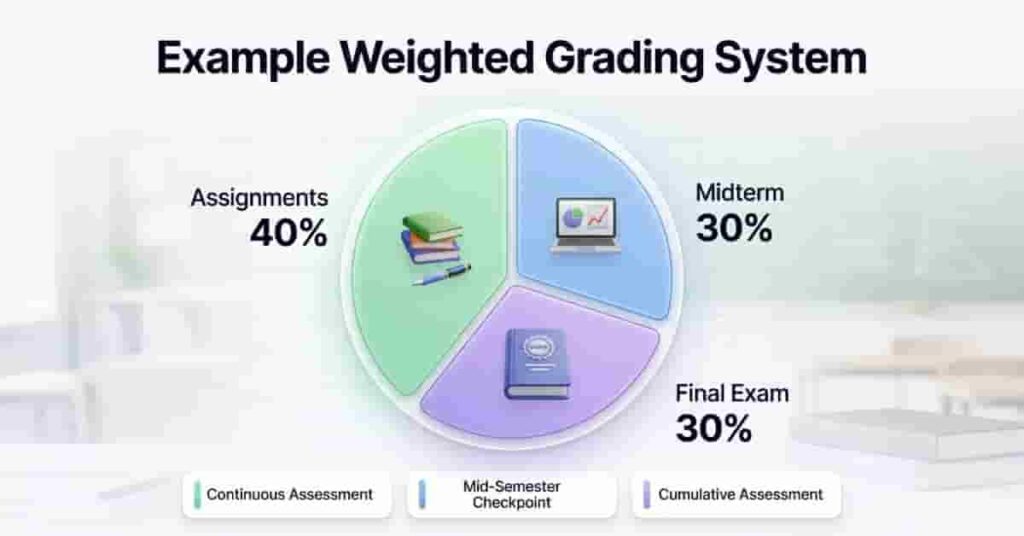
A weighted grading system decides your final grade based on different parts of your course. Instead of treating every score equally, each section has its own importance. This is why two students with similar test scores can still end up with different final grades. If you are trying to figure out what grade I need to get an A, understanding this system is essential.
In most USA schools and colleges, your grade is divided into categories like assignments, quizzes, midterms, and final exams. Each category has a specific weight that indicates how much it affects your final result. The higher the weight, the more influence it has on your overall grade.
For example, a common structure looks like this: assignments may count for 40%, midterms for 30%, and the final exam for 30%. This means your final exam alone can significantly change your grade, even if your earlier performance is strong. That is why students often focus more on finals when they want to secure an A.
The key idea is simple. Each part of your course contributes differently to your final grade. A small change in a high-weight section, like the final exam, can shift your overall result more than small improvements in assignments.
📌 Why This Matters
If you ignore weights, you may miscalculate your required score. A strong understanding of weighted grading helps you plan better and avoid surprises at the end of the semester.
Required Final Exam Score Formula
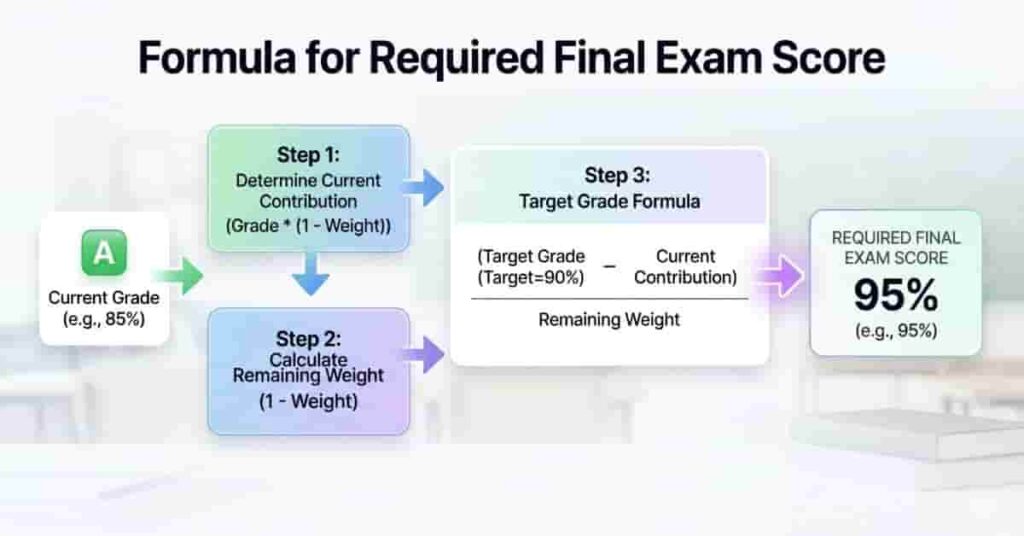
To understand what grade I need to get an A, I need a simple breakdown of how your final exam affects your overall grade. Most students feel confused here, but the logic is actually straightforward once you break it into steps.
Your final grade depends on two main parts: what you have already earned and what is still left in the course. The “current grade contribution” is how much your existing work already counts toward your final result. The “remaining weight” is the part of your grade that still depends on the final exam. Your “target grade” is the final percentage you want, usually an A (e.g., 90% or higher).
First, your current grade contribution shows how much of your final grade is already secured. If you have strong assignment and midterm scores, this number will be higher. Next, you look at the remaining weight, which is usually your final exam percentage. This is the part where you still have full control to improve your grade.
Now you combine both to find the target equation. The idea is simple: subtract your current contribution from your target grade, then divide the result by the remaining weight. This tells you exactly what score you need on your final exam to reach your goal.
Understanding this formula helps you stop guessing. Instead, you get a clear number that shows whether an A is realistic and what effort is needed to achieve it.
📌 Real Example: What Grade Do You Need for an A?
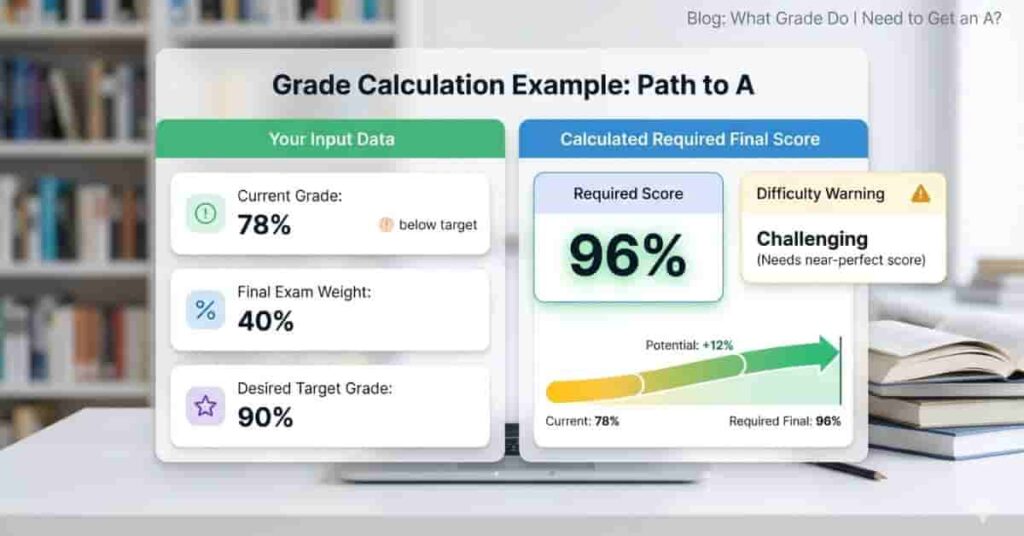
Let’s understand this with a simple real-life scenario. This is exactly how students in the USA calculate their final exam requirements when they ask, “What grade do I need to get an A?” Breaking it into steps makes it easy to see what score you actually need.
🎯 Example Scenario
- Current Grade: 78%
- Final Exam Weight: 40%
- Target Grade: A (90%)
🧠 Step-by-Step Logic
First, we calculate how much your current grade already contributes to your final result. Your 78% grade counts for 60% of the course (because the final is 40%). So, your current contribution is already partially secured.
Next, we look at what is still open. The final exam is worth 40%, which means you still have a strong chance to improve your overall grade. This is where most of the change happens.
Now we compare your target grade with what you already have. You need to reach 90% overall, so we calculate how much is still required from the final exam to close that gap.
📊 Final Required Score Result
Based on this scenario, you would need a very high score on your final exam to reach an A. In most cases like this, the required score is close to 80–90%+ on the final, depending on rounding rules.
This shows how important the final exam becomes when your current grade is slightly below an A range.
🚀 Try It Yourself
Every student’s situation is different. Small changes in your current grade or final weight can completely change your required score.
👉 Try your own values in the calculator above to see your exact result instantly.
⚠️ Common Mistakes Students Make
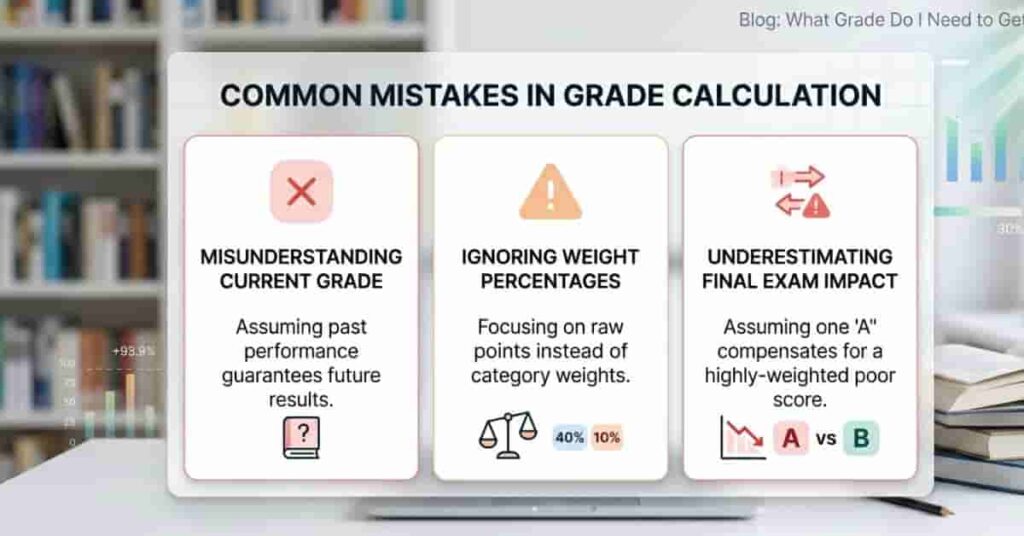
Many students struggle to figure out what grade they need to get an A because they misunderstand how weighted grading works. Small errors in thinking can lead to big surprises in the final results. When you ignore the system behind the calculation, your expectations become inaccurate.
One common mistake is assuming your current grade is your final grade. Your current score only reflects completed work, not the final outcome. The final exam can still change everything, especially in weighted systems used in the USA.
Another mistake is ignoring weight percentages. Not all assignments matter equally. A 40% final exam has much more impact than a 10% quiz. If you treat every score the same, you will misjudge your required final exam score.
Students also fail to understand the real impact of the final exam. Even a strong current grade can drop if the final exam performance is low. On the other hand, a high final exam score can boost a borderline grade into the A range.
The key idea is simple. Small mistakes in understanding weights can lead to big grade changes. That is why using a proper calculator is more reliable than guessing.
📌 Key Takeaway
Never assume your grade is fixed before the final exam. Weighted systems always keep room for change until the last assessment is completed.
📈 Why This Matters
Your final exam can completely change your course outcome. Even if your current grade looks strong, one test can decide whether you finish with an A or drop to a B. This is why students often feel pressure during exam season when they try to figure out what grade they need to get an A.
In a weighted grading system, the final exam usually carries a large percentage of your total grade. That means your performance at the end of the course matters just as much as everything you did before. A small drop in your final score can reduce your overall grade more than you expect. On the other hand, a strong final exam performance can lift your grade significantly and secure your A.
This is why planning matters. When you know the exact score you need, you can focus your study time better. Instead of guessing or stressing, you get a clear target to aim for. This helps you avoid last-minute panic and improves your exam strategy.
Understanding this impact also helps you make smarter decisions during revision. You can prioritize topics that give you the highest chance of scoring well on the final exam.
Still unsure if you can reach an A? Test different scores with the Final Grade Calculator and see how your overall grade changes in real time.
📌 Key Takeaway
Your final exam is not just another test. It is often the deciding factor between grade improvement and grade drop.
🧮 Try Different Scenarios
Before your final exam, it helps to test different outcomes rather than guess. Many students ask, “What grade do I need to get an A?” But the real answer depends on how much a final exam score changes your overall grade.
For example, if you score 70% on your final exam, your overall grade may drop below an A depending on your course weight. If you score 90%, you may secure your A or even improve a borderline grade. This shows how powerful the final exam is in a weighted grading system.
Instead of guessing, try changing your final exam score and see how your grade responds. This gives you a clear target and helps you understand how close you are to your goal. Even a small difference of 5–10% can completely change your final result.
When you test different scenarios, you stop relying on assumptions. You start seeing real numbers that guide your study plan. This makes your preparation more focused and less stressful.
📌 Key Insight
Small changes in your final exam score can lead to big changes in your final grade. That is why scenario testing is so important.
🚀 Action Step
Don’t guess your outcome. Go back to the calculator and try different values to see how your grade changes instantly.
conclusion
In this guide, you learned how weighted grading systems work and how your final exam impacts your overall grade. You also saw how to calculate the exact score needed to reach your target result. This makes it easier to understand what grade I need to get an A in any course.
Instead of guessing, you can now use a clear method to find your required score using your current grade, final weight, and target grade. This helps you plan smarter and avoid last-minute surprises during exams. The weighted grade calculator makes this process fast and accurate for any situation.
If you are still unsure about your final grade, don’t leave it to chance. Try different values and see how your result changes. Share this guide with classmates who are also preparing for finals, or explore more tools on our website to improve your academic planning.

Team ClassRank builds smart, student-friendly calculators to make grade and rank tracking simple and accurate. For questions or feedback, contact us at classrankcalculator@gmail.com.