


Intoduction
Ever wondered how teachers turn homework, quizzes, exams, and projects into one final semester grade?
Understanding how to calculate semester grades is important for every student. Your semester grade can affect academic standing, scholarships, class rankings, and graduation requirements. In U.S. high schools, colleges, and universities, grades are often based on weighted categories such as assignments, quizzes, midterms, and final exams. However, grading systems can vary from one school to another, making the process confusing for beginners.
The good news is that calculating a semester grade is easier than it seems. Once you understand the basic formula and category weights, you can accurately track your progress throughout the term. In this guide, you’ll learn the semester grade formula, see step-by-step examples, discover how to calculate a semester grade without a final exam, and understand how final exams affect your overall grade.
Need a quick answer? Use our Semester Grade Calculator to calculate your grade instantly.
What Is a Semester Grade?

A semester grade is the final score a student earns during a semester. It reflects performance across multiple assignments, tests, and assessments completed during that term. Schools use semester grades to measure academic progress and determine whether students meet course requirements.
Understanding the meaning of semester grades helps students track their performance and plan for future assignments. In most U.S. schools, a semester lasts about 15 to 18 weeks. Teachers combine scores from different categories to calculate one overall grade at the end of the term.
While the exact grading method varies by school, most institutions follow a structured semester grading system. Some schools give equal value to every assignment, while others use weighted categories that place more importance on exams and major projects.
Key Takeaways
- A semester grade summarizes your performance during one academic term.
- It combines scores from multiple assignments and assessments.
- Schools may use weighted or unweighted grading systems.
- Semester grades often affect GPA, academic standing, and course credit.
Semester Grade Definition
A semester grade is the overall grade earned for a course during a single semester. Teachers calculate it using scores from coursework completed throughout the term. Depending on the school’s grading policy, each category may contribute a different percentage to the final result.
For example, homework might count for 20% of the grade, while a final exam counts for 35%. This approach gives a more complete picture of student performance than a single test score.
Many high schools, colleges, and universities use semester grades when awarding credits, calculating GPAs, and evaluating academic progress.
Pro Tip
Always review your course syllabus at the start of the semester. It explains how each assignment category affects your final grade.
How Semester Grades Work
To understand how semester grades work, you need to know how grades are combined. Most teachers organize coursework into categories and assign a percentage weight to each one. Higher-weight categories have a greater impact on the final grade.
For example, a final exam may affect your semester grade more than a weekly homework assignment. Teachers multiply each category score by its assigned weight, then sum the results to calculate the final semester grade.
This method rewards consistent performance throughout the semester rather than relying on a single assessment.
Common Components Included in Semester Grades
Most semester grades include several types of coursework. Each category helps teachers evaluate different skills and learning outcomes.
Common components include:
- Homework: Practice completed outside class.
- Assignments: Daily or weekly coursework.
- Quizzes: Short assessments that check understanding.
- Projects: Larger tasks that require research or application.
- Midterms: Exams taken halfway through the semester.
- Final Exams: Comprehensive assessments given at the end of the term.
The weight assigned to each category depends on the school’s grading policy. Some courses emphasize exams, while others place greater value on projects and ongoing coursework.
How Do You Calculate a Semester Grade?
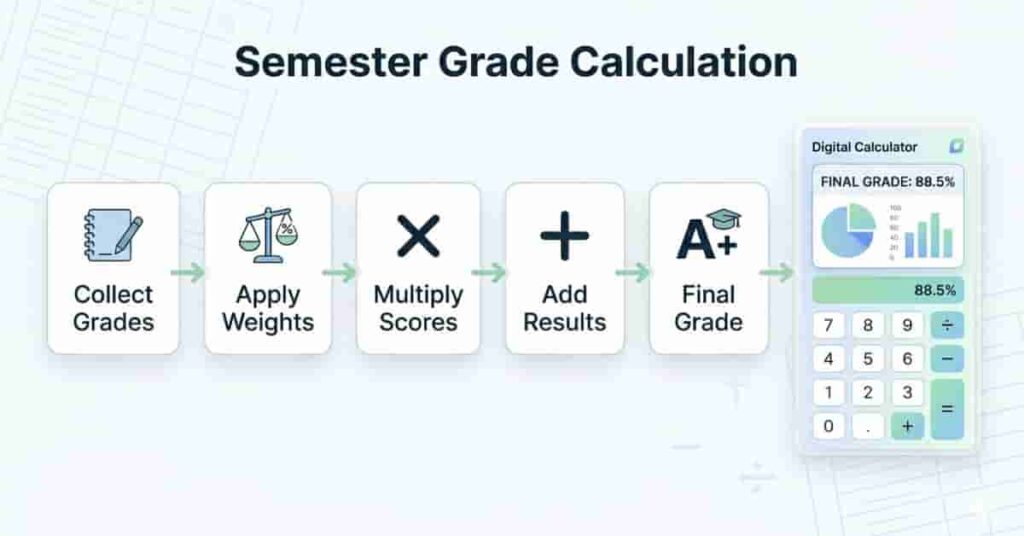
Quick Answer: To calculate a semester grade, gather all category grades, find each category’s weight, multiply each grade by its weight, add the weighted values together, and divide by the total weight if needed. The final result is your semester grade.
Most schools use a weighted grading system. This means some categories affect your grade more than others. For example, a final exam often carries more weight than homework assignments.
Follow these simple steps:
- Gather all category grades.
- Find the weight assigned to each category.
- Convert percentage weights into decimals.
- Multiply each grade by its weight.
- Add all weighted values together.
- Divide by the total weight if the weights do not equal 100%.
For example, if Homework is 85% and worth 20%, you would calculate:
85 × 0.20 = 17
Repeat the process for every category. Then add the results to find your final semester grade.
Key Takeaways
- Semester grades often use weighted averages.
- Higher-weight categories have a larger impact on your grade.
- Convert percentages to decimals before multiplying.
- Add all weighted values to find the final result.
Semester Grade Formula
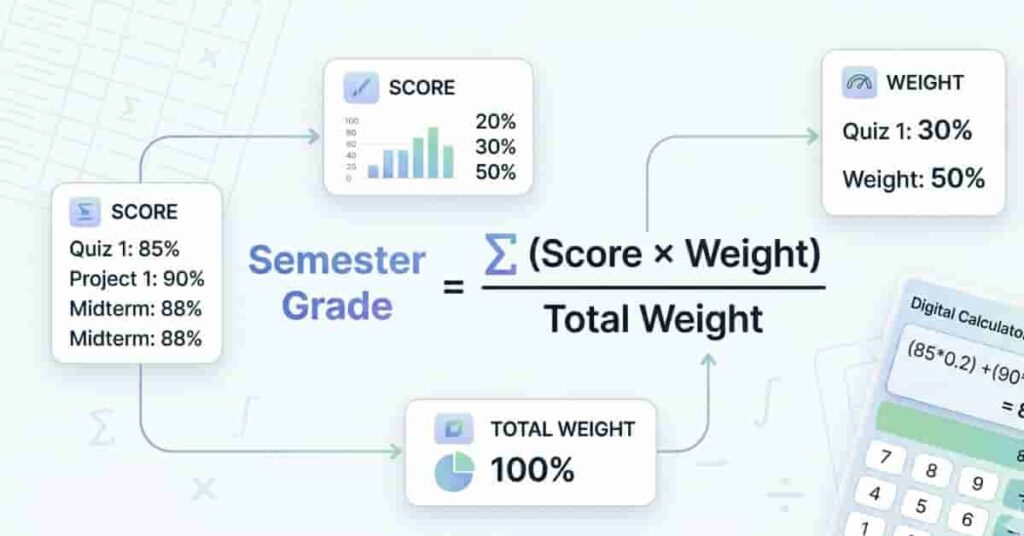
Most schools calculate semester grades using a weighted average formula. This method assigns different values to each grading category. As a result, major assessments have a greater impact on the final grade than smaller assignments.
The standard semester grade formula is:
Semester Grade = Σ (Score × Weight) ÷ Total Weight
This formula works for both high school and college courses. It helps teachers combine grades from homework, quizzes, projects, midterms, and final exams into one overall score.
If all category weights sum to 100%, you usually do not need to divide further. However, if some categories are missing or the weights do not total 100%, dividing by the total weight ensures an accurate result.
Formula Breakdown
To use the formula correctly, you need to understand each part.
- Score: The grade earned in a category, such as 85% on homework or 92% on a quiz.
- Weight: The percentage assigned to that category. For example, homework may count for 20% of the final grade.
- Total Weight: The combined weight of all grading categories included in the calculation.
Suppose your homework grade is 90%, and homework is worth 20% of your semester grade. You would multiply:
90 × 0.20 = 18
You then repeat the process for each category and add the results. The final total becomes your semester grade.
Pro Tip
Always convert percentages into decimals before multiplying. For example, 25% becomes 0.25 and 40% becomes 0.40.
Why Schools Use Weighted Grading
Many schools use weighted grading because not all assignments measure learning equally. A major exam usually covers more material than a short homework assignment. Weighted grading reflects that difference.
This system gives important assessments a larger role in the final grade. For example, a final exam may count for 35% of the semester grade, while homework counts for 15% or 20%.
Weighted grading also provides a more accurate picture of student performance. It prevents small assignments from influencing the final grade too much and rewards success on major coursework.
How to Calculate Semester Grades Step by Step
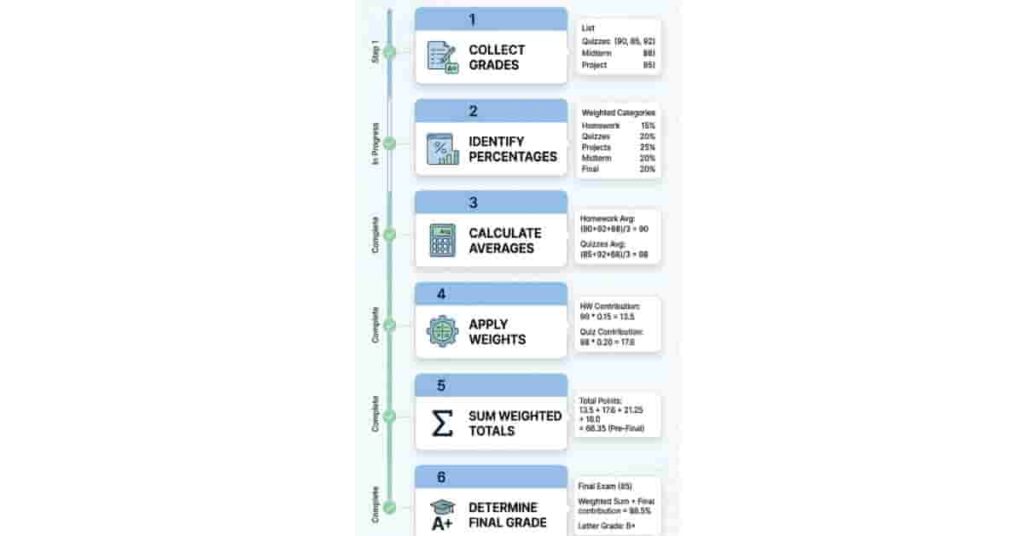
Calculating a semester grade becomes simple when you break the process into small steps. Most schools use weighted grading, which means each category contributes a different percentage to the final result.
Before you start, gather your grades and grading weights from your course syllabus, learning management system, or teacher. Then follow the six steps below to calculate your semester grade accurately.
Step 1 — Gather Your Grades
Start by collecting all grades that count toward your semester average. These grades usually come from different coursework categories.
Common categories include:
- Homework
- Quizzes
- Projects
- Midterms
- Final Exams
Check your gradebook or course portal to ensure the scores are up to date. Missing or outdated grades can lead to inaccurate results.
For example, your grades might look like this:
- Homework: 85%
- Quizzes: 90%
- Midterm: 78%
- Final Exam: 88%
Step 2 — Find Category Weights
Next, identify the weight assigned to each grading category. These percentages determine how much each category affects your semester grade.
A typical grading system may look like this:
- Homework = 20%
- Quizzes = 20%
- Midterm = 25%
- Final Exam = 35%
Notice that the final exam carries the largest weight. This means it has the greatest impact on the final semester grade.
You can usually find category weights in the course syllabus or grading policy.
Pro Tip
Never assume all categories have equal value. Many grading mistakes happen because students ignore category weights.
Step 3 — Convert Weights to Decimals
Before using the semester grade formula, convert percentage weights into decimals.
Here are common conversions:
- 20% = 0.20
- 25% = 0.25
- 35% = 0.35
To convert a percentage, divide it by 100. This step prepares the weights for multiplication.
For example:
20 ÷ 100 = 0.20
Every weight must be converted before moving to the next step.
Step 4 — Multiply Scores by Weights
Now multiply each grade by its decimal weight. This gives you the weighted value for each category.
Using the example grades:
- Homework: 85 × 0.20 = 17.0
- Quizzes: 90 × 0.20 = 18.0
- Midterm: 78 × 0.25 = 19.5
- Final Exam: 88 × 0.35 = 30.8
Each result represents that category’s contribution to the semester grade.
Step 5 — Add Weighted Scores
After calculating each weighted value, add them together.
Using the previous example:
17.0 + 18.0 + 19.5 + 30.8 = 85.3
This total represents the combined weighted performance across all grading categories.
Always review your math before moving to the final step.
Step 6 — Calculate Your Final Semester Grade
If your category weights add up to 100%, the total weighted score is your final semester grade.
In this example:
Final Semester Grade = 85.3%
If the weights do not total 100%, divide the weighted total by the combined weight. This adjustment ensures an accurate result.
Once you complete this step, you will know your current semester grade and can better track your academic progress.
Pro Tip
Use a semester grade calculator to verify your answer and save time when working with multiple categories.
Use our Semester & Quarter Grade Calculator to calculate your grades instantly. Track progress, estimate results, and stay on top of your academic goals.
Example of Semester Grade Calculation
Understanding the formula is helpful, but seeing a real example makes the process much easier. Let’s calculate a semester grade using common grading categories found in many U.S. schools.
In this example, each category has a different weight. We will multiply each score by its weight, then sum the results to find the final semester grade.
Semester Grade Calculation Table
| Category | Score | Weight |
| Homework | 85 | 20% |
| Quizzes | 90 | 20% |
| Midterm | 78 | 25% |
| Final Exam | 88 | 35% |
Step-by-Step Calculation
Convert each weight to a decimal and multiply it by the category score:
- Homework: 85 × 0.20 = 17.0
- Quizzes: 90 × 0.20 = 18.0
- Midterm: 78 × 0.25 = 19.5
- Final Exam: 88 × 0.35 = 30.8
Now add all weighted values:
17.0 + 18.0 + 19.5 + 30.8 = 85.3
Final Semester Grade
Semester Grade = 85.3%
Based on a typical U.S. grading scale, an 85.3% usually falls within the B grade range, although grading policies may vary by school.
Key Takeaways
- Multiply each category score by its weight.
- Add all weighted values together.
- The total becomes your semester grade when the weights sum to 100%.
- Weighted grading gives greater weight to major assessments, such as final exams.
How to Calculate a Semester Grade Without a Final Exam

Students often need to track progress before the final exam is taken. This helps them understand where they stand in the course. The method for calculating a semester grade without final method uses only completed grading categories.
You do not include the final exam in the calculation. Instead, you focus on homework, quizzes, projects, and midterms that already have scores. This gives you a temporary semester grade.
When Students Need This Calculation
Students usually calculate their grade without a final exam in these situations:
- The final exam has not happened yet.
- The teacher has not entered final exam scores.
- Students want to track their progress during the semester.
This method helps you understand your current performance before the course ends.
Formula Without Final Exam
Use only the completed categories. Multiply each score by its weight, then divide by the total completed weight.
Semester Grade (Temporary) = Σ (Score × Weight) ÷ Total Completed Weight
This adjustment is important because the final exam weight is excluded.
Example Calculation Without Final
Let’s assume the final exam is not included yet.
| Category | Score | Weight |
| Homework | 85 | 20% |
| Quizzes | 90 | 20% |
| Midterm | 78 | 25% |
Step-by-step calculation:
- Homework: 85 × 0.20 = 17.0
- Quizzes: 90 × 0.20 = 18.0
- Midterm: 78 × 0.25 = 19.5
Now add results:
17.0 + 18.0 + 19.5 = 54.5
Total completed weight = 65%
Now divide:
54.5 ÷ 0.65 = 83.8%
Estimating Your Current Semester Grade
This result shows your current semester performance without the final exam. It is not your final grade yet. The final exam can still increase or decrease your overall score.
You can also use this method to estimate what score you need on the final exam to reach a target grade.
Pro Tip
Always recalculate your grade after each major assignment update. Small changes can significantly affect your projected final outcome when weights are high.
Try our Semester & Quarter Grade Calculator for fast and accurate grade calculations. See where you stand and plan ahead with confidence.
How to Calculate Semester Grades With Finals
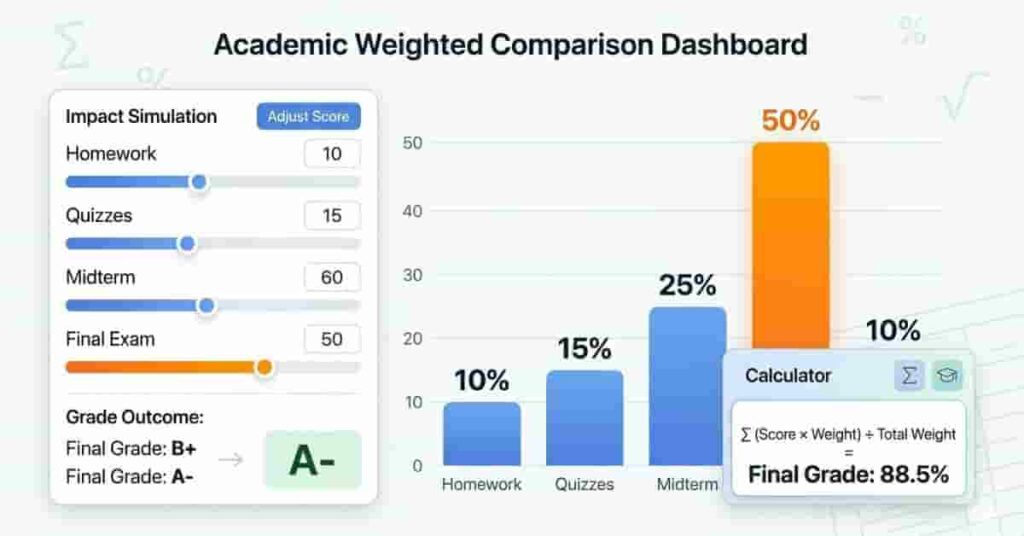
The method for calculating semester grades with finals includes every grading category, including the final exam. This gives you the most accurate view of your overall performance at the end of the semester.
Final exams usually carry a higher weight than other assignments. Because of this, they can significantly influence your semester grade.
Why Final Exams Matter
Final exams are important because they test your overall understanding of the course. They often cover everything taught during the semester.
In most U.S. schools, the final exam has a large impact on your grade. Even if your homework and quizzes are strong, a low final exam score can reduce your overall result.
Final exams also help teachers evaluate long-term learning instead of short-term performance.
Include Final Exam Weight
Final exams are usually one of the highest-weight categories in a semester grading system. A common structure looks like this:
- Homework: 20%
- Quizzes: 20%
- Midterm: 25%
- Final Exam: 35%
This means the final exam alone can influence more than one-third of your total semester grade.
Example With Final Exam Included
Let’s calculate a full semester grade using all categories:
| Category | Score | Weight |
| Homework | 85 | 20% |
| Quizzes | 90 | 20% |
| Midterm | 78 | 25% |
| Final Exam | 88 | 35% |
Step-by-step calculation:
- Homework: 85 × 0.20 = 17.0
- Quizzes: 90 × 0.20 = 18.0
- Midterm: 78 × 0.25 = 19.5
- Final Exam: 88 × 0.35 = 30.8
Now add all values:
17.0 + 18.0 + 19.5 + 30.8 = 85.3%
How Much Can a Final Exam Change Your Grade?
The final exam can change your semester grade more than any other assignment. Since it often carries the most weight, even a small score difference can affect your final result.
For example:
- A high final exam score can raise your grade significantly.
- A low score can reduce your overall semester average.
This is why students should devote extra preparation time to final exams, especially when they count for 30% or more of the total grade.
How to Calculate Both Semester Grades
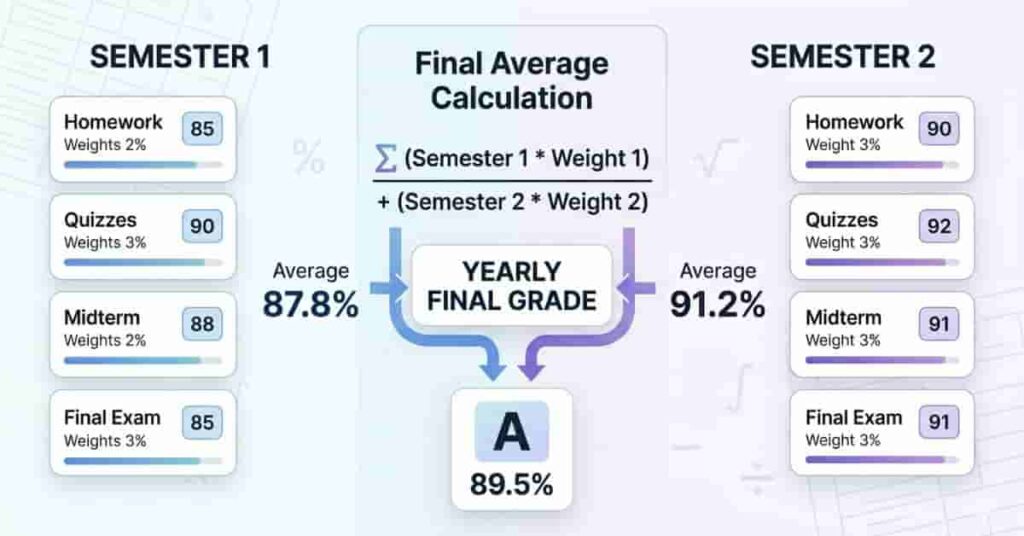
The how to calculate both semester grades method helps you find your overall yearly grade. Schools often combine Semester 1 and Semester 2 to show full academic performance. This final result may affect GPA, class rank, and graduation requirements.
Combining Semester 1 and Semester 2 Grades
In many schools, both semesters carry equal value. This means each semester contributes 50% to your final year grade. You simply average the two semester scores to get your final result.
However, always check your school policy. Some institutions may give more weight to one semester.
Formula
Final Year Grade = (Semester 1 + Semester 2) ÷ 2
This formula is used when both semesters are equally important.
Example
Let’s calculate a simple yearly grade:
- Semester 1 = 84%
- Semester 2 = 90%
Now apply the formula:
(84 + 90) ÷ 2 = 174 ÷ 2 = 87%
So, the final year grade is 87%.
This method gives a balanced view of performance across the entire academic year.
Weighted Semester Systems
Some schools do not treat both semesters equally. Instead, they use weighted semester systems.
For example:
- Semester 1 = 40% of final grade
- Semester 2 = 60% of final grade
In this case, the formula changes to a weighted average instead of a simple mean. Always check your syllabus or school grading policy to confirm the correct method.
Pro Tip
If your grades improve in Semester 2, a weighted system can boost your final result. Always focus on steady improvement, not just one strong semester.
Weighted vs Unweighted Semester Grades
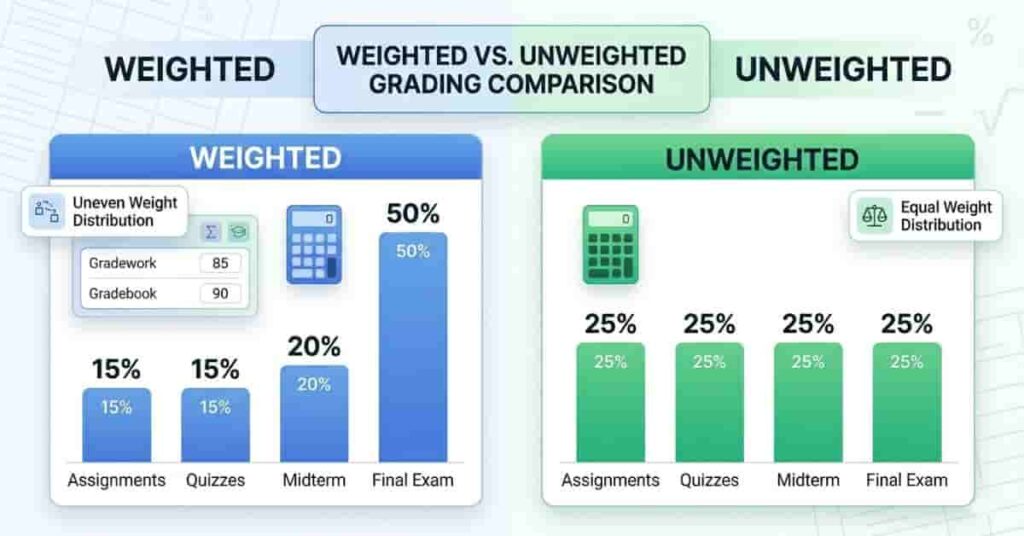
Semester grades are calculated using either a weighted or unweighted system. Understanding the difference helps you know how your performance is evaluated. It also helps you plan your study strategy more effectively.
Weighted Semester Grades
Weighted semester grades assign different importance to each category. Some assignments affect your grade more than others.
For example:
- Final exams may carry 30–40% weight.
- Homework may carry only 10–20%
This is the most common system in U.S. schools. It gives more value to major assessments like exams and projects. As a result, small assignments do not impact your grade as heavily.
Weighted grading reflects real academic performance more accurately. It rewards strong performance on high-value tasks.
Unweighted Semester Grades
Unweighted semester grades treat every assignment equally. Each score has the same value in the final calculation.
For example:
- Homework = same value as a quiz
- Quiz = same value as a test
This system is simpler to calculate. You just average all scores together without assigning weights.
However, it may not fully reflect the difficulty or importance of major exams.
Which System Does Your School Use?
To understand your grading system, check official course resources:
- Course syllabus
- Teacher grading policy
- LMS portal (like Canvas, Google Classroom, or Blackboard)
These sources clearly show whether your semester grade is weighted or unweighted. If you are unsure, always ask your teacher directly.
How U.S. Schools Calculate Semester Grades
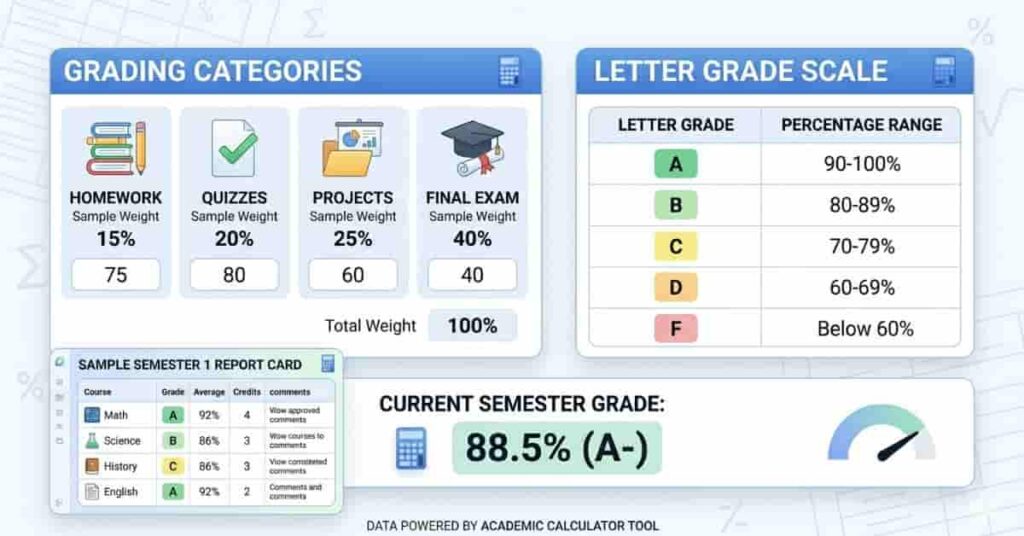
U.S. schools use a structured system to calculate semester grades. These grades combine different types of coursework into one final score. The goal is to measure overall student performance across the entire term.
Most schools rely on either weighted or unweighted grading systems. In a weighted system, major assessments, such as exams, carry more weight than smaller assignments. In an unweighted system, all assignments may contribute equally.
Common Grading Categories
Semester grades in U.S. schools usually include multiple categories. Each category helps measure different learning skills and academic progress.
- Homework
- Classwork
- Quizzes
- Projects
- Midterms
- Finals
Teachers assign each category a percentage weight in most courses. These weights determine how much each part affects the final semester grade.
Typical U.S. Letter Grade Scale
| Percentage | Letter Grade |
| 90–100 | A |
| 80–89 | B |
| 70–79 | C |
| 60–69 | D |
| Below 60 | F |
This grading scale is widely used across high schools and colleges in the United States. However, exact cutoffs may vary slightly by school or district.
Important Note
Schools and colleges may use different grading policies. Always check your course syllabus or official grading guide to understand how your semester grade is calculated.
Semester Grade vs Final Exam Grade
A semester grade and a final exam grade are not the same. Many students confuse the two, but they measure different things. Understanding the difference helps you track your academic progress more accurately.
A semester grade reflects your overall performance across the entire course. A final exam grade only shows how well you performed on one exam at the end of the term.
Comparison: Semester Grade vs Final Exam Grade
| Semester Grade | Final Exam Grade |
| Includes all coursework | One exam only |
| Covers entire term | Final assessment |
| Usually weighted | Single score |
| Reflects overall performance | Focuses on exam result |
| Based on multiple categories | Part of semester grade |
Semester grades combine homework, quizzes, projects, midterms, and final exams. Final exam grades only measure your performance on the final test.
Key Difference
The main difference is simple: a final exam affects a semester grade, but it does not replace it. Your semester grade represents your full academic effort, while the final exam is just one part of it.
This means a strong final exam can improve your semester grade, while a weak one can lower it significantly depending on its weight.
Common Mistakes When Calculating Semester Grades
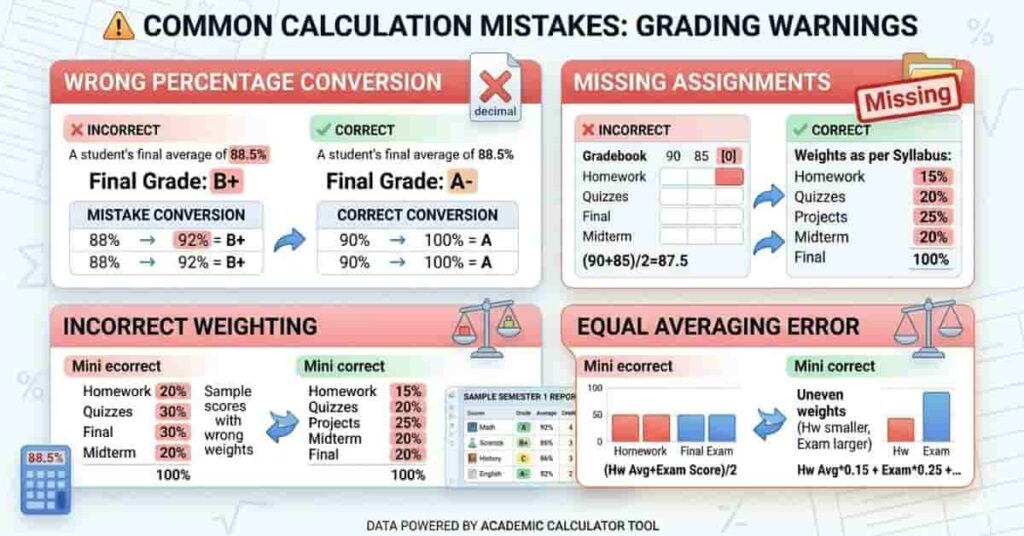
Many students calculate their semester grades incorrectly because they miss small but important details. These mistakes can lead to wrong expectations and poor study planning. Understanding them helps you get a more accurate picture of your real performance.
Most errors happen when students ignore how weighted grading works or skip important assignments. Even small missteps can change your final result, especially in high-weight courses.
Ignoring Category Weights
One of the biggest mistakes is ignoring category weights. Many students assume all assignments matter equally, but that is not true in most U.S. schools.
In a weighted system, some categories affect your grade more than others. For example, a final exam may count for 35%, while homework may only count for 20%. If you ignore these weights, your calculation will be incorrect.
Using Percentages Incorrectly
Another common mistake is using percentages without converting them into decimals. Students often multiply incorrectly or skip this step completely.
For example, 25% must be written as 0.25 before calculations. If you use 25 instead of 0.25, your result will be completely wrong.
Forgetting Major Assignments
Some students forget to include important assignments, such as projects, midterms, or quizzes. This leads to an incomplete semester grade calculation.
Missing even one high-weight assignment can significantly change your final result. Always include every graded category listed in your course.
Pro Tip
Cross-check your gradebook before calculating. Missing one category can noticeably affect your final grade.
Averaging Everything Equally
Many students wrongly average all grades together. This only works if your course is unweighted, which is uncommon at most U.S. schools.
In weighted systems, each category has a different importance. Treating them equally gives an inaccurate semester grade.
Pro Tip
Never assume equal weight. Always confirm whether your course uses weighted or unweighted grading.
How to Improve Your Semester Grade
Improving your semester grade requires consistent effort and smart planning. Small changes in your study habits can have a big impact on your final result, especially in weighted grading systems used in most U.S. schools.
The key is to focus on high-impact areas first. This means prioritizing assignments and exams that carry more weight in your overall grade.
Focus on High-Weight Categories
High-weight categories like midterms and final exams affect your semester grade more than small assignments. Improving performance in these areas can quickly boost your overall score.
For example, a final exam worth 35% has more influence than weekly homework worth 10–20%. Focus your energy where it matters most.
Improve Final Exam Performance
Final exams often carry the highest weight in a semester grading system. Strong preparation can significantly improve your final grade.
Practice past papers, review key concepts, and focus on weak areas. Consistent revision works better than last-minute cramming.
Expert Tip
Create a revision schedule at least two weeks before your final exam. Short daily sessions improve retention more than long study marathons.
Submit Assignments on Time
Late submissions can lower your grade or result in penalties. Staying organized helps you avoid unnecessary grade loss.
Use a calendar or planner to track due dates. Completing assignments early also gives you time to review your work.
Expert Tip
Set reminders 24 hours before every deadline. This simple habit prevents last-minute stress and missed submissions.
Track Grades Regularly
Checking your grades regularly helps you understand where you stand in the course. It also helps you identify weak areas early.
Most schools provide online grade portals where you can monitor your progress in real time.
Use Grade Calculators for Planning
Grade calculators help you estimate your current semester grade and predict future outcomes. They are useful for planning how much effort you need to put in to reach your target grade.
You can test different scores to see how they affect your final result. This helps you make better study decisions.
Conclusion
Calculating semester grades becomes simple when you follow a clear step-by-step method. This guide explained the meaning of semester grades, formulas, weighted systems, examples, and common mistakes. You also learned how to handle grades with and without final exams using real calculations.
Understanding how to calculate semester grades helps you track performance and plan smarter study strategies. It also makes it easier to predict results before final exams. Using tools like a semester grade calculator saves time and reduces errors in manual calculations.
If you want faster and more accurate results, try our calculator tool today. You can instantly check your grade, estimate the impact on your final exam, and plan your next steps with confidence. Share this guide with classmates who struggle with grade calculations. You can also explore more study resources on our website to improve your academic performance.

Team ClassRank builds smart, student-friendly calculators to make grade and rank tracking simple and accurate. For questions or feedback, contact us at classrankcalculator@gmail.com.