

Table of Contents
Introduction
Have you ever wondered how your quarter grades affect your overall course average?
Many students in the United States see grades posted every quarter but are unsure how those scores contribute to their final performance. Understanding how to calculate quarter grades and term averages can help you track academic progress, set realistic goals, and avoid surprises on report cards. Whether your school uses weighted categories, equal grading periods, or final exams, knowing the calculation process is an important academic skill.
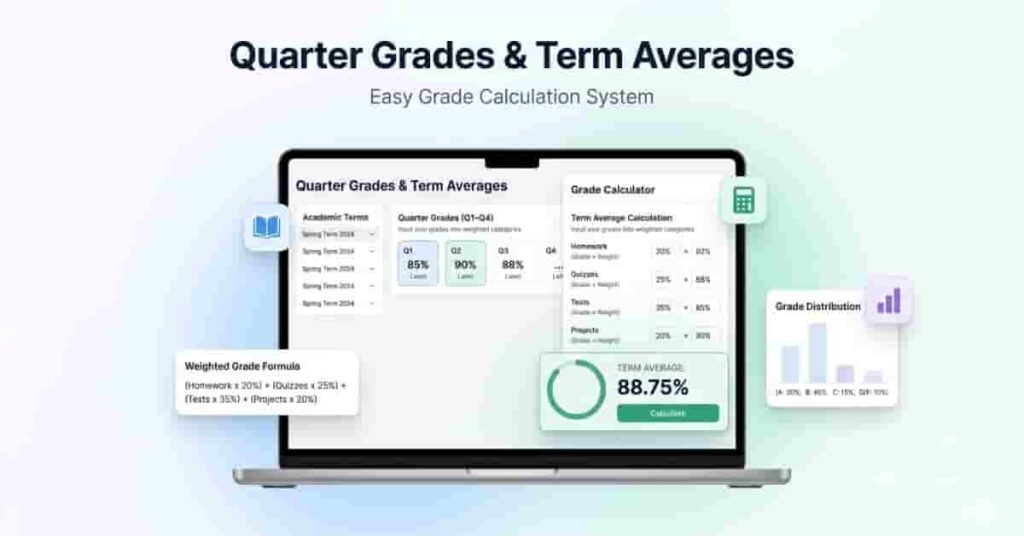
In this guide, you’ll learn how quarter grades are calculated, how term averages work, and how different grading systems affect your final course grade. We’ll also walk through simple formulas, real examples, and common mistakes to avoid. If you want a faster solution, you can use a Quarter Grade Calculator to instantly calculate weighted grades and term averages with greater accuracy.
What Is a Quarter Grading System?

A quarter grading system divides the academic year into four separate grading periods. These periods are usually called Quarter 1 (Q1), Quarter 2 (Q2), Quarter 3 (Q3), and Quarter 4 (Q4). Instead of waiting until the end of a semester, students receive grades at the end of each quarter. This gives them a clearer picture of their academic progress throughout the school year.
In a typical U.S. quarter grading system, each quarter grade reflects a student’s performance during that specific grading period. Teachers evaluate coursework completed within the quarter and assign a final grade based on various academic activities.
How Does the Quarter Grading System Work?
Quarter grades in school are often based on a combination of:
- Homework assignments
- Classwork activities
- Quizzes
- Unit tests
- Projects
- Class participation
Many schools use weighted grading categories. For example, tests may count more toward the final quarter grade than homework. Because grading policies vary, students should review their school’s grading guidelines each year.
Why Do Schools Use Quarter Systems?
Schools choose quarter systems because they provide more frequent academic updates and help students stay on track. Shorter grading periods also allow teachers and parents to identify learning challenges earlier.
Some key benefits include:
- More frequent progress tracking
- Faster feedback on academic performance
- Better monitoring of improvement throughout the year
- More opportunities to raise grades before the final course average
Expert Tip: Don’t wait until the end of the semester to review your grades. Regularly checking your quarterly performance makes it easier to address weak areas before they affect your overall course average.
What Is a Term Average?
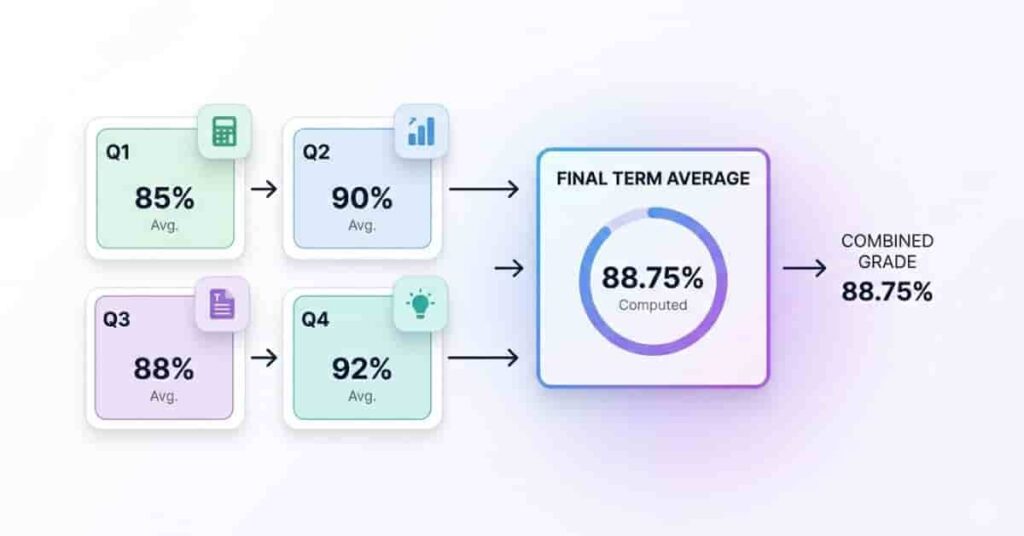
A term average is the overall average of multiple grading periods within a course. Instead of looking at performance in just one quarter, it combines grades from several quarters to show how a student performed over a longer period. Schools often use term averages to evaluate consistent academic progress and determine overall course achievement.
For students in a quarter grading system, the term average provides a broader view of performance than a single quarter grade. This makes it an important number for report cards, academic planning, and final grade calculations.
Quarter Grade vs Term Average
| Quarter Grade | Term Average |
| Measures performance during one quarter | Measures performance across multiple quarters |
| Covers a shorter grading period | Covers a longer academic period |
| Calculated separately | Combines multiple quarter grades |
| Reflects short-term performance | Reflects overall progress over time |
A quarter grade shows how well you performed during a specific grading period. A term average combines those results to create a more complete picture of your academic performance.
Why Do Term Averages Matter?
Schools use term averages for several important purposes. They help teachers, students, and parents understand overall progress throughout the school year.
Term averages are commonly used to:
- Determine report card grades
- Measure overall course performance
- Contribute to final course grades
- Track academic improvement over time
- Identify areas that need additional support
How Quarter Grades Affect Your Final Course Grade
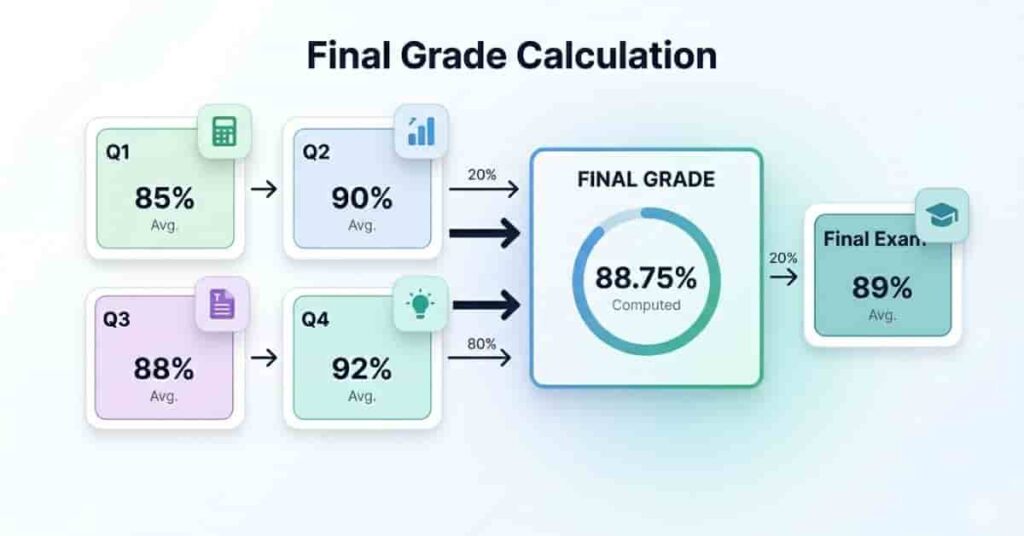
Your quarter grades can play a major role in determining your final course grade. However, the exact impact depends on your school’s grading policy. Some schools assign equal weight to each quarter, while others use weighted grading systems or include final exams in the calculation.
Understanding how your grades are combined can help you predict your final average and make better academic decisions throughout the year.
Equal-Weight Grading Systems
In an equal-weight system, each quarter contributes the same percentage to the final course grade. This approach is simple because each grading period is equally important.
For example:
- Q1 = 85
- Q2 = 88
- Q3 = 90
- Q4 = 92
Since there are four quarters, each grade contributes 25% of the final course average. Schools using this system calculate the final grade by averaging all four quarter grades.
Weighted Grading Systems
Some schools assign different weights to grading periods. In these systems, certain quarters, semesters, or assessments may count more than others.
For example, a school might:
- Give greater weight to second-semester grades.
- Count semester averages instead of individual quarters
- Include special projects or state assessments.
As a result, improving performance in a heavily weighted grading period can have a larger impact on the final course grade.
Final Exam Inclusion
Many schools also include a final exam when calculating the final grade. Depending on the grading policy, the final course grade may be based on:
- Quarter grades
- Semester grades
- Final exam scores
- A combination of all three
Because grading methods vary, students should always review their school’s grading handbook or course syllabus.
How Quarter Grades Are Calculated
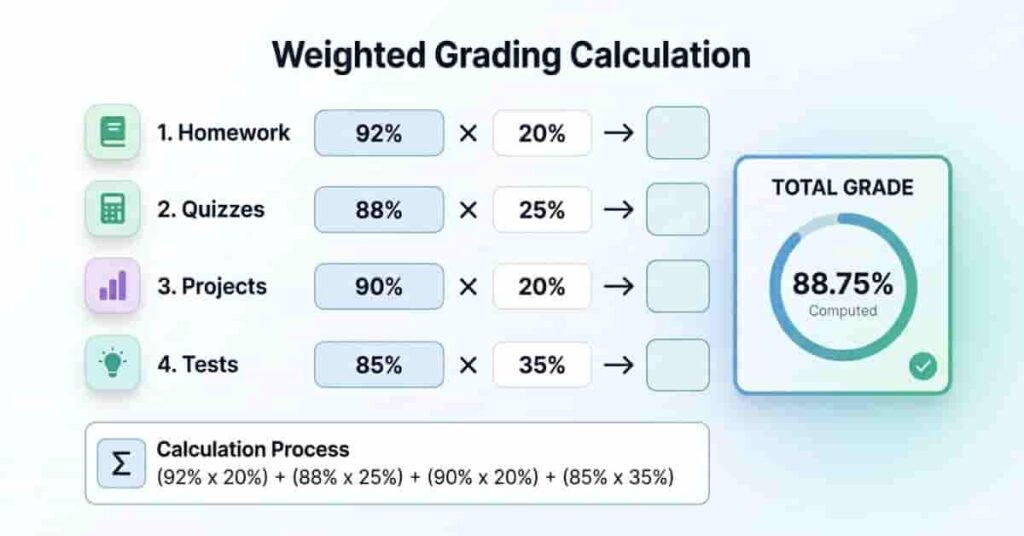
Most schools calculate quarter grades using a weighted grading system. Instead of treating every assignment equally, schools group coursework into categories and assign a percentage weight to each one. This method places greater weight on major assessments while still rewarding consistent effort throughout the quarter.
For example, a unit test often affects your grade more than a single homework assignment. As a result, understanding category weights is essential for accurately calculating quarter grades.
Common Categories Used in Quarter Grading
Schools may use different grading structures, but these categories are common in many classrooms:
- Homework
- Classwork
- Quizzes
- Projects
- Unit Tests
- Participation
Teachers record scores throughout the quarter and then apply the assigned weight for each category. The weighted scores are combined to determine the final quarter grade.
Typical Category Weights
| Category | Weight |
| Homework | 20% |
| Quizzes | 20% |
| Projects | 25% |
| Tests | 35% |
In this example, tests have the greatest impact because they account for 35% of the quarter grade. Projects contribute 25%, while homework and quizzes each contribute 20%.
This means a high test score can significantly boost your overall average. Likewise, poor performance in a heavily weighted category can lower your final quarter grade more than expected.
Why Category Weights Matter
Many students make the mistake of averaging all assignment scores together. This often produces an incorrect result because weighted categories are not equal.
Before calculating your grade, always check:
- Which categories are used
- The weight assigned to each category.
- Whether participation or extra credit is included
Quarter Grade Formula
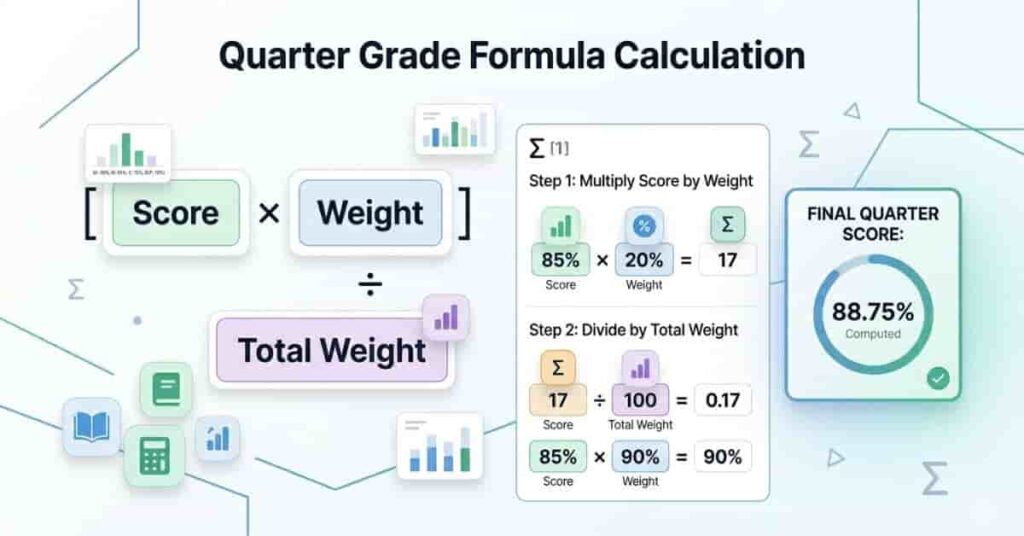
If you want to calculate quarter grades, you need to use a weighted average formula. This method accounts for the importance of each grading category, such as homework, quizzes, projects, and tests. Schools use this approach because not every assignment contributes equally to the final quarter grade.
Quick Answer
Quarter Grade = Σ (Score × Weight) ÷ Total Weight
In simple terms, multiply each score by its assigned weight, add the weighted values together, and divide by the total weight. The result is your final quarter grade percentage.
How to Calculate a Quarter Grade Step by Step
Follow these simple steps:
- Multiply each score by its weight.
- Add all weighted scores together.
- Divide by the total weight.
- The result is your quarter grade percentage.
This process ensures that higher-weight categories have a greater impact on the final grade.
Example Calculation
Suppose a student has the following scores:
- Homework: 85 × 20%
- Quiz: 90 × 20%
- Project: 88 × 25%
- Test: 92 × 35%
First, multiply each score by its assigned weight. Then add all weighted values together. The combined result represents the student’s final quarter grade.
The next section will walk through the complete calculation and show exactly how the final percentage is determined.
Pro Tip
Before calculating your grade, convert percentages into decimals. For example, 20% becomes 0.20 and 35% becomes 0.35. This makes calculations faster and reduces mistakes.
Example 1 – Calculating a Quarter Grade
Now let’s use a real example to see how the quarter grade formula works. This example uses the weighted grading categories discussed earlier. By following each step, you can learn how to calculate quarter grades manually and better understand how different assignments affect your final average.
Student Scores
| Category | Score | Weight |
| Homework | 85 | 20% |
| Quizzes | 90 | 20% |
| Projects | 88 | 25% |
| Tests | 92 | 35% |
Step 1: Multiply Each Score by Its Weight
Convert each percentage weight to a decimal, then multiply it by the category score.
- Homework: 85 × 0.20 = 17.0
- Quizzes: 90 × 0.20 = 18.0
- Projects: 88 × 0.25 = 22.0
- Tests: 92 × 0.35 = 32.2
Step 2: Add the Weighted Scores
Next, combine all weighted values:
17.0 + 18.0 + 22.0 + 32.2 = 89.2
Final Quarter Grade
The student’s final quarter grade is:
89.2%
This result shows why weighted grading systems matter. Although the student earned different scores in each category, the strong test score had the biggest impact because tests carried the highest weight.
Pro Tip
Before focusing on small homework improvements, check which category carries the most weight. Raising a heavily weighted test average often improves your quarter grade faster.
Example 2 – Calculating a Term Average
Once you know your quarter grades, calculating a term average is simple. A term average combines grades from multiple grading periods to show your overall performance during a course. Many schools use this average for report cards, academic evaluations, and final grade calculations.
In this example, a student has completed four quarters and wants to find their overall term average.
Quarterly Grades
| Quarter | Grade |
| Q1 | 85 |
| Q2 | 88 |
| Q3 | 90 |
| Q4 | 92 |
Step 1: Add All Quarter Grades
First, add the grades from each quarter:
85 + 88 + 90 + 92 = 355
Step 2: Divide by the Number of Quarters
Since there are four grading periods, divide the total by 4:
355 ÷ 4 = 88.75
Final Term Average
88.75%
This means the student’s overall average across all four quarters is 88.75%. In an equal-weight grading system, each quarter contributes the same amount to the final term average.
If your school uses weighted quarters or includes semester exams, the calculation may be different. Always check your school’s grading policy before estimating final grades.
Quarter System vs Semester System
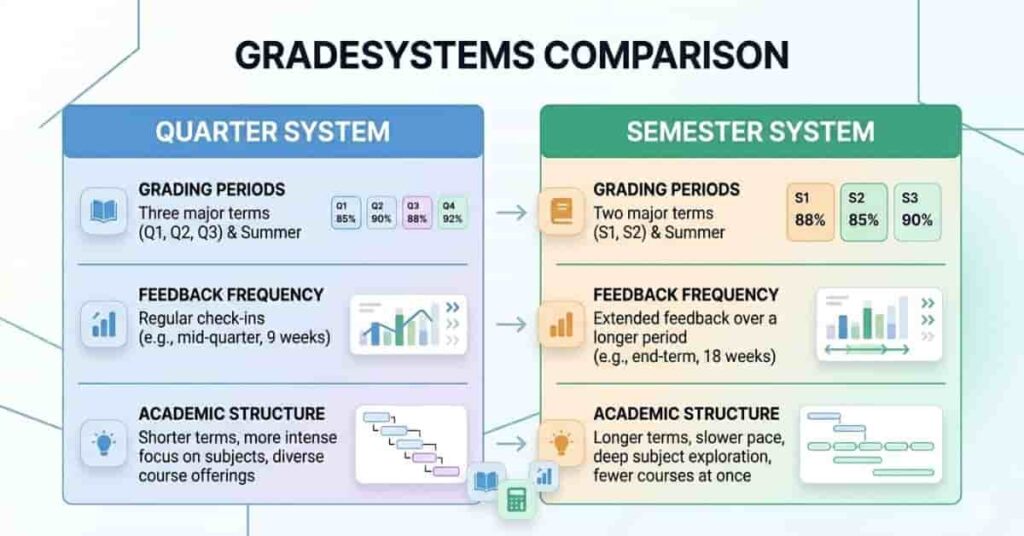
Schools use different grading structures to track student performance. The two most common systems are the quarter system and the semester system. Both organise the school year differently and affect how often students receive grades and feedback.
Understanding the difference helps students plan better and avoid confusion when calculating grades or term averages.
Quarter System
In a quarter system, the academic year is divided into four grading periods. Each quarter covers a shorter time span, so grades update more frequently. This system helps students track progress throughout the year and adjust quickly if their performance drops.
Key features of the quarter system include:
- Four grading periods per year
- More frequent progress checks
- Faster grade updates
- Students receive feedback sooner.
- Common in K–12 schools and some international programs
Because grades are updated often, students can identify weak areas earlier and improve before the final course grade is calculated.
Semester System
A semester system divides the school year into two longer grading periods. Each semester covers a larger portion of the course, so grades reflect performance over a longer time.
Key features of the semester system include:
- Two grading periods per year
- Longer grading windows
- Fewer progress reports
- Grades are updated less frequently.
- Common in colleges and universities
Since each semester carries more content, exams and assignments often have a larger impact on the final grade.
Which System Is Better?
Neither system is better overall. Each one has advantages depending on how a school structures its curriculum. Quarter systems offer faster feedback, while semester systems provide more time to build long-term understanding.
Schools choose the system that best supports their teaching style and academic goals.
Why Students Use a Quarter Grade Calculator
A quarter-grade calculator helps students quickly understand their academic performance without doing manual calculations. Since quarter grades often use weighted categories, even small calculation errors can lead to incorrect results. A calculator removes that risk and gives accurate results in seconds.
Students use these tools to stay organised, track progress, and make better academic decisions throughout the school year.
Save Time
Manually calculating weighted grades takes time and effort. A quarter-grade calculator automates the entire process.
Instead of multiplying and adding scores by hand, students can enter their grades and get instant results. This saves time during busy school schedules.
Reduce Errors
Human error is common in manual calculations. One wrong weight or score can change the final grade.
A calculator uses correct formulas automatically. This improves accuracy and ensures students get reliable results every time.
Track Progress
Quarter-grade calculators help students monitor their performance throughout the school year. They can check how each assignment affects their overall grade.
This makes it easier to identify weak areas early and improve before the next grading period.
Plan Academic Goals
Students can use calculators to set realistic academic targets. For example, they can estimate what score they need on upcoming assignments or tests.
This helps with better planning and stronger study habits.
Prepare for GPA Calculations
Quarter grades often contribute to final academic records and GPA calculations. A calculator helps students understand where they currently stand.
This makes long-term academic planning easier and more accurate.
Common Mistakes When Calculating Quarter Grades
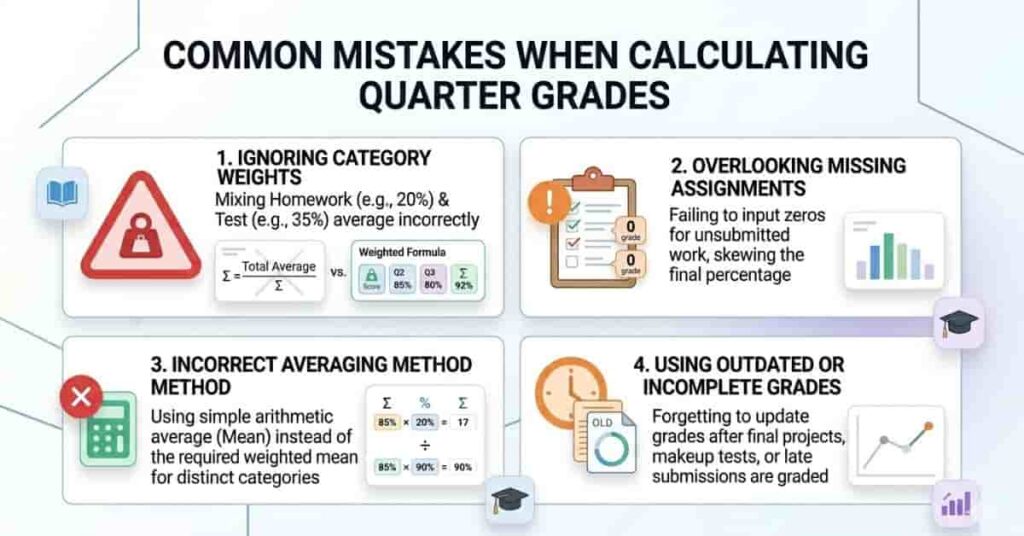
Many students try to calculate quarter grades on their own but often make small mistakes that lead to incorrect results. Since most schools use weighted grading systems, even minor errors can change the final percentage. Understanding these mistakes helps you calculate your grade more accurately and avoid surprises on your report card.
Ignoring Category Weights
One of the most common mistakes is ignoring how weights work. In a quarter-grading system, not all assignments carry the same weight.
For example, tests often count more than homework. If you treat all scores equally, your final grade will be incorrect. Always check each category’s weight before calculating.
Averaging Scores Incorrectly
Many students simply add all scores and divide them. This method does not work for weighted systems.
A simple average ignores category importance. This leads to inaccurate results, especially when tests or projects carry higher weights than homework or quizzes.
Forgetting Participation Grades
Participation may seem small, but it can still affect your overall grade. Some teachers include it as a separate category.
If you forget to include participation scores, your final calculation may be slightly off. Always check your syllabus for hidden or extra categories.
Missing Assignment Scores
Incomplete data leads to wrong results. If even one assignment is missing, your final calculation will not reflect your true performance.
Before calculating, make sure all grades are entered, including quizzes, tests, and projects.
Using Outdated Grades
Grades change throughout the quarter as new assignments are added. Using old data gives an inaccurate result.
Always update your scores before calculating your quarter grade to ensure accuracy.
Conclusion
This guide explained how quarter grades work and how schools calculate term averages. You also learned formulas, examples, and common mistakes to avoid. Understanding these basics makes it easier to track your academic progress with confidence.
Using a quarter-grade calculator helps you avoid errors and save time during calculations. It also gives a clear picture of your performance across different grading periods. When you understand your quarter grades in school, you can plan better and improve your final course results.
Stay consistent with your tracking and use the right tools for accurate results. If this guide helped you, share it with other students or leave a comment with your experience. You can also explore more grading and GPA resources on our site to improve your academic planning.

Team ClassRank builds smart, student-friendly calculators to make grade and rank tracking simple and accurate. For questions or feedback, contact us at classrankcalculator@gmail.com.