โญ Key Featuresย
- โก Instant Calculations
Get accurate class boundaries in seconds without manual work. - ๐ Single & Multiple Intervals Support
Calculate boundaries for a single class or multiple class intervals simultaneously. - ๐ง Step-by-Step Explanation
Understand each step clearly, not just the final answer. - ๐ Number Line Visualization
See how class boundaries work visually for better understanding. - ๐ Automatic Histogram Support
Visualize your data with continuous class boundaries. - โ๏ธ Custom Boundary Adjustment
Use 0.5 for whole numbers or adjust for decimal data easily. - โ Error Reduction System
Avoid common mistakes, such as incorrect limits or calculations. - ๐ Export Options Available
Copy results, download as CSV, or print your data quickly. - ๐ฏ Student-Friendly Interface
Simple design that works for beginners, school students, and college learners. - ๐ Fast, Free, and Easy to Use
No signup required. Use it anytime for homework or exam preparation.
๐ Class Boundaries Calculator
Calculate precise lower & upper class boundaries for frequency distributions.
๐ Calculation Results
| # | Class Interval (e.g., 60-69) | Frequency (opt.) |
|---|
| # | Class Interval | Frequency | Lower Boundary | Upper Boundary |
|---|
Upper Boundary = Upper Limit + Adjustment
Default adjustment = 0.5 (for whole-number data)
๐งญ How to Calculate Class Boundaries (Step-by-Step Guide)
Follow these simple steps to calculate class boundaries correctly using the calculator. This guide helps you understand the full process and avoid common mistakes.
- Step 1
- Step 2
- Step 3
- Step 4
- Step 5
- Step 6
- Step 7
- Step 8
Choose Calculation Type

First, select whether you want to calculate for a single interval or multiple intervals.
Use Single Interval for one class
Use Multiple Intervals for grouped data
๐ This helps you work faster based on your problem type.
Enter Class Limits

Enter your class interval values:
Lower Class Limit (e.g., 60)
Upper Class Limit (e.g., 69)
๐ Make sure your values are correct to avoid wrong results.
Set Boundary Adjustment

![]()
Choose the correct boundary adjustment value:
Use 0.5 for whole numbers
Use 0.05 for decimal values
๐ This step is very important because it removes gaps between classes.
Click Calculate Button

![]()
Click the โCalculate Boundariesโ button to process your data.
๐ The calculator will instantly apply the formula and generate results.
View Class Boundaries Results
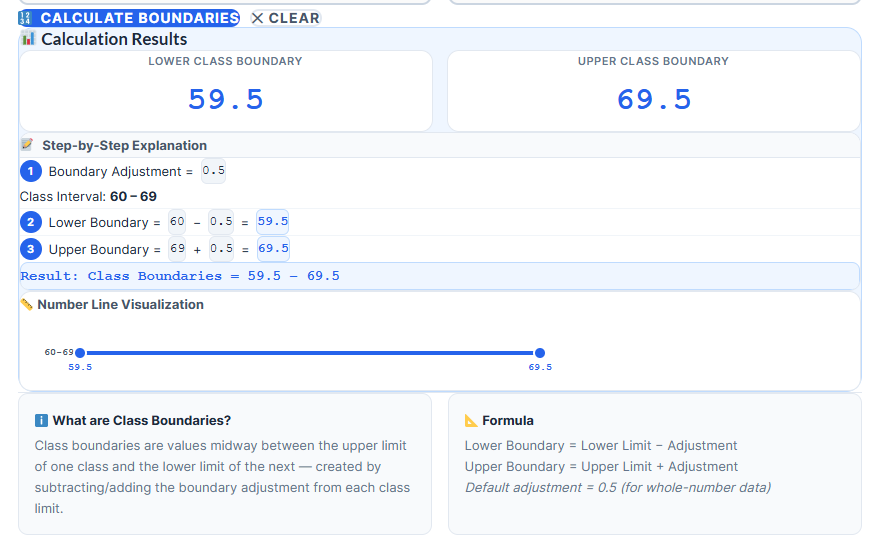
You will see the final results:
Lower Class Boundary (e.g., 59.5)
Upper Class Boundary (e.g., 69.5)
๐ These values represent the real limits of your class interval.
Understand Step-by-Step Solution
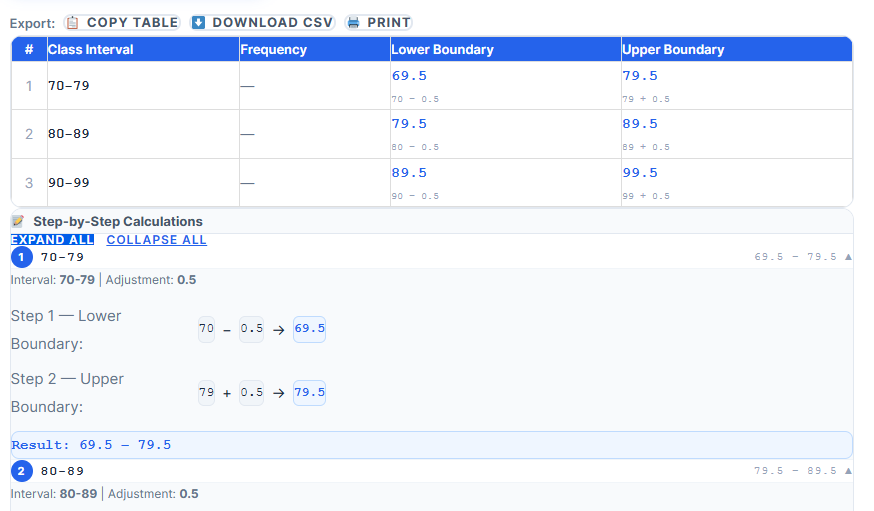
Check the detailed explanation:
Shows subtraction and addition clearly
Helps you learn the method
๐ This is useful for exams and concept clarity.
View Number Line Visualization
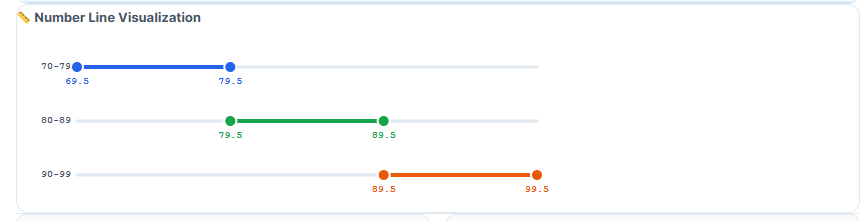
See how boundaries work visually on a number line.
๐ This helps you understand how gaps are removed between classes.
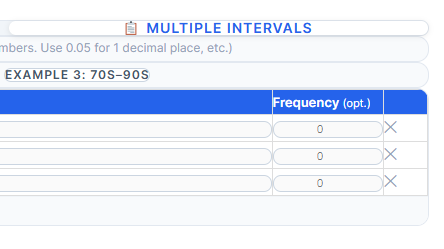
Use Multiple Intervalsย

If you have grouped data:
Add multiple class intervals
Click โCalculate All Boundariesโ
Get results for all classes together
๐ This saves time for large datasets.
๐ก Pro Tip for Students
Always use the correct boundary adjustment value based on your data type.
๐ Use 0.5 for whole numbers
๐ Use 0.05 for decimal values
This small step makes a big difference and helps you avoid losing marks in exams.
๐ฏ Why Students Prefer This Calculator
- It provides clear, easy-to-follow step-by-step solutions.
- It supports both single- and multiple-class intervals.
- It helps you avoid common calculation mistakes.
- It saves time during exams and assignments.
- It improves your understanding of statistics concepts.
๐ Class Boundaries Formula
- Lower Boundary = Lower Limit โ Adjustment
- Upper Boundary = Upper Limit + Adjustment
Use 0.5 for whole numbers (like 60โ69)
Use 0.05 for decimal values (like 60.1โ69.9)
๐ Example of Class Boundaries
Adjustment: 0.5
- Lower Boundary = 60 โ 0.5 = 59.5
- Upper Boundary = 69 + 0.5 = 69.5
๐ What Are Class Boundaries?
Class boundaries are the true limits of a class interval. They remove the gaps between classes and make the data continuous.
For example, without boundaries, there is a small gap between 69 and 70. Class boundaries remove this gap and connect the data smoothly. We use class boundaries in statistics when working with grouped data and when drawing histograms.
Lower and Upper Class Boundaries
Each class interval has two boundaries:
Lower class boundary โ lower limit minus adjustment
Upper class boundary โ upper limit plus adjustment
These boundaries show the exact range of values in each class and help represent data more accurately.
๐ Why Class Boundaries Are Important
Class boundaries are important for understanding and analyzing data correctly:
They make data continuous
They help create accurate histograms
They remove gaps between class intervals
They improve accuracy in grouped data calculations
Many students lose marks because they use class limits instead of boundaries. Using the correct method helps you avoid this problem.
โ ๏ธ Common Mistakes Students Make
Students often make small but important mistakes in this topic:
Using class limits instead of boundaries
Choosing the wrong adjustment value
Ignoring decimal values in data
Writing overlapping or incorrect intervals
This calculator helps you avoid these mistakes and gives reliable results every time.
๐ Related Concepts You Should Know
To fully understand class boundaries, you should also learn these concepts:
Class limits โ the starting and ending values of a class
Class width โ the size of the class interval
Class midpoint โ the center value of a class
These concepts are often used together in statistics problems.
Do not waste time solving long calculations manually.
๐ Use this Class Boundaries Calculator now to get fast, accurate, and step-by-step results for your statistics problems.
๐Class Boundaries Calculator FAQs :
How do you find class boundaries step by step?
To find class boundaries, subtract the adjustment from the lower limit and add the adjustment to the upper limit. For example, for 60โ69 with 0.5 adjustment, the boundaries are 59.5 and 69.5.
What is a class boundary?
A class boundary is the real limit of a class interval that makes data continuous.
Why do we use 0.5 in class boundaries?
We use 0.5 to remove gaps between whole number class intervals.
Can I calculate multiple class boundaries at once?
Yes, this calculator supports multiple intervals for grouped data.
Is this calculator useful for exams and homework?
Yes, it helps you understand the concept and check your answers quickly.
What is the difference between class limits and class boundaries?
Class limits are the given values of a class interval, such as 60โ69. Class boundaries are the real limits, like 59.5โ69.5, which remove gaps between classes.
When should I use 0.5 or 0.05 in class boundaries?
Use 0.5 when your data is in whole numbers. Use 0.05 when your data includes one decimal place. This ensures your data becomes continuous.
Why are class boundaries used in histograms?
Class boundaries are used in histograms to make bars touch each other. This shows continuous data and gives a more accurate representation.