

Table of Contents
Introduction
Have you ever wondered why statisticians care about how large a sample is compared with the population?
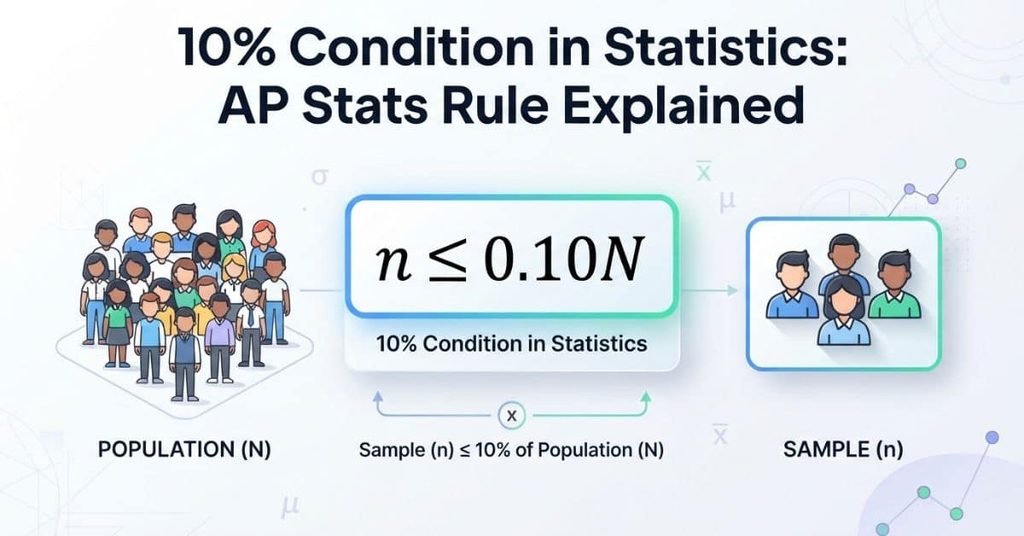
The 10% condition in statistics is an important rule for sampling without replacement. It helps make sure observations are reasonably independent during statistical calculations. This matters when you work with confidence intervals, hypothesis tests, and other AP Statistics problems.
For beginners, the rule is simple once you know what to check. Your sample should be no more than 10% of the population when sampling without replacement.
In this guide, you will learn exactly what the 10% condition means. You will also learn the 10% condition formula and how to check it quickly.
We’ll walk through simple examples using realistic numbers. You’ll see when the condition is satisfied and when it fails.
By the end, you’ll know how to apply the 10 percent condition in statistics confidently on homework, quizzes, and AP Stats exams.
What Is the 10% Condition in Statistics?
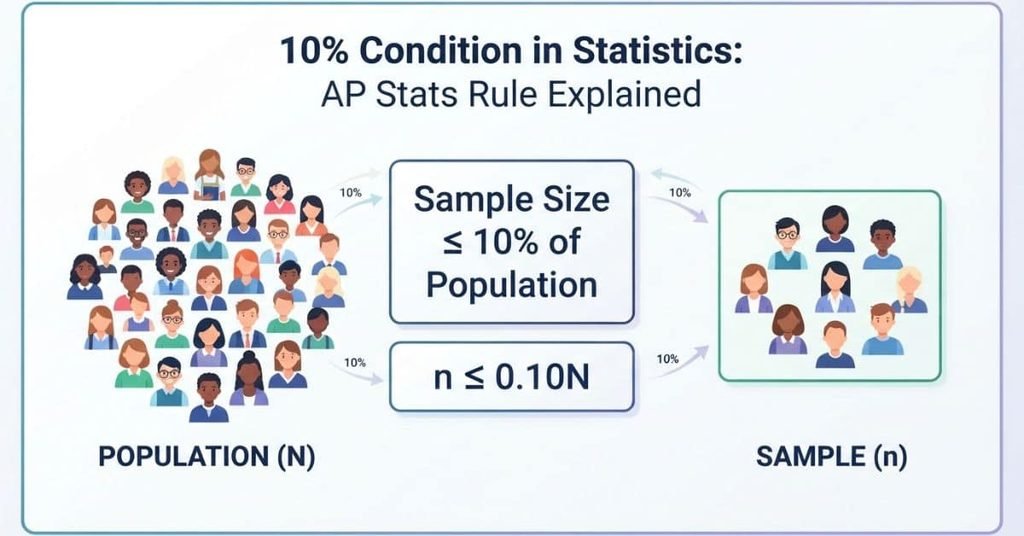
The 10% condition in statistics says a sample should be no more than 10% of the population. This guideline commonly applies when you sample without replacement. It helps support the assumption that observations are approximately independent.
The sample size is the number of individuals or items selected for a study. The population size is the total number of individuals or items you could potentially select. To check the condition, compare the sample size with 10% of the population size.
10% condition formula:
Sample size ≤ 0.10 × Population size
For example, suppose a school has 800 students, and you randomly select 60 students without replacement. Ten percent of 800 is 80. Since 60 is less than 80, the sample meets the 10% condition.
Why does this matter? Sampling without replacement can make observations dependent. After selecting one person, that person cannot appear again in the sample. However, when the sample is small compared with the population, each selection changes the population very little. This makes the observations approximately independent for many statistical calculations.
Important Clarification
The 10% condition is not a universal requirement for every statistics problem. It is mainly a guideline used when sampling without replacement. Always check the specific statistical method and its required conditions before applying the rule.
Quick takeaway: If you sample without replacement, check whether your sample is 10% or less of the population before assuming approximate independence.
What Is the 10% Condition in AP Stats?
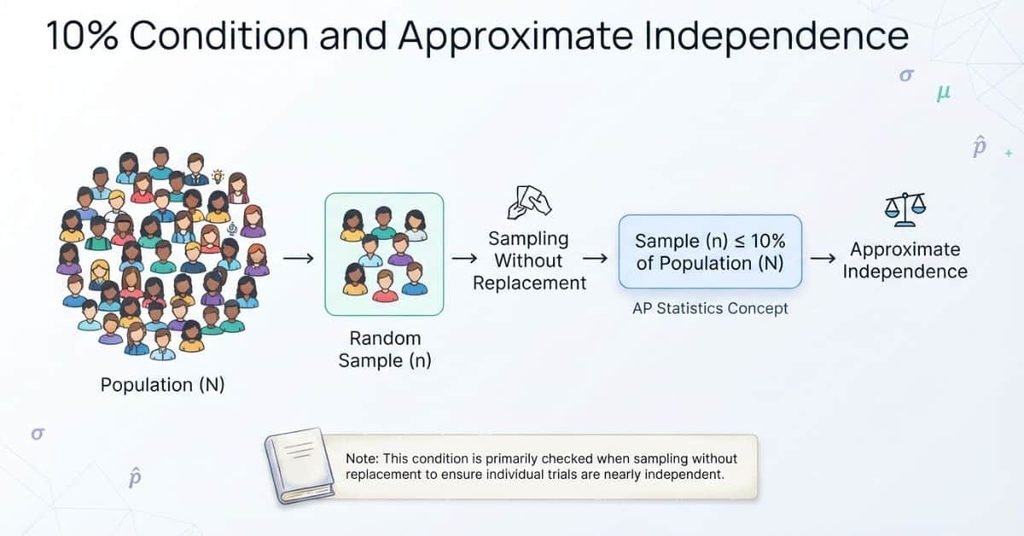
In AP Statistics, the 10% condition helps you decide whether observations can reasonably be treated as independent. You may need to check it when a sample comes from a finite population without replacement.
You can encounter this condition in several AP Stats topics. These include confidence intervals, hypothesis tests, and sampling distributions. It can also appear in one-sample procedures and two-sample procedures involving sampling without replacement.
For example, suppose you randomly select 80 students from a school with 1,000 students. Ten percent of the population is 100 students. Since 80 is less than 100, the sample meets the 10% condition.
The condition matters because sampling without replacement creates some dependence between observations. Each selection slightly changes the population available for the next selection. A sample of 10% or less keeps that change small enough to support approximate independence.
For AP Stats questions, look for the phrase “sampled without replacement.” Then compare the sample size with 10% of the population size. If the sample is no more than 10% of the population, the condition is satisfied.
Remember that this is a condition to check when it applies. It does not automatically apply to every AP Statistics problem.
The 10% Condition Formula
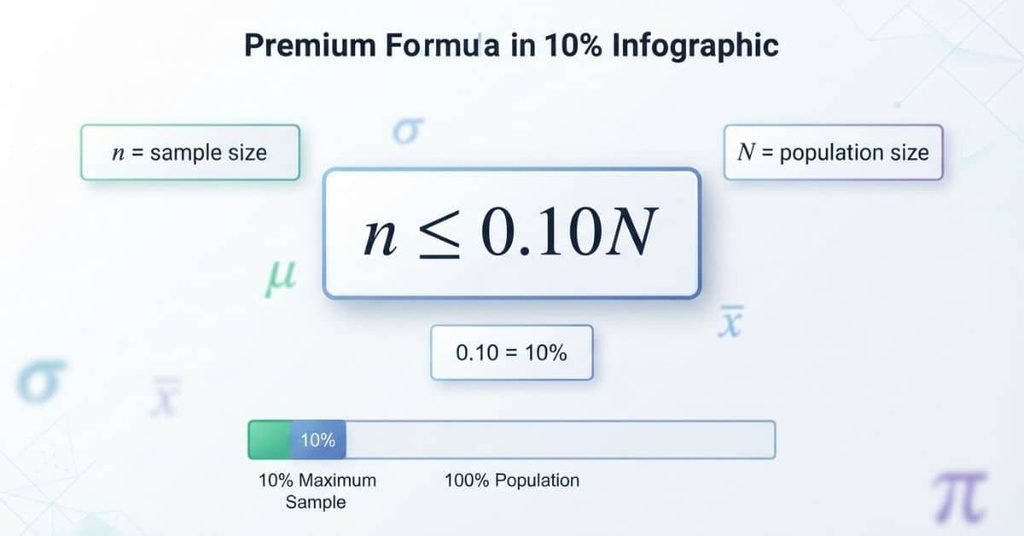
The 10% condition formula gives you a quick way to check whether a sample is small enough relative to its population.
n ≤ 0.10N
Here, n represents the sample size, while N represents the population size. The inequality means the sample should be no more than 10% of the population when sampling without replacement.
What Does n Represent?
The letter n represents the sample size. It tells you how many individuals or items you selected from the population.
For example, if a researcher randomly selects 75 students from a school, then n = 75. You use this number when checking the 10% condition.
What Does N Represent?
The letter N represents the population size. It tells you how many individuals or items are in the population being sampled.
If the school has 900 students, then N = 900. Ten percent of that population is 90 students.
Why 10%?
The 10% limit helps keep the sample small compared with the population. This matters when sampling without replacement because each selection changes the remaining population.
A small sample has a relatively small effect on later selections. Therefore, treating observations as approximately independent becomes more reasonable.
The 10% guideline does not mean exactly 10% is required in every situation. It is a common condition used when checking independence for sampling without replacement.
How to Check the 10% Condition
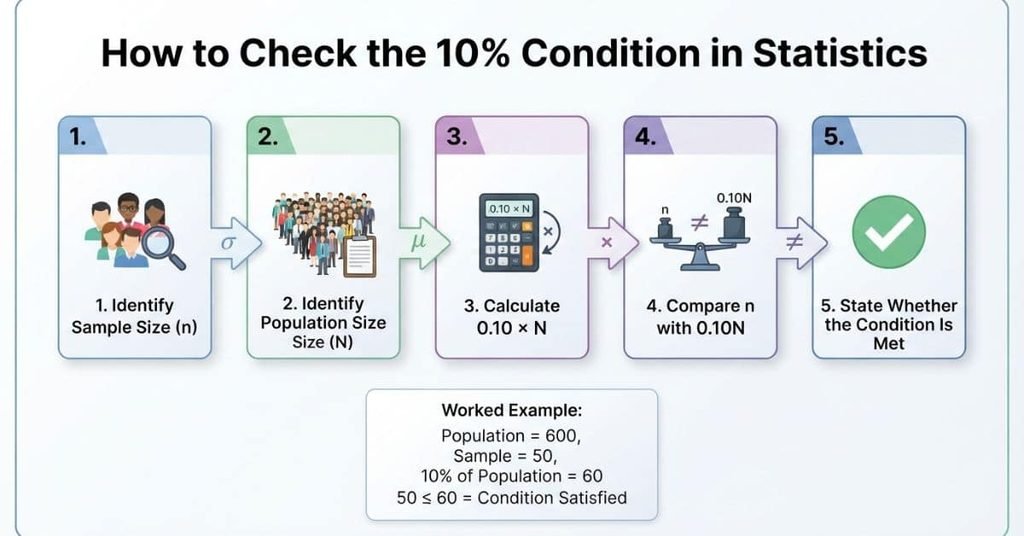
Checking the 10% condition only takes three simple steps. First, identify the sample and population sizes. Then calculate 10% of the population and compare the result with the sample size.
Step 1: Identify the Sample Size
Find n, which represents the number of individuals or items in your sample.
For example, suppose you randomly select 50 students from a school. Your sample size is n = 50.
Step 2: Identify the Population Size
Find N, which represents the total population available for sampling.
If the school has 600 students, then your population size is N = 600.
Step 3: Compare the Sample to 10% of the Population
Calculate 0.10 × N.
For this example:
0.10 × 600 = 60
Now compare the result with n = 50. Since 50 is less than 60, the sample meets the 10% condition.
Result
- n ≤ 0.10N → The condition is satisfied.
- n > 0.10N → The condition is not satisfied.
When the condition is satisfied, observations can often be treated as approximately independent for procedures that require this assumption.
10% Condition Examples
The easiest way to understand the 10% condition in statistics is to work through a few examples. Each example follows the same basic process: find 10% of the population, then compare it with the sample size.
Example 1 — Condition Is Met
Suppose a university has 2,000 students. A researcher randomly selects 100 students without replacement.
Here:
- Population size: N = 2,000
- Sample size: n = 100
First, calculate 10% of the population:
0.10 × 2,000 = 200
Now compare the sample size with 200:
100 ≤ 200
The condition is satisfied. The sample contains only 5% of the population, which is below the 10% limit.
Example 2 — Condition Is Not Met
Suppose a population contains 500 people. A researcher selects 75 people without replacement.
Here:
- Population size: N = 500
- Sample size: n = 75
Calculate 10% of the population:
0.10 × 500 = 50
Now compare the sample with 50:
75 > 50
The condition is not satisfied. The sample represents 15% of the population, which exceeds the 10% limit.
Example 3 — Exactly 10%
Suppose a population contains 1,000 people. A researcher selects 100 people without replacement.
Calculate 10% of the population:
0.10 × 1,000 = 100
Therefore:
100 = 100
The condition is satisfied because the sample is not greater than 10% of the population. An exactly 10% sample meets the condition.
These examples show an important detail: the condition uses “less than or equal to,” not just “less than.” A sample can equal 10% and still satisfy the condition.
Why Is the 10% Condition Important?
The 10% condition matters because many statistical procedures rely on observations being independent. This condition is especially relevant when you sample without replacement.
When your sample is small compared with the population, each selection has little effect on the people or items remaining. This makes it reasonable to treat the observations as approximately independent.
Independence
Sampling without replacement creates some dependence between observations. Once you select one person, that person cannot be selected again.
For example, choosing one student slightly changes the group available for the next selection. If the sample is no more than 10% of the population, that change is usually small enough for approximate independence.
Avoiding Excessive Sampling
A large sample can change the remaining population substantially. This becomes important when the sample represents a large fraction of the population.
For example, selecting 40 people from a population of 50 removes most of the available individuals. Each selection strongly affects the chances of later selections.
The 10% condition helps avoid this situation. It keeps the sample relatively small compared with the population.
Statistical Inference
AP Statistics uses statistical inference to learn about populations from samples. Many confidence intervals and hypothesis tests require observations to be independent or approximately independent.
The 10% condition can support that assumption when sampling without replacement. It does not prove complete independence, but it provides a practical guideline for treating observations as approximately independent.
AP Stats tip: When you see sampling without replacement, check the 10% condition before moving forward with a procedure that requires independence.
When Do You Need the 10% Condition?
You should check the 10% condition when sampling without replacement and a statistical procedure requires independent observations. It is a common independence check in AP Statistics.
Sampling Without Replacement
This is the primary situation where the 10% condition applies. When you sample without replacement, each selection changes the population slightly.
If the sample is no more than 10% of the population, that change remains relatively small. You can then treat the observations as approximately independent when the procedure requires that assumption.
Confidence Intervals
The 10% condition can support the independence requirement for a confidence interval. This applies when you randomly sample observations without replacement from a finite population.
For example, a survey might select 80 voters from a population of 2,000 voters. You can check whether 80 is no more than 10% of 2,000.
You should still check all other conditions required for the specific confidence interval.
Hypothesis Tests
The same idea applies to hypothesis tests involving samples without replacement. The 10% condition helps justify treating observations as approximately independent.
For AP Stats problems, identify the sampling method before deciding whether this condition applies.
Sampling Distributions
Sampling distributions describe how a statistic varies across repeated samples. Independence helps support many probability calculations involving these statistics.
When sampling without replacement, the 10% condition can help justify approximate independence. Always consider the other conditions for the specific sampling distribution or procedure.
When Do You Not Need the 10% Condition?
The 10% condition does not apply to every statistics problem. Students should identify the sampling method and procedure before using this rule.
Sampling With Replacement
If you sample with replacement, each selected item returns to the population before the next selection. This keeps the population available for each selection unchanged.
Therefore, the usual finite-population 10% check is not needed to justify independence.
Genuinely Independent Observations
Some data already come from observations that can reasonably be considered independent. For example, separate randomly selected observations may not depend on one another.
In such cases, the 10% condition may not be the relevant independence check.
Other Statistical Situations
Some statistical problems do not involve sampling a finite population without replacement. The sample-to-population relationship may therefore not require this particular condition.
For example, a study might involve experimental units assigned independently to treatment groups. The 10% condition is not automatically part of that design.
The key is to follow the conditions for the specific statistical procedure. In AP Statistics, do not add the 10% condition simply because you see a sample.
AP Stats tip: First identify how the data were collected. Then check the assumptions and conditions that apply to that procedure.
10% Condition vs. Other AP Statistics Conditions
AP Statistics problems often include several conditions. Each condition checks a different part of the statistical method.
| Condition | Purpose |
|---|---|
| 10% Condition | Supports approximate independence when sampling without replacement |
| Random Condition | Supports the use of random or representative sampling |
| Large Counts Condition | Checks success and failure counts for certain proportion procedures |
| Nearly Normal Condition | Checks whether a distribution is reasonably suitable for certain means procedures |
Do not confuse these conditions with one another. A problem may require several conditions at the same time.
For example, a confidence interval for a population proportion may require a random sample and a large enough number of successes and failures. If the sample comes from a finite population without replacement, the 10% condition may also support the independence assumption.
The correct conditions depend on the procedure and how the data were collected. Always identify the statistical method before deciding which conditions to check.
Common Mistakes With the 10% Condition
The 10% condition looks simple, but students often make small errors when applying it. These mistakes can lead to an incorrect conclusion about independence.
Confusing Sample and Population
A common mistake is using the sample size as the denominator. The population size must be the denominator when finding 10%.
If the population is 800 and the sample is 60, calculate 10% of 800, not 10% of 60.
Using 10% of the Sample
The correct calculation is:
0.10 × N
Here, N represents the population size. Never calculate 10% of the sample size when checking this condition.
For example, if N = 1,000, then:
0.10 × 1,000 = 100
The maximum sample size is therefore 100.
Reversing the Inequality
The correct condition is:
n ≤ 0.10N
The sample size must be less than or equal to 10% of the population. If the sample exceeds that amount, the condition is not satisfied.
Forgetting Sampling Without Replacement
Students sometimes apply the 10% condition to every sample. The condition commonly matters when sampling without replacement.
Always check how the observations were collected before using this rule.
Saying “Exactly 10%”
The sample does not need to equal exactly 10% of the population. Ten percent is the maximum recommended fraction under this condition.
A sample below 10% also satisfies the condition. For example, 50 observations from a population of 1,000 represent only 5%.
AP Stats tip: Remember “sample ≤ 10% of population.” This makes the direction of the inequality easier to recall.
How to Write the 10% Condition on an AP Stats Exam
Knowing the 10% condition in statistics is only part of the skill. On an AP Stats exam, you should also explain your check clearly.
A strong response shows your work and gives a clear conclusion. You can use the same five-step structure for most 10% condition questions.
Step 1: State the Sample Size
Identify the number of individuals or observations selected for the sample.
Use n for the sample size.
For example, if a study selects 80 students, then:
n = 80
Step 2: State the Population Size
Identify the total number of individuals in the population.
Use N for the population size.
If the population contains 1,000 students, then:
N = 1,000
Step 3: Calculate 10% of the Population
Multiply the population size by 0.10.
0.10 × N = 0.10 × 1,000 = 100
This gives the largest sample size allowed by the condition.
Step 4: Compare the Values
Compare the sample size with 10% of the population.
80 ≤ 100
The sample does not exceed 10% of the population.
Step 5: State Whether the Condition Is Met
Finish with a direct conclusion.
The 10% condition is satisfied because the sample size is no more than 10% of the population.
AP-Style Example Response
Suppose a researcher randomly selects 80 students from a population of 1,000 students without replacement.
A professional AP Stats response could say:
The sample size is 80, and the population size is 1,000. Ten percent of the population is 0.10(1,000) = 100. Since 80 ≤ 100, the sample is no more than 10% of the population. Therefore, the 10% condition is satisfied.
AP Stats Tip: Don’t stop after calculating 10%. Always compare the sample size and state your conclusion.
Quick Response Template
You can memorize this structure:
“The sample size is n = __ and the population size is N = __. Ten percent of the population is 0.10N = __. Since n ≤ 0.10N, the 10% condition is satisfied.”
If the sample exceeds 10%, replace the final sentence with:
“Since n > 0.10N, the 10% condition is not satisfied.”
10% Condition Practice Problems
Now it’s time to practice the 10% condition in statistics. For each problem, identify the population and sample sizes first.
Then calculate 10% of the population and compare it with the sample size.
Try each problem before opening the answer.
Problem 1
Population: 5,000
Sample: 400
Question: Is the 10% condition satisfied?
10% of the population:
0.10 × 5,000 = 500
Compare the sample with 500:
400 ≤ 500
Answer: Yes, the 10% condition is satisfied.
Problem 2
Population: 800
Sample: 100
Question: Is the 10% condition satisfied?
10% of the population:
0.10 × 800 = 80
Compare the sample with 80:
100 > 80
Answer: No, the 10% condition is not satisfied.
Problem 3
Population: 1,500
Sample: 150
Question: Is the 10% condition satisfied?
10% of the population:
0.10 × 1,500 = 150
Compare the sample with 150:
150 ≤ 150
Answer: Yes, the 10% condition is satisfied. The sample equals exactly 10% of the population.
Problem 4
Population: 300
Sample: 40
Question: Is the 10% condition satisfied?
10% of the population:
0.10 × 300 = 30
Compare the sample with 30:
40 > 30
Answer: No, the 10% condition is not satisfied.
Practice Takeaway
Remember the key comparison:
Sample size ≤ 10% of population size
If the sample is equal to or smaller than 10% of the population, the condition is satisfied. If the sample is larger than 10%, it is not satisfied.
10% Condition Quick Reference
Use this quick reference when you need to check the 10% condition in statistics during homework, quizzes, or an AP Stats exam.
10% Condition Formula
n ≤ 0.10N
| Quick Check | What to Remember |
|---|---|
| Formula | n ≤ 0.10N |
| Check | Sample size ≤ 10% of population |
| Used Mainly When | Sampling without replacement |
| Purpose | Supports approximate independence |
| AP Stats Tip | Identify the sample and population before calculating 10%. |
How to Use It
1. Find n → Identify the sample size.
2. Find N → Identify the population size.
3. Calculate 0.10N → Find 10% of the population.
4. Compare → Check whether n ≤ 0.10N.
5. Conclude → State whether the condition is satisfied.
Remember
The 10% condition does not require the sample to equal 10% of the population. Any sample that is 10% or less satisfies the condition.
AP Stats shortcut:
Sample ≤ 10% of population = condition satisfied.
Conclusion
The 10% condition in statistics helps you check whether a sample is small enough compared with its population. We covered the formula, when to use it, common mistakes, AP Stats examples, and practice problems.
Remember the key rule: n ≤ 0.10N. When sampling without replacement, this condition supports treating observations as approximately independent. Always identify the sample and population before doing the calculation.
With a little practice, checking the 10 percent condition becomes quick and straightforward. Use the five-step method to write clear answers on AP Stats exams.
Ready to practice more? Try other statistics calculators and guides on our website. You can also share this guide with a classmate preparing for AP Statistics.
Frequently Asked Questions
Find clear answers to common questions about the 10% condition in statistics and AP Statistics.
What is the 10% condition in statistics?
The 10% condition says a sample should be no more than 10% of the population. It mainly applies when you sample without replacement. The condition supports treating observations as approximately independent.
What is the 10% condition in AP Stats?
In AP Statistics, the 10% condition helps justify approximate independence when sampling without replacement. You check whether the sample size is at most 10% of the population.
What is the 10 percent condition?
The 10 percent condition means the sample should not exceed 10% of the population. In symbols, the rule is n ≤ 0.10N.
How do you calculate the 10% condition?
First, identify the sample size and population size. Then calculate 0.10 × population size. Compare that result with the sample size. If the sample is equal to or smaller than the result, the condition is satisfied.
What is the formula for the 10% condition?
The formula is n ≤ 0.10N. Here, n represents the sample size, while N represents the population size. The sample must be no more than 10% of the population.
Why is the 10% condition important?
Sampling without replacement creates some dependence between observations. A sample of 10% or less makes this effect small enough to support approximate independence in common statistical procedures.
When do you use the 10% condition?
You mainly use it when sampling without replacement from a finite population. It often appears with confidence intervals and hypothesis tests that require approximately independent observations.
Does the sample have to be exactly 10% of the population?
No. The sample can be less than 10% and still satisfy the condition. The rule requires the sample to be 10% or less, not exactly 10%.
What happens if the sample is more than 10% of the population?
The 10% condition is not satisfied. You should not use the condition to justify treating the observations as approximately independent.
Does the 10% condition apply when sampling with replacement?
Usually, no. Sampling with replacement allows an individual to be selected again, so this specific finite-population check is generally unnecessary. Always follow the conditions required by the statistical procedure.

Team ClassRank builds smart, student-friendly calculators to make grade and rank tracking simple and accurate. For questions or feedback, contact us at classrankcalculator@gmail.com.