

Table of Contents
Introduction
Many students struggle to understand how to calculate GPA with weighted grades, especially when AP and Honors classes are involved. A regular GPA may look simple, but weighted grading systems can quickly become confusing. Even small calculation mistakes can lower or inflate your GPA results.
In many U.S. schools, weighted GPAs play a major role in college admissions, scholarships, and academic rankings. Advanced courses like AP and Honors classes often carry extra GPA points because they are more challenging. However, many students still calculate their GPA incorrectly by ignoring course difficulty, using the wrong GPA scale, or combining weighted and unweighted grades.
A common mistake is treating every class equally. In reality, schools may use different GPA scales for regular, Honors, and AP courses. This can make manual GPA calculation frustrating, especially when managing multiple classes with different credit values.
Expert Tip: Before calculating your GPA, always check which GPA scale your school uses. Some schools follow a 4.0 scale, while others use a 5.0 weighted system for advanced classes.
This guide will show you how weighted GPA works in a simple and beginner-friendly way. You’ll learn the weighted GPA formula, step-by-step GPA calculation methods, grading scales, and how AP or Honors classes affect your final GPA. We’ll also compare weighted vs unweighted GPA with clear examples to help you avoid common mistakes.
Want faster results without manual calculations? Use our Weighted Grade Calculator to instantly calculate weighted grades, percentages, and GPA values accurately.
What Is a Weighted GPA?
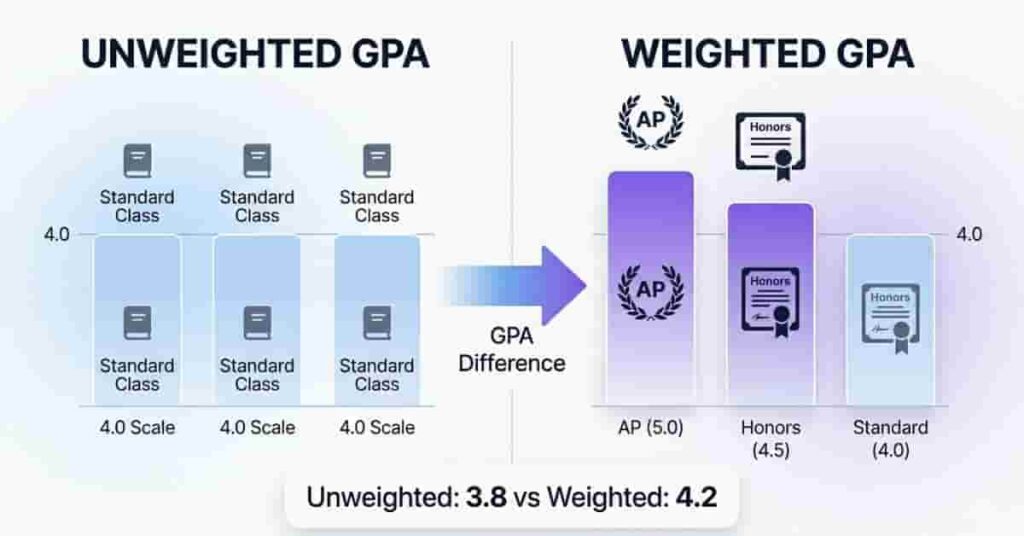
A weighted GPA is a grading system that assigns greater weight to more difficult classes. Unlike a standard GPA, a weighted GPA considers course difficulty when calculating academic performance. This means advanced classes can increase your GPA more than regular classes.
In most U.S. schools, AP and Honors courses carry additional grade points because they require more challenging coursework. For example, an A in a regular class may equal 4.0 GPA points, while an A in an AP class could equal 5.0 points. Because of this difference, students taking advanced classes often earn a higher weighted GPA.
Schools use weighted GPA systems to reward students who challenge themselves academically. A student taking difficult AP or Honors classes may work much harder than someone taking only regular courses. Weighted grading helps schools accurately reflect that extra effort.
Weighted GPA also helps colleges compare students from different academic backgrounds. Many colleges review both weighted and unweighted GPAs during admissions because they want to see not only high grades but also the rigor of the courses. Strong performance in advanced classes can improve college applications and scholarship opportunities.
👉 Instead of doing manual calculations, you can quickly check your results using our Weighted Grade Calculator for accurate GPA in seconds.
Different schools may use different weighted GPA scales. The most common systems include:
- 4.0 Scale: Often used for unweighted GPA calculations
- 5.0 Scale: Common for weighted GPA with AP and Honors classes
- 6.0 Scale: Used by some schools with heavily weighted advanced programs
Because grading systems vary, students should always check their school’s GPA policy before manually calculating their results.
Pro Tip
If your school uses weighted grades, never assume every “A” has the same GPA value. AP, IB, and Honors classes may carry higher point values than regular courses.
Weighted GPA vs Unweighted GPA
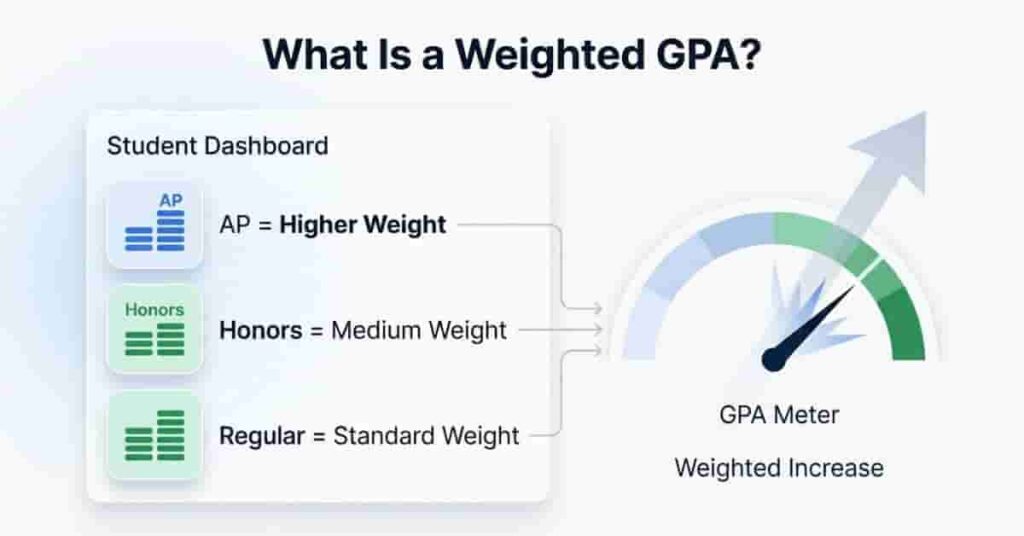
Many students confuse weighted GPA with unweighted GPA because both measure academic performance differently. Understanding the difference is important when comparing grades, applying to colleges, or planning future courses. While both systems track your academic progress, they calculate GPA in different ways.
A weighted GPA rewards students for taking more challenging classes, such as AP or Honors courses. An unweighted GPA, on the other hand, treats every course equally, regardless of difficulty. Colleges in the United States often review both GPA types to better understand a student’s performance and the rigor of their courses.
What Is an Unweighted GPA?
An unweighted GPA uses the standard 4.0 grading scale. In this system, every class receives the same value regardless of course difficulty. A regular English class and an AP Calculus class are treated equally when calculating GPA.
For example, an A grade usually equals 4.0 points, a B grade equals 3.0 points, and a C grade equals 2.0 points. The final GPA depends only on grades earned, not on how challenging the classes were.
Many schools use unweighted GPAs because they create a simple, consistent grading system. However, it may not fully reflect the effort required for advanced coursework.
What Is a Weighted GPA?
A weighted GPA gives extra GPA points to more difficult classes. Schools use this system to reward students who take challenging courses like AP, Honors, IB, or dual enrollment classes.
In a weighted grading system, advanced courses can increase your GPA above the standard 4.0 scale. For example, an A in a regular class may equal 4.0 points, while an A in an AP class may equal 5.0 points.
This system encourages students to challenge themselves academically without worrying that harder classes will hurt their GPA. Weighted GPA also helps colleges identify students who successfully handle advanced coursework.
Key Differences Between Weighted and Unweighted GPA
| Feature | Weighted GPA | Unweighted GPA |
| Course Difficulty | Included | Ignored |
| GPA Scale | 5.0 possible | Usually 4.0 |
| AP/Honors Benefit | Yes | No |
| College Evaluation | Common | Common |
Both GPA systems matter during college admissions. Weighted GPA highlights academic challenge, while unweighted GPA shows overall grade consistency. Many colleges review both together to get a clearer picture of student performance.
Weighted GPA Formula Explained
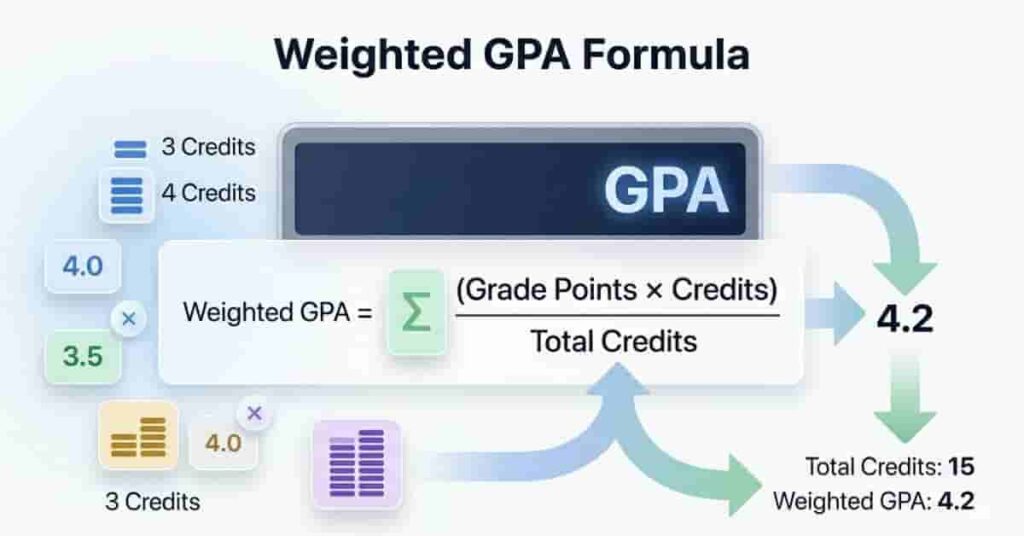
Calculating weighted GPA becomes much easier once you understand the formula behind it. Schools use this formula to combine grade points, course difficulty, and class credits into a single final GPA.
The weighted GPA formula gives greater weight to advanced courses such as AP and Honors classes. It also considers course credits, which means classes with higher credit values can affect your GPA more strongly.
Weighted GPA Formula
───────────────────────────────
Σ Total Credits
In simple terms, you multiply each course’s grade points by its credit value. Then, you add all the weighted grade points together and divide the total by the number of credits completed.
This method produces a more accurate GPA by reflecting both academic performance and course difficulty.
Grade Points
Grade points represent the numerical value of a letter grade. In weighted GPA systems, advanced courses often receive extra points compared to regular classes.
Here are common examples:
- Regular A = 4.0
- Honors A = 4.5
- AP A = 5.0
This means a student earning an A in an AP class receives a larger GPA boost than someone earning the same grade in a regular class.
Different schools may use slightly different GPA scales. Always verify your school’s grading policy before manually calculating the weighted GPA.
Pro Tip
Keep a copy of your school’s GPA conversion chart nearby when calculating grades. Small grading differences can change your final GPA result.
Course Credits
Course credits indicate the academic value of a class during a semester or school year. Classes with more credits usually affect GPA more heavily because they represent more instructional time or workload.
For example, a full-year science class may carry more credit weight than a short elective course. Because of this, high-credit classes can have a greater impact on your weighted GPA.
Schools combine course credits with grade points to create a balanced GPA system. This helps reflect both student performance and class importance more accurately.
👉 Save time and avoid errors by trying our Weighted Grade Calculator, which instantly calculates GPA, grades, and course weights for you.
How to Calculate GPA with Weighted Grades Step by Step
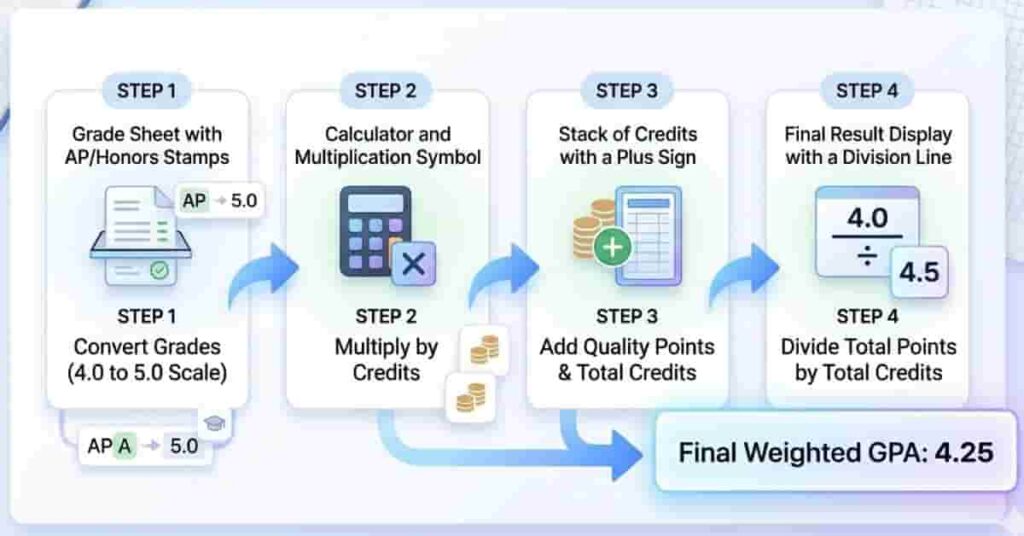
Learning how to calculate GPA with weighted grades becomes much easier when you break the process into simple steps. Most schools calculate weighted GPAs by combining grade points, course difficulty, and class credits into a single final average.
If you follow each step carefully, you can avoid common GPA mistakes and understand how AP or Honors classes affect your academic performance.
Step 1 — Convert Letter Grades into GPA Points
The first step is to convert each letter grade into GPA points using your school’s grading scale. Regular, Honors, and AP classes often use different point values because advanced courses carry extra weight.
Here is a common weighted GPA chart used in many U.S. schools:
| Grade | Standard | Honors | AP |
| A | 4.0 | 4.5 | 5.0 |
| B | 3.0 | 3.5 | 4.0 |
| C | 2.0 | 2.5 | 3.0 |
For example, earning an A in an AP class usually gives more GPA points than earning an A in a regular course. This is why advanced classes can increase your weighted GPA faster.
Different schools may use slightly different grading scales, so always verify your school’s official GPA policy before calculating results manually.
Step 2 — Multiply GPA Points by Course Credits
After converting grades into GPA points, multiply each class’s GPA value by its course credits. This step adjusts your GPA based on each class’s academic contribution.
For example, if an Honors Biology class has 4.5 GPA points and carries 1 credit, the weighted contribution equals 4.5. If a class carries more credits, it will affect your GPA more strongly.
This system helps schools balance both academic performance and course workload. High-credit classes usually have a bigger impact on your final weighted GPA.
Step 3 — Add All Weighted Grade Points
Next, add together all the weighted grade points from every class. This creates your total weighted score before finding the final GPA average.
For example, if your weighted class totals are:
- English = 4.0
- Honors Biology = 4.5
- AP Calculus = 5.0
- History = 4.0
Your combined weighted grade points would equal 17.5.
This total represents your overall academic performance across all completed courses.
Step 4 — Divide by Total Credits
The final step is dividing your total weighted grade points by the number of course credits completed.
\text{Weighted GPA} = \frac{17.5}{4}
In this example, the final weighted GPA equals 4.375.
This final number reflects:
- your grades
- course difficulty
- class credit values
Weighted GPA gives colleges and schools a better picture of how well you perform in challenging academic courses.
Weighted GPA Calculation Example
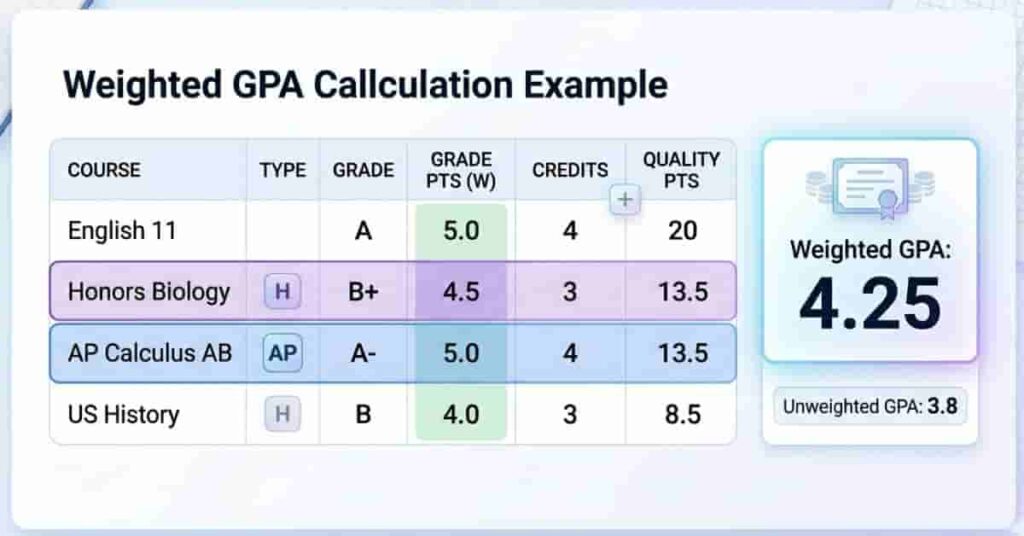
Understanding a real weighted GPA example can make the calculation process much easier. The example below shows how different course types affect GPA values when using a weighted grading system.
In this sample schedule, the student takes regular, Honors, and AP classes. Each course has its own GPA point value based on difficulty level.
| Course | Grade | Type | GPA Points | Credits |
| English | A | Regular | 4.0 | 1 |
| Biology | A | Honors | 4.5 | 1 |
| Calculus | B | AP | 4.0 | 1 |
| History | A | Regular | 4.0 | 1 |
The student earns higher GPA points in the Honors Biology class because advanced courses carry extra weight. Even though the student received a B in AP Calculus, the weighted scale still gives more value than a regular B grade in many schools.
Next, add all weighted GPA points together, then divide by total credits.
After solving the formula, the student’s weighted GPA equals 4.125.
This result shows how advanced classes can increase GPA beyond the traditional 4.0 scale. Because the student completed Honors and AP coursework, the final GPA exceeded the standard unweighted average.
Pro Tip
When comparing GPA results with friends or classmates, always check whether the GPA is weighted or unweighted. Two students may have similar grades but very different GPA calculations because of course difficulty.
Instead of manually calculating every course weight and GPA point, try our Weighted Grade Calculator to get accurate GPA estimates instantly.
How AP and Honors Classes Affect GPA
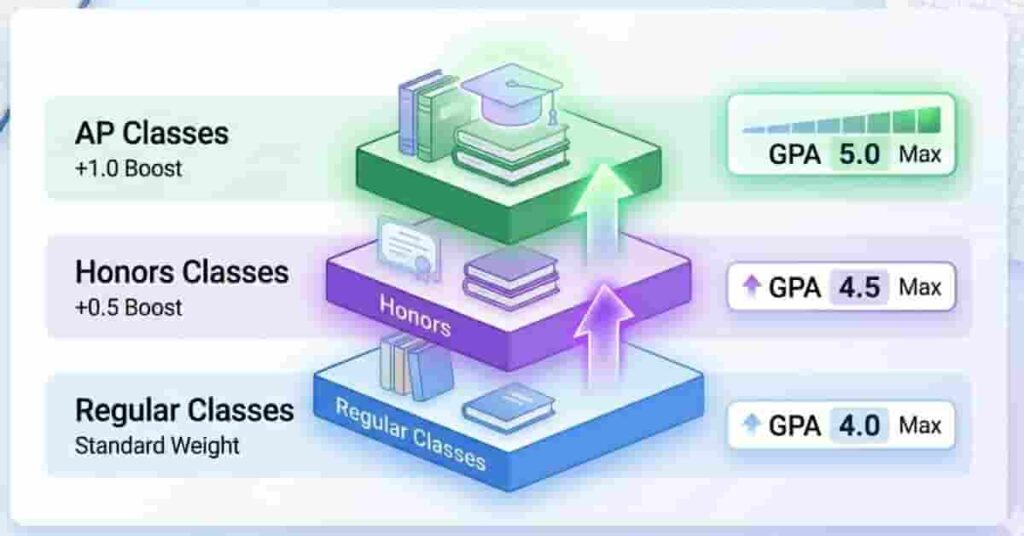
AP and Honors classes can significantly boost your weighted GPA because they carry extra academic weight. Schools use weighted grading systems to reward students who take more challenging classes rather than choosing only easier ones.
In many high schools across the United States, advanced courses earn higher GPAs than regular classes. For example, an A in a regular course may equal 4.0 points, while an A in an Honors class may equal 4.5 points. An A in an AP class can sometimes equal 5.0 points depending on the school’s grading policy.
Because of this extra weighting, students taking advanced courses often earn higher weighted GPAs even if their classes are more difficult. This system encourages academic growth and helps schools recognize students who challenge themselves.
AP classes usually carry the highest GPA boost because they are college-level courses designed by the College Board. Honors classes also increase GPA, but they may use slightly lower weighting than AP courses. Some schools also offer dual enrollment programs, where students earn both high school and college credit simultaneously. Dual enrollment classes may also receive weighted GPA benefits depending on school policy.
Colleges often pay close attention to advanced coursework during admissions. A strong weighted GPA combined with difficult classes can demonstrate academic rigor, discipline, and college readiness. Admissions officers usually want to see students succeed in challenging courses rather than earn easy grades in less demanding classes.
However, the course’s difficulty should remain balanced. Taking too many advanced classes at once can become overwhelming and may negatively affect grades if workload management becomes difficult.
Common Weighted GPA Scales
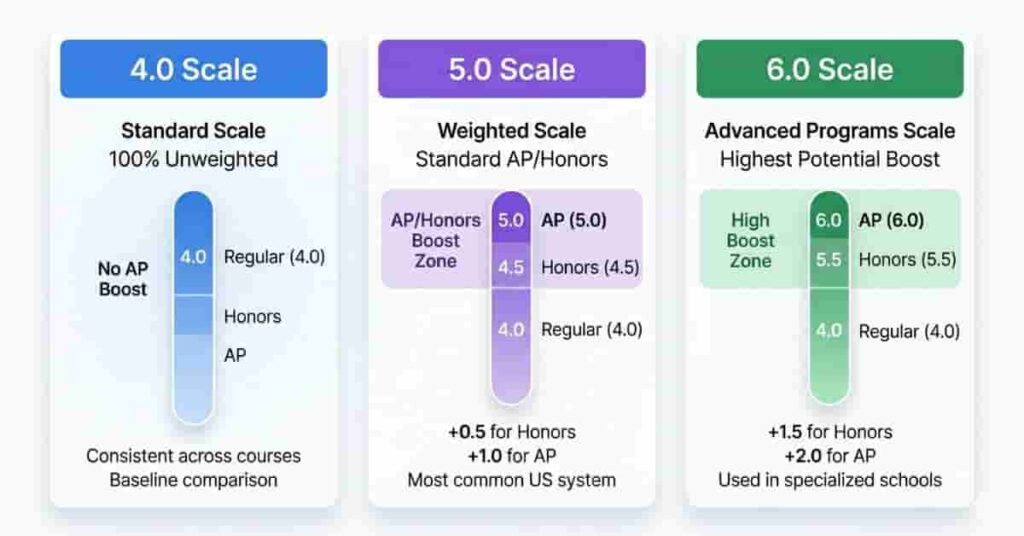
Schools in the United States do not always use the same GPA system. Some schools follow a traditional 4.0 scale, while others use weighted scales like 5.0 or even percentage-based grading systems. Understanding your school’s GPA scale is important before manually calculating weighted grades.
Different GPA scales can change how grades appear on transcripts and college applications. This is why two students with similar grades may have different GPA results depending on their school’s grading policy.
4.0 GPA Scale
The 4.0 GPA scale is the most common grading system in U.S. schools and colleges. It is often used for unweighted GPA calculations because every class is given equal weight regardless of difficulty.
In this system:
- A = 4.0
- B = 3.0
- C = 2.0
- D = 1.0
Most regular classes follow the standard 4.0 scale. Even if students take advanced coursework, some schools still report an unweighted GPA separately using this system.
The 4.0 scale makes GPA comparisons simple and easy to understand. However, it may not fully reflect course rigor because advanced classes receive no additional weight.
5.0 GPA Scale
The 5.0 GPA scale is commonly used for weighted GPA calculations. Schools using this system reward students for taking AP, Honors, IB, or dual enrollment classes.
Under a weighted 5.0 scale:
- Regular A may equal 4.0
- Honors A may equal 4.5
- AP A may equal 5.0
This system gives extra credit for difficult coursework and encourages students to challenge themselves academically. As a result, the weighted GPA can exceed the traditional 4.0 limit.
Many competitive high schools use the 5.0 scale because it better reflects academic difficulty and student effort.
100-Point GPA Scale
Some schools use a 100-point grading scale instead of a traditional GPA scale. In this system, grades are reported as percentages rather than GPA points.
For example:
- 90–100 = A range
- 80–89 = B range
- 70–79 = C range
Schools using percentage grading may still convert final scores into weighted GPA values later. Advanced courses can sometimes receive bonus percentage points to reflect increased difficulty.
Percentage-based systems provide a more detailed picture of academic performance by showing exact scores rather than rounded GPA averages.
Weighted GPA Conversion Chart
Many schools convert percentage grades into GPA points using a weighted grading scale. This chart helps students understand how letter grades and percentages usually connect to weighted GPA values.
Keep in mind that GPA conversion systems can vary by school district, state, or college. Some schools use slightly different ranges for AP, Honors, or dual enrollment classes. Always check your school’s official grading policy for the most accurate conversion method.
Here is a common weighted GPA conversion chart used in many U.S. schools:
| Percentage | Letter Grade | Weighted GPA |
| 97–100 | A+ | 5.0 |
| 93–96 | A | 4.0–5.0 |
| 90–92 | A- | 3.7–4.7 |
In weighted grading systems, advanced classes often earn additional GPA points than regular courses. For example, a student earning an A in an AP class may receive a higher GPA value than a student earning the same grade in a standard course.
This conversion system helps schools measure both academic performance and course difficulty. It also gives colleges a clearer view of how students perform in challenging classes.
However, not every school follows the same GPA scale. Some schools cap weighted GPA at 5.0, while others may use 5.5 or 6.0 systems for advanced coursework.
Common Weighted GPA Mistakes Students Make
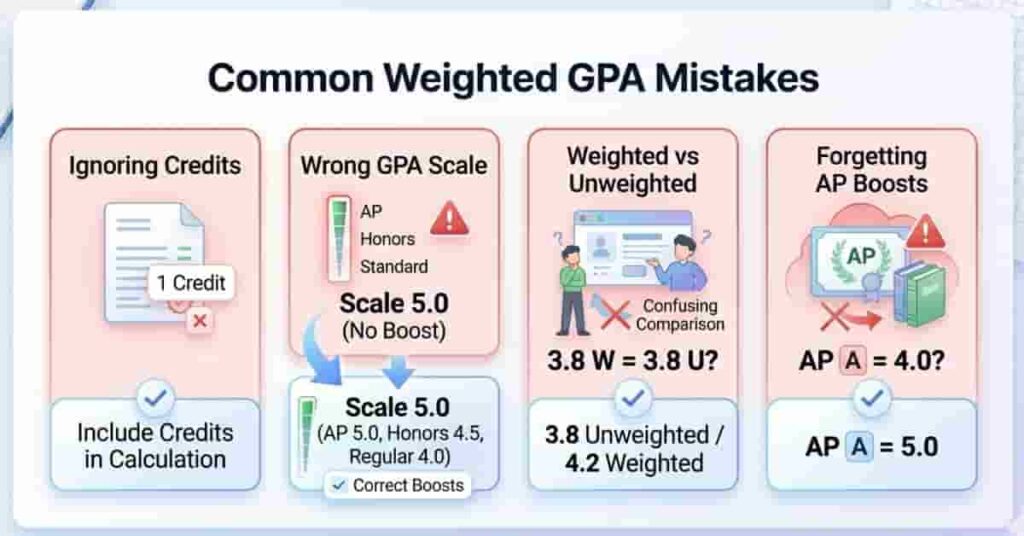
Many students make small mistakes in their GPA calculations that lead to incorrect results. Weighted GPA systems can become confusing because schools often use different grading scales, course weights, and credit values. Even one small error can affect your final GPA significantly.
One of the most common mistakes is ignoring course credits during calculation. Some students simply average their grades without considering how much each class contributes to their academic performance. Classes with higher credit values usually have a stronger impact on weighted GPA.
Another common problem is using the wrong GPA scale. Some schools follow a standard 4.0 system, while others use weighted 5.0 or 6.0 scales for AP and Honors courses. Calculating GPA with the wrong scale can produce inaccurate results.
Students also frequently confuse weighted GPA with unweighted GPA. An unweighted GPA treats every course equally, while a weighted GPA gives extra value to difficult classes. Mixing the two systems often yields misleading averages.
Forgetting AP or Honors boosts is another major mistake. Advanced classes usually carry additional GPA points, so treating them like regular classes can incorrectly lower the final weighted GPA.
Simple math errors also happen during manual calculations. Students may:
- Add grade points incorrectly.
- divide by the wrong number of credits
- forget weighted course adjustments
- Use outdated GPA conversion charts.
These mistakes can create confusion during college applications, scholarship reviews, or academic planning.
Why Weighted GPA Matters for College Admissions
Weighted GPA plays an important role in college admissions because it helps schools measure both academic performance and course difficulty. Many colleges in the United States want students who challenge themselves with advanced classes instead of taking only easier courses.
In competitive admissions, a strong weighted GPA can help students stand out from other applicants. Colleges often compare students from different schools and academic backgrounds, so a weighted GPA gives admissions officers a clearer picture of how difficult a student’s coursework was.
Advanced classes such as AP, Honors, IB, and dual enrollment courses demonstrate academic rigor. This means students are willing to take challenging subjects and manage higher workloads successfully. Strong performance in difficult classes can demonstrate discipline, consistency, and college readiness.
Weighted GPA also matters during scholarship evaluation. Many merit-based scholarships consider GPA when selecting recipients. A higher weighted GPA may improve eligibility for academic scholarships, honors programs, and competitive university applications.
Colleges usually review both weighted and unweighted GPAs together. The unweighted GPA shows overall grade consistency, while the weighted GPA highlights course difficulty and advanced academic effort. Admissions officers often compare both numbers to better understand a student’s full academic profile.
However, GPA is usually not the only factor colleges review. Many schools also consider:
- standardized test scores
- extracurricular activities
- leadership experience
- recommendation letters
- personal essays
Still, a strong weighted GPA remains one of the most important academic indicators during the admissions process.
Can Weighted GPA Be Higher Than 4.0?
Yes, a weighted GPA can be higher than 4.0. This usually happens when schools award extra GPA points for advanced courses such as AP, Honors, IB, or dual enrollment classes.
In a traditional unweighted GPA system, the highest GPA is normally 4.0 because every class uses the same grading scale. However, weighted GPA systems give more weight to more difficult courses, reflecting academic rigor more accurately.
For example, many schools use:
- 4.5 points for Honors classes
- 5.0 points for AP classes
- higher scales in some advanced programs
Because of these extra points, students taking multiple advanced courses may earn a weighted GPA above 4.0.
The maximum weighted GPA depends on the school’s grading scale. Some schools cap GPA at 5.0, while others may use 5.5 or even 6.0 scales for heavily weighted coursework. This is why GPA comparisons between schools can sometimes be misleading.
AP and Honors classes play a major role in boosting weighted GPA because they carry additional academic value. Students who perform well in challenging courses often see their GPA increase faster than students taking only regular classes.
However, earning a higher weighted GPA still requires strong grades. Advanced coursework alone will not improve GPA if overall academic performance remains weak.
Pro Tip
Before comparing GPA scores with classmates or online examples, check whether the GPA is weighted or unweighted and review the school’s grading scale carefully.
Is Weighted GPA Better Than Unweighted GPA?
Weighted GPA is not necessarily better than unweighted GPA, because the two systems measure different aspects of academic performance. Schools and colleges often review both together to better understand a student’s grades.
A weighted GPA reflects the difficulty and rigor of courses. It rewards students for taking challenging classes like AP, Honors, IB, or dual enrollment courses. Students who succeed in advanced classes may earn higher weighted GPAs because these courses carry extra grade points.
An unweighted GPA focuses only on grade consistency. Every class receives equal value regardless of difficulty, which simplifies the grading system and makes comparisons across students easier.
Colleges usually want to see both strong grades and challenging coursework. A high weighted GPA can show academic ambition, while a strong unweighted GPA demonstrates consistent performance across all subjects.
For example:
- A student with difficult AP courses and solid grades may impress colleges through academic rigor.
- A student with excellent grades in regular classes may show strong consistency and discipline.
Admissions officers often review transcripts closely rather than relying on GPA alone. They compare:
- course difficulty
- grade trends
- GPA type
- academic balance
Because grading systems vary between schools, colleges typically evaluate GPA within the context of the student’s school environment.
conclusion
Understanding how to calculate GPA with weighted grades can help you make smarter academic decisions throughout high school. In this guide, you learned how weighted GPA works, how AP and Honors classes affect GPA, and how to calculate weighted GPA step by step.
Weighted grading systems reward students who take challenging courses and maintain strong academic performance. However, accurate calculation is important because small mistakes with credits or GPA scales can change your final results.
Using a weighted GPA calculator is often the easiest way to save time and avoid manual errors. It also helps students plan future grades and track academic progress more confidently.
Use our free Weighted Grade Calculator to quickly calculate weighted grades, GPA averages, and final scores with better accuracy. You can also explore more grading guides and calculators on our website to simplify your academic planning.

Team ClassRank builds smart, student-friendly calculators to make grade and rank tracking simple and accurate. For questions or feedback, contact us at classrankcalculator@gmail.com.