
High School GPA Calculator (Weighted & Unweighted) – Calculate GPA Instantly

Calculate your high school GPA quickly and accurately with our free High School GPA Calculator. Whether you’re tracking academic progress, preparing for college admissions, applying for scholarships, or simply monitoring your grades, this calculator helps you determine your GPA in seconds.

High school GPA (Grade Point Average) is one of the most important academic metrics used by schools, colleges, universities, and scholarship programs. By converting your course grades into grade points and averaging them based on credits earned, GPA provides a clear picture of your overall academic performance.

Use the calculator above to calculate your GPA instantly and gain a better understanding of where you stand academically.

What Is a High School GPA Calculator?

A High School GPA Calculator is an academic tool that helps students calculate their Grade Point Average based on grades earned in different courses. Instead of manually converting letter grades into grade points and performing calculations by hand, students can enter their grades and credits to receive an instant GPA result.

Most high schools use either an unweighted GPA scale or a weighted GPA scale. The calculator can simplify both methods and provide accurate results based on the information entered.

Students commonly use GPA calculators to:

  • Track academic performance

  • Set GPA goals

  • Monitor semester progress

  • Prepare for college applications

  • Qualify for scholarships

  • Improve class rank standing

Because GPA plays a major role in future educational opportunities, regularly monitoring it can help students make informed academic decisions.

High School GPA Calculator
Live Calculator

High School GPA
Calculator

Calculate your Unweighted & Weighted GPA in seconds with real-time analytics and smart insights.

0.00
GPA
No Courses
Unweighted GPA
4.0 Standard Scale
Weighted GPA
With Honors/AP Boost
Total Credits
0
Credit Hours
Course Builder
Course NameGradeCreditsType
Visual Analytics
Grade Distribution
GPA Trend
Credits by Course Type
What-If Simulator

Add a hypothetical next course to project your GPA.

Projected GPA
Smart Insights
Settings
GPA Scale
Standard or 5.0 weighted max
Credit System
Semester or full-year
Honors / AP Boost
Include type bonus in weighted GPA
Export & Share
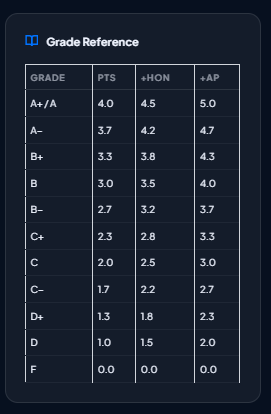
Grade Reference
GradePts+Hon+AP
A+ / A4.04.55.0
A−3.74.24.7
B+3.33.84.3
B3.03.54.0
B−2.73.23.7
C+2.32.83.3
C2.02.53.0
C−1.72.22.7
D+1.31.82.3
D1.01.52.0
F0.00.00.0

How GPA Works

What is GPA?

Grade Point Average (GPA) summarizes your academic performance by converting letter grades to numerical points and averaging them weighted by credit hours.

Unweighted GPA

Uses a standard 4.0 scale. An "A" = 4.0 regardless of course difficulty. Most colleges report unweighted GPA for comparison.

Weighted GPA

Gives bonus points for harder courses. Honors adds +0.5 and AP/IB adds +1.0 to grade points, allowing GPAs above 4.0 (up to 5.0).

Formula

  • Multiply each course's grade points × credit hours
  • Sum all products
  • Divide by total credit hours

Grade Point Scale

LetterPercentagePoints
A+ / A93–100%4.0
A−90–92%3.7
B+87–89%3.3
B83–86%3.0
B−80–82%2.7
C70–76%2.0
D60–69%1.0
F<60%0.0

How to Calculate High School GPA (Step-by-Step Guide)

Start by entering all your courses, grades, and credits into the GPA calculator. Each subject is converted into grade points and weighted based on credit hours to ensure accurate results. Once all data is added, the calculator automatically computes your unweighted and weighted GPA in real time, helping you quickly understand your overall academic performance without manual calculations.

Step 1 — Enter Your Courses

Student entering multiple subjects into high school GPA calculator course builder

Start by adding all your courses into the GPA calculator. This includes every subject that contributes to your final GPA such as Math, English, Science, History, and electives.

Each course should be entered separately so the calculator can track them individually and ensure accurate GPA calculation. Without proper course entry, the GPA result may not reflect your true academic performance.

Step 2 — Select Letter Grades

Selecting letter grades in high school GPA calculator dropdown interface

After adding courses, select the correct letter grade for each subject. Common grades include A, B, C, D, and F, sometimes with plus or minus variations like A-, B+.

These letter grades are automatically converted into grade points by the calculator. This step is important because even a small change in grade can significantly affect your overall GPA.

Step 3 — Add Credits

Adding credit hours for courses in GPA calculator input fields

Now enter the credit hours for each course. Credits represent how much weight a subject carries in your GPA calculation.

Most courses are worth 1 credit, but some may be 0.5 or higher depending on your school system. Higher credit courses have a greater impact on your final GPA.

Step 4 — Select Course Type (Regular, Honors, AP/IB)
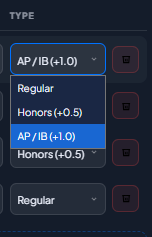
Selecting course type honors AP IB weighted GPA calculator interface

Choose the type of each course based on difficulty level. Standard courses are marked as Regular, while advanced classes like Honors or AP/IB receive additional weight.

This step is important for calculating Weighted GPA. Honors and AP courses can boost your GPA above the standard 4.0 scale, depending on your school system.

Step 5 — Calculate GPA Instantly
High school GPA calculator showing real-time weighted and unweighted GPA results

Once all data is entered, the calculator automatically computes your GPA in real time. You will see both Unweighted GPA and Weighted GPA along with total credits and performance indicators.

This gives you a clear picture of your academic standing without any manual calculations.

Step 6 — View Analytics & Insights
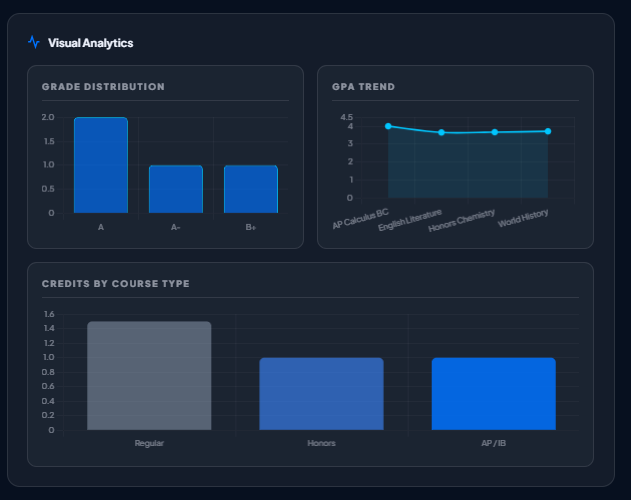
GPA analytics dashboard showing charts grade distribution and performance insights

The calculator also provides visual analytics such as grade distribution, GPA trends, and performance breakdown by course type.

These insights help you understand your strengths and weaknesses so you can improve your academic performance strategically.

Step 7 — What-If GPA Simulator
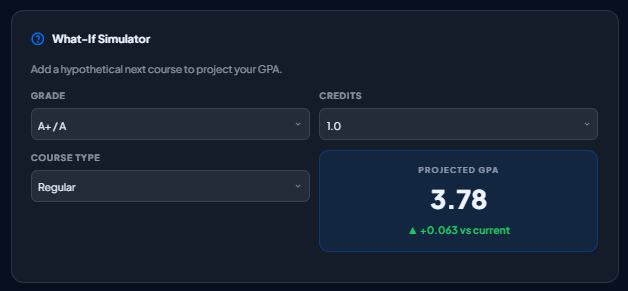
What-if GPA simulator showing projected GPA changes with future grades

This feature allows you to add hypothetical future grades to predict your potential GPA. It helps you understand what you need to achieve your target GPA.

You can test different scenarios and plan your academic improvement more effectively.

Step 8 — Export & Share Results

GPA calculator export options including PDF download and share link buttons

Finally, you can export your GPA report as a PDF, copy your summary, or share your results via link.

This is useful for academic records, college applications, or personal tracking of your progress.

Why GPA Matters in High School

Your GPA is more than just a number. It reflects your academic consistency and performance across multiple courses over time.

College Admissions

Many colleges and universities consider GPA one of the most important factors during the admissions process. A strong GPA demonstrates academic readiness and commitment.

Scholarship Opportunities

Numerous scholarships include minimum GPA requirements. Maintaining a competitive GPA may increase eligibility for merit-based financial aid.

Academic Recognition

Honor rolls, academic awards, and advanced academic programs often use GPA as part of their qualification criteria.

Class Rank

Many schools calculate class rank using cumulative GPA. Improving your GPA can positively affect your standing among classmates.

Future Academic Planning

Knowing your GPA helps you determine whether you’re on track to meet graduation requirements, college admission standards, and personal academic goals.

Weighted vs Unweighted GPA

Understanding the difference between weighted and unweighted GPA is essential when evaluating academic performance.

GPA TypeDescription
Unweighted GPAUses a standard 4.0 scale regardless of course difficulty.
Weighted GPAAssigns additional value to Honors, AP, IB, or advanced courses.

Unweighted GPA

An unweighted GPA treats every class equally. An A grade typically equals 4.0 grade points regardless of whether the course is standard or advanced.

Weighted GPA

A weighted GPA rewards students for taking more challenging courses. Advanced classes may receive additional grade points, allowing GPAs to exceed 4.0 in some schools.

Because grading policies vary between schools, students should verify which GPA system their institution uses.

High School GPA Scale

While grading systems may vary slightly, the following GPA scale is commonly used by many schools.

Letter GradeGPA Value
A+4.0
A4.0
A-3.7
B+3.3
B3.0
B-2.7
C+2.3
C2.0
C-1.7
D1.0
F0.0

This GPA conversion chart provides a general reference for understanding how letter grades contribute to overall GPA calculations.


High School GPA Formula

The basic GPA formula is straightforward:

GPA = Total Grade Points ÷ Total Credits Earned

To calculate GPA manually:

  1. Convert each letter grade into grade points.

  2. Multiply grade points by course credits.

  3. Add all grade points together.

  4. Add all course credits together.

  5. Divide total grade points by total credits.

Although the formula is simple, calculating multiple courses manually can become time-consuming, which is why many students prefer using a GPA calculator.

High School GPA Calculation Example

Consider the following example:

CourseGradeCredit
MathematicsA1
EnglishB1
ScienceA1
HistoryB1

Grade points:

  • A = 4.0

  • B = 3.0

Total grade points:

4 + 3 + 4 + 3 = 14

Total credits:

1 + 1 + 1 + 1 = 4

GPA:

14 ÷ 4 = 3.5

In this example, the student’s GPA is 3.5.


What Is a Good High School GPA?

The definition of a “good GPA” varies depending on academic goals, school competitiveness, and college admission requirements.

Below Average GPA

A GPA below 2.5 may limit some academic opportunities and scholarship options.

Good GPA

A GPA between 3.0 and 3.4 is generally considered good and demonstrates solid academic performance.

Very Good GPA

A GPA between 3.5 and 3.8 is competitive for many colleges and scholarship programs.

Excellent GPA

A GPA of 3.9 to 4.0 reflects exceptional academic achievement and may strengthen college applications significantly.

Students aiming for selective colleges often strive to maintain the highest GPA possible throughout high school.

Tips to Improve Your High School GPA

Improving GPA requires consistent effort and effective study habits.

Focus on Lower Grades First

Improving weaker subjects can have a significant impact on overall GPA.

Stay Organized

Use planners, calendars, and assignment trackers to avoid missing deadlines.

Develop Better Study Habits

Create a structured study schedule and review material regularly.

Seek Academic Support

Tutors, teachers, and study groups can help improve understanding of challenging subjects.

Monitor GPA Regularly

Tracking GPA each semester helps identify areas needing improvement before they become larger problems.

Small improvements across multiple courses can lead to meaningful GPA growth over time.

Related Academic Calculators

Students often use multiple academic calculators to track grades and performance throughout the school year.

You may also find these tools useful:

  • Final Grade Calculator

  • Semester GPA Calculator

  • College GPA Calculator

  • Cumulative GPA Calculator

  • Weighted GPA Calculator

  • Class Rank Calculator

  • Grade Percentage Calculator

Using multiple academic planning tools together provides a clearer picture of overall academic progress.

📌 Frequently Asked Questions :

How do I calculate my high school GPA?

Convert each course grade into grade points, multiply by credits, add all grade points together, and divide by total credits earned.

A GPA above 3.0 is generally considered good, while a GPA above 3.5 is often considered highly competitive.

Yes. A 3.5 GPA is considered strong and may be competitive for many colleges and universities.

An unweighted GPA uses a standard scale, while a weighted GPA provides additional points for advanced courses.

Yes. GPA is one of the primary academic factors considered during college admissions.

Many scholarship programs use GPA requirements as part of their eligibility criteria.

Students should monitor GPA after each grading period or semester to track academic progress accurately.

A high school GPA is one of the most important indicators of academic performance. Whether your goal is improving grades, qualifying for scholarships, increasing class rank, or preparing for college admissions, understanding and monitoring your GPA is essential.

Use our High School GPA Calculator to instantly calculate your GPA, evaluate academic progress, and make informed decisions that support your educational goals.

Scroll to Top