

Table of Contents
Introduction
Why does your frequency table still have gaps?
Many beginners in the USA find grouped data challenging. Often, they skip a crucial step: using class boundaries. Without these, your data can seem right but produce incorrect graphs or distributions.
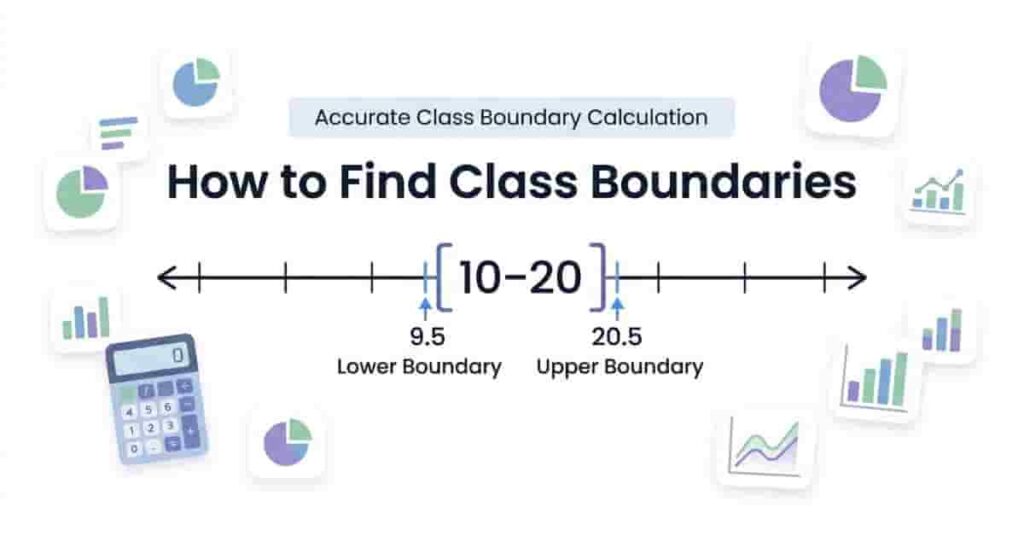
Learn how to find class boundaries here. This step transforms separated intervals into seamless, continuous data and is essential for histograms and frequency distributions.
Follow this guide to calculate class boundaries step by step. See clear examples to apply the concept confidently. By the end, you’ll avoid mistakes and manage grouped data like a pro.
“Stop worrying about gaps or mistakes in your data! Try our Class Boundaries Calculator to get instant, accurate boundaries for any dataset.”
What Are Class Boundaries?
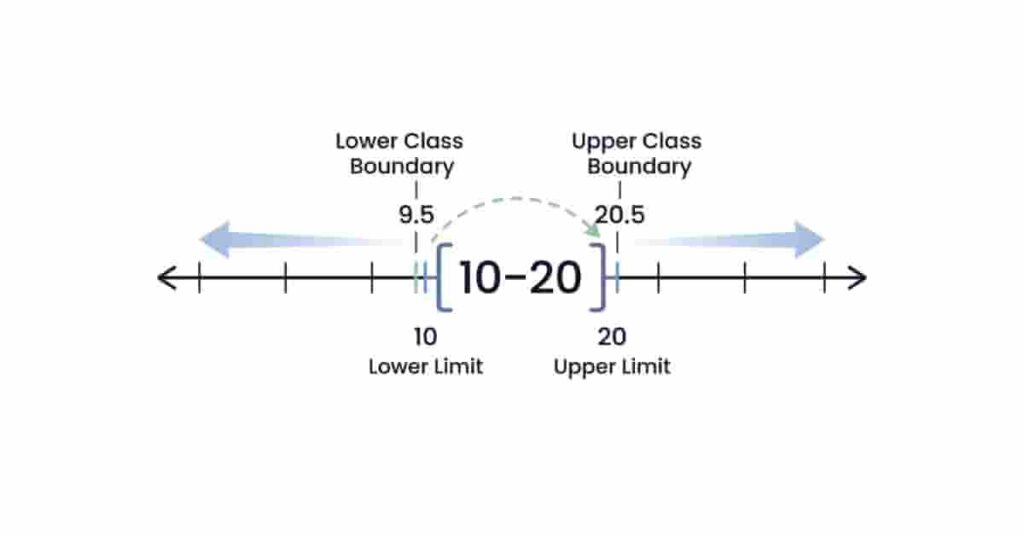
Class boundaries in statistics are the true limits of a class interval. They show where one class actually ends, and the next begins, without any gaps. This small adjustment makes your data continuous and more accurate.
To find class boundaries, slightly adjust class limits. This removes spaces between intervals. For example, 10–20 and 20–30 are not connected unless boundaries are set.
Instead of using exact limits, boundaries extend each class slightly. This ensures there is no missing value between intervals. As a result, your grouped data becomes smoother and ready for graphs such as histograms.
Use class boundaries when working with frequency distributions, especially with whole numbers. Without boundaries, your analysis may look right but have hidden gaps.
🔑 Key Takeaways
- Class boundaries are the true limits of class intervals.
- They remove gaps between classes.
- They make grouped data continuous.
- They improve accuracy in statistical graphs.
💡 Pro Tips
When using whole numbers, apply a small adjustment (e.g., 0.5). This ensures connected class intervals.
Why Are Class Boundaries Important?
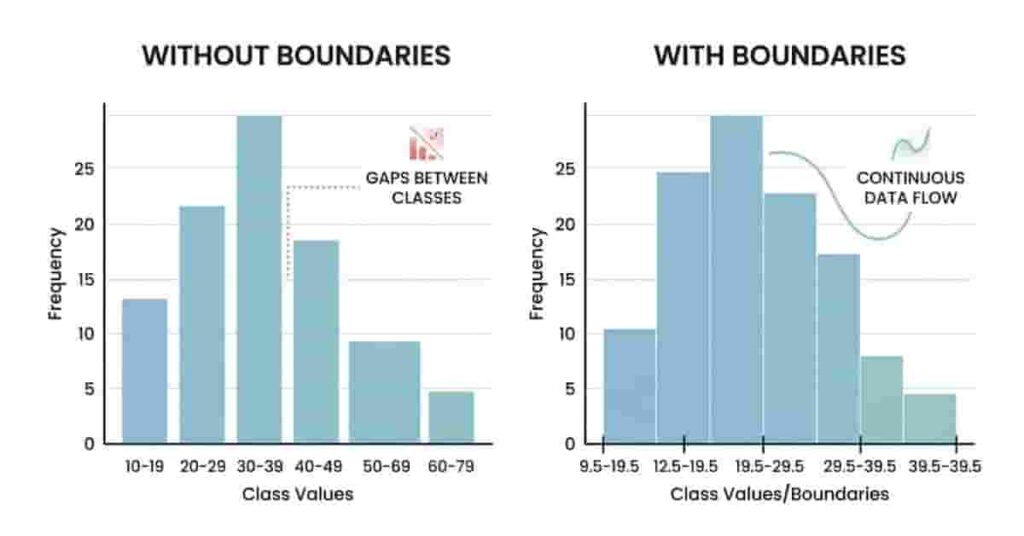
Class boundaries make your data accurate and reliable. Without them, grouped data looks right but hides gaps. These gaps cause incorrect graphs and misleading results.
Class boundaries keep data continuous. They connect each class interval smoothly to the next, which is crucial for histograms where bars must touch.
They boost accuracy in frequency distributions. With proper boundaries, each value belongs to only one class, avoiding overlap and confusion.
Another important reason is gap removal. Class limits like 10–20 and 20–30 seem connected, but there is actually a small gap between them. Boundaries fix this issue by slightly adjusting the limits, making your dataset complete.
To sum up, class boundaries help you present data clearly and correctly. They make sure your analysis shows real patterns, not mistakes from missing connections.
🔑 Key Takeaways
- Class boundaries ensure smooth, continuous data.
- They improve accuracy in frequency distributions.
- They remove gaps between class intervals.
- They make graphs like histograms more reliable.
💡 Pro Tips
Always use class boundaries before drawing a histogram. Even small gaps can distort your data visually.
“Want to save time and avoid manual errors? Use our Class Boundaries Calculator right here and see your lower and upper boundaries calculated instantly.”
Class Boundaries Formula (Easy Method)
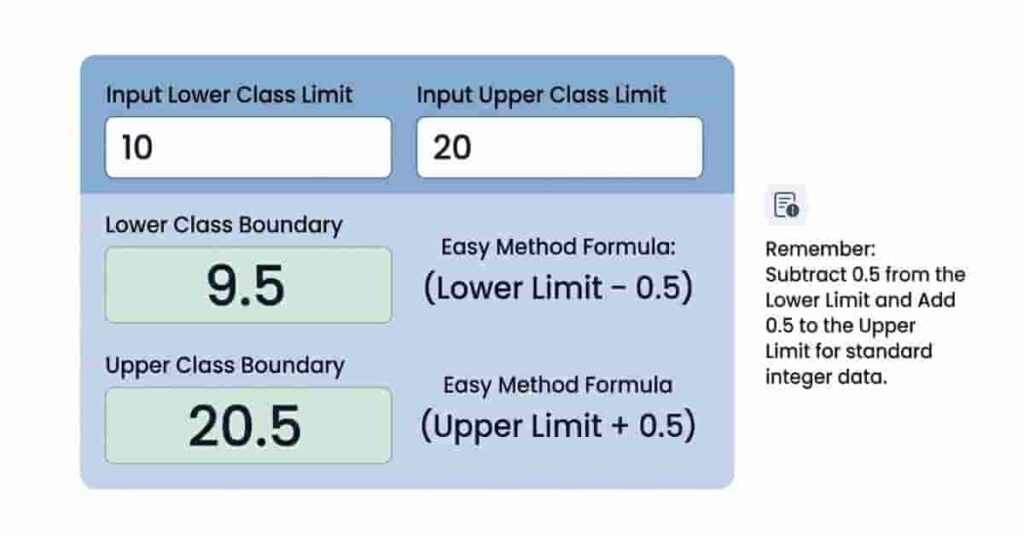
The class boundaries formula is the quickest way to remove gaps between class intervals. It uses a small adjustment to turn class limits into true boundaries. This method works best when your data uses whole numbers.
Lower Boundary=Lower Limit−0.5
Upper Boundary=Upper Limit+0.5
To determine class boundaries, you subtract 0.5 from the lower limit and add 0.5 to the upper limit. This creates a continuous range with no gaps between classes.
For example, if your class interval is 10–20:
- Lower boundary = 10 − 0.5 = 9.5
- Upper boundary = 20 + 0.5 = 20.5
Now, this class connects smoothly with the next interval. There is no gap between 20.5 and the next lower boundary.
This formula is simple but very important in statistics. It ensures your grouped data is accurate and ready for charts like histograms. Without it, your results may look fine but still contain small errors.
👉 Note: This method applies when the gap between values is 1 (whole numbers).
🔑 Key Takeaways
- The formula adjusts class limits into true boundaries.
- Subtract 0.5 from the lower limit.
- Add 0.5 to the upper limit.
- It removes gaps and improves accuracy.
💡 Pro Tips
If your data uses decimals or a different gap, adjust by half of that gap instead of 0.5.
How to Find Class Boundaries (Step-by-Step)
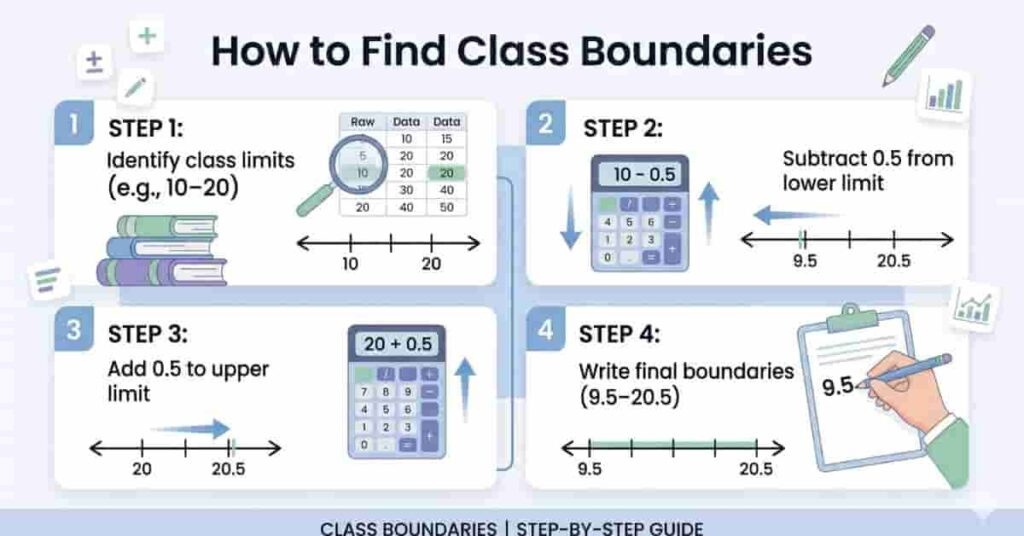
If you’re wondering how to find class boundaries, follow these simple steps. This method works well for most grouped data with whole numbers. It ensures your intervals connect smoothly without gaps.
Step-by-Step Method
Step 1: Identify class limits
Start by locating the lower and upper limits of each class interval. For example, in 10–20, 10 is the lower limit, and 20 is the upper limit.
Step 2: Subtract 0.5 from the lower limit
Take the lower limit and subtract 0.5. This gives you the lower boundary.
Example: 10 − 0.5 = 9.5
Step 3: Add 0.5 to the upper limit
Now add 0.5 to the upper limit. This gives you the upper boundary.
Example: 20 + 0.5 = 20.5
Step 4: Write the final boundaries
Combine both values to form the class boundaries.
So, 10–20 becomes 9.5–20.5
This process shows how to clearly and quickly identify class boundaries. Repeat these steps for each class interval in your dataset.
🔑 Key Takeaways
- Identify lower and upper class limits first.
- Subtract 0.5 from the lower limit.
- Add 0.5 to the upper limit.
- Write the new continuous boundaries.
💡 Pro Tips
Apply the same steps to all classes to keep your data consistent. Even one missed boundary can create gaps.
Example of Finding Class Boundaries
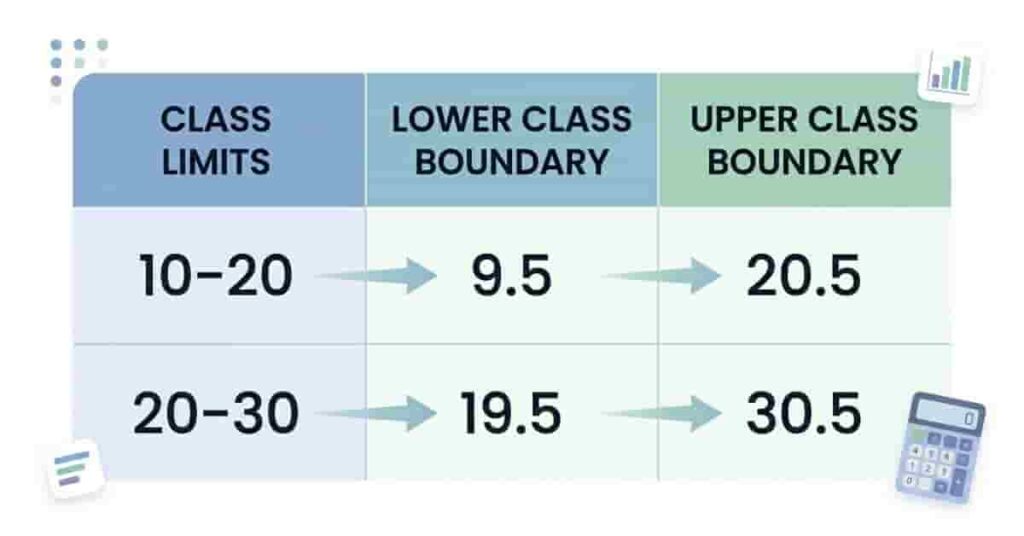
Here’s a simple example to show how to find class boundaries step by step.
Example Table
| 10 – 20 | 9.5 | 20.5 |
| 20 – 30 | 19.5 | 30.5 |
In this example, each class interval is adjusted using the standard method. We subtract 0.5 from the lower limit and add 0.5 to the upper limit. This removes the gap between 20 and the next class.
Notice how the upper boundary of the first class (20.5) connects smoothly with the next class. This creates a continuous dataset with no missing values. That’s why finding class boundaries in statistics is so important.
You can apply this same method to any grouped data. Just follow the same steps for each class interval, and your data will be accurate and ready for graphs.
🔑 Key Takeaways
- Class boundaries remove gaps between intervals.
- Each class connects smoothly to the next.
- The method stays the same for all intervals.
💡 Pro Tips
Use real-life data, such as test scores or ages, to practice. It makes learning class boundaries much easier.
How to Find Class Boundaries in Grouped Data
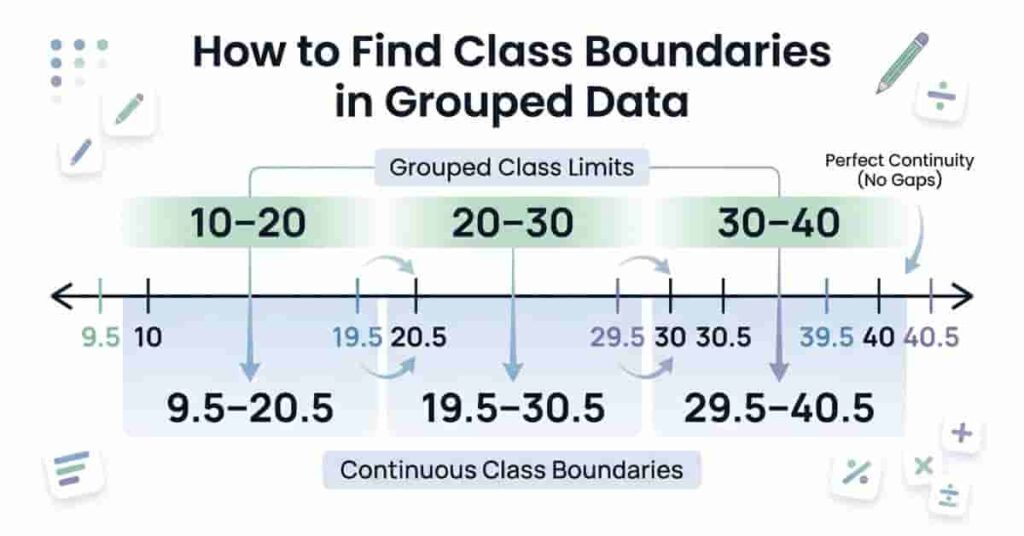
Finding the class boundaries for grouped data follows the same simple method used for single intervals. The goal is to make all classes continuous, with no gaps between them. This is important when working with frequency tables and histograms.
Start by listing all your class intervals clearly. To find each class boundary, use this formula:
Subtract 0.5 from every lower class limit and add 0.5 to every upper class limit. This ensures each class connects smoothly with the next one.
For example, if your grouped data includes:
- 10–20
- 20–30
- 30–40
You will convert them into:
- 9.5–20.5
- 19.5–30.5
- 29.5–40.5
Now, there are no gaps between the classes. This makes your data continuous and more accurate for analysis.
When learning how to find class boundaries in grouped data, consistency is key. You must apply the same adjustment to every interval. Even one mistake can create errors in your final graph or distribution.
🔑 Key Takeaways
- Apply the same formula to every class interval.
- Subtract 0.5 from the lower limits.
- Add 0.5 to upper limits.
- Ensure all classes connect without gaps.
💡 Pro Tips
If your data uses a different interval gap, adjust by half of that gap instead of 0.5.
⚠️ Common Mistakes Students Make
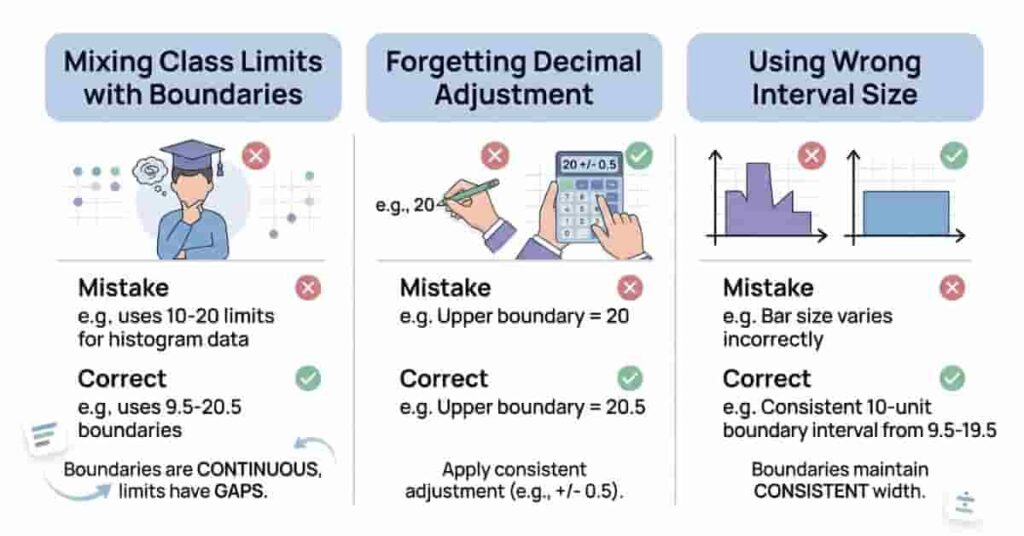
Even beginners aware of class boundaries can make simple mistakes. Spotting these early saves time and prevents data errors.
Mixing class limits with boundaries is one of the most common issues. Some students use the original limits in charts or calculations, forgetting that boundaries slightly adjust the values. This creates gaps or overlaps in graphs.
Forgetting the decimal adjustment is another common mistake. Omitting ±0.5 can leave gaps and mislead your results.
Inconsistent interval sizes are a problem. Misaligned boundaries distort frequency distributions and histograms.
By understanding these pitfalls, you can apply the class boundaries formula correctly and maintain accurate, continuous data. Double-check each step: identify the limits, adjust the decimals, and verify the interval sizes before using the data in graphs.
🔑 Key Takeaways
- Don’t confuse class limits with boundaries.
- Always apply the decimal adjustment.
- Ensure consistent interval sizes.
- Mistakes here affect data accuracy.
💡 Pro Tips
Make a checklist before drawing histograms. Check limits, boundaries, and intervals for every class to avoid errors.
Class Boundaries vs Class Limits
Grasping the distinction between class boundaries and class limits is fundamental to clear, accurate statistical data analysis.
Class limits are the numbers that set each group. For example, in 10–20, 10 is the lowest value, and 20 is the highest. These are the main numbers used to sort data.
Class boundaries are values that have changed slightly, so groups overlap. Using the same example, the class boundaries are 9.5–20.5. This helps make the data look smooth and joined, which is important for charts like histograms.
In short:
- Class Limits: Original interval values
- Class Boundaries: Adjusted values for continuity
Understanding this difference is crucial when creating statistical visuals or performing calculations. For example, always use class boundaries when drawing histograms to show continuous data without gaps, and use class limits when organising raw data in tables.
🔑 Key Takeaways
- Class limits define the interval.
- Class boundaries adjust limits for continuity.
- Boundaries prevent gaps between classes.
- Limits are used in tables; boundaries in graphs.
💡 Pro Tips
When labelling histograms, use the class boundaries for the axes to ensure the bars touch, but keep the class limits in your data tables for reference.
Related Concepts You Should Know
To fully master the class’s boundaries, it helps to understand related concepts. These ideas are connected and often appear together in frequency tables and histograms.
First, consider lower and upper class boundaries – these are the adjusted values that define the start and end of each class interval. Knowing them ensures your classes are continuous and accurate.
Class Width and Midpoint – Class width is the difference between consecutive class boundaries. The midpoint is the average of the lower and upper boundaries. Both are essential for calculating frequency distributions and visualising data.
Frequency Distribution – This organises data into classes, showing how often each value occurs. Proper boundaries and class widths make your frequency table accurate and easy to interpret.
Understanding these concepts together will make your statistical analysis smoother. You’ll be able to build accurate tables, histograms, and charts with confidence.
🔑 Key Takeaways
- The lower and upper boundaries define the true class limits.
- Class width shows interval size; midpoint shows central value.
- Frequency distribution organises data for analysis.
- All concepts work together to ensure continuous, accurate data.
💡 Pro Tips
Link these concepts when teaching or analysing data. Use internal links to separate guides on class width, midpoints, and frequency distributions to enhance learning and SEO.
Use a Class Boundaries Calculator (Recommended)
Manual class boundary calculations can be tedious and easy to miscalculate, especially with large datasets.
A Class Boundaries Calculator takes all the guesswork out of the process. Just enter your class limits, and it instantly provides the correct lower and upper boundaries. This saves time and ensures accuracy every time. Whether you’re working on test scores, ages, or survey data, the calculator makes your grouped data continuous and reliable.
Using a calculator also helps beginners build confidence. You can double-check manual calculations, practice with examples, and focus on learning statistical concepts instead of worrying about arithmetic mistakes.
👉 Try our Class Boundaries Calculator now. Enter your class limits to receive instant, accurate boundaries. Experience fast and reliable data analysis firsthand.
🔑 Key Takeaways
- Saves time and reduces errors
- Converts class limits to accurate boundaries instantly
- Ideal for beginners and large datasets
- Supports consistent, continuous data for graphs
💡 Pro Tips
Use the calculator alongside manual practice. Understanding the steps while having a verification tool builds both skill and confidence.
Conclusion
In this guide, we covered how to find class boundaries step by step. You learned the formula, common mistakes, and examples with grouped data. Understanding boundaries ensures your data is continuous, accurate, and ready for frequency tables or histograms.
By applying the decimal adjustments correctly, you avoid gaps and improve the reliability of your analysis. We also explored related concepts such as class width, midpoints, and frequency distributions to give you a complete understanding.
Don’t waste time with manual calculations. Use our Class Boundaries Calculator for instant, accurate results every time. Practice these steps with your own datasets, and soon you’ll handle grouped data confidently.
👉 Try the calculator above and see how easy it is to get accurate class boundaries instantly.

Team ClassRank builds smart, student-friendly calculators to make grade and rank tracking simple and accurate. For questions or feedback, contact us at classrankcalculator@gmail.com.