

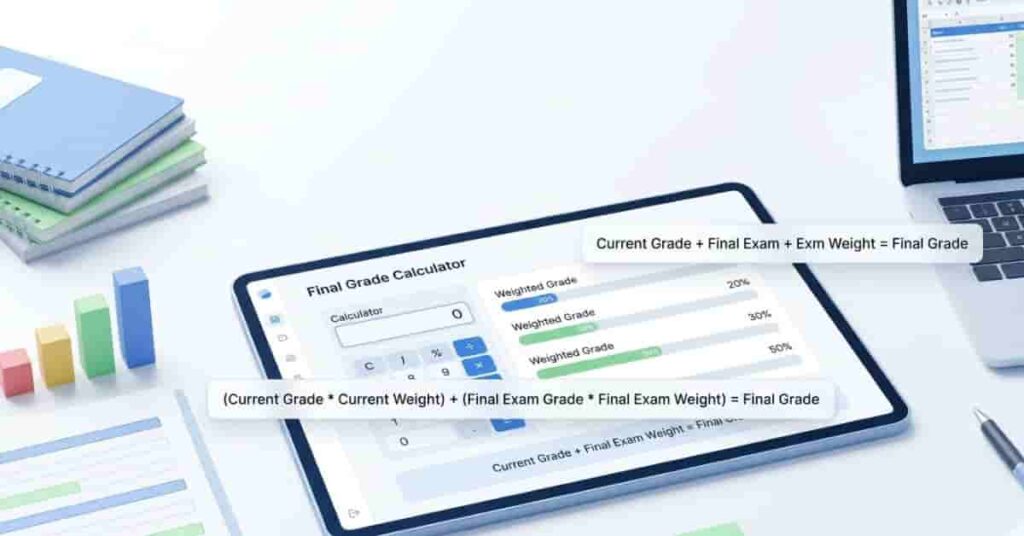
Table of Contents
Introduction
Ever wondered whether your final exam could raise your grade or put your course result at risk?
Knowing how to calculate final grade scores helps you understand exactly where you stand before the semester ends. Many students in U.S. high schools and colleges wait until grades are posted, only to discover they needed a higher exam score to reach their target grade.
A final grade combines your coursework, assignments, quizzes, tests, and final exam based on your instructor’s grading policy. Calculating it in advance can help you set realistic goals, avoid surprises, and make better study decisions.
Whether you’re aiming for an A, trying to pass a course, protecting your GPA, or preparing for college admissions, understanding your numbers matters. The good news is that the process is easier than most students think.
In this guide, you’ll learn what a final grade is, how final grades are calculated, and how to determine the score you need on your final exam. You’ll also see practical examples and learn when using a Final Grade Calculator can save time and reduce mistakes.
What Is a Final Grade?

Your final grade is the overall score you earn in a course after all assignments, quizzes, tests, projects, and exams are counted. Schools and colleges use this grade to measure your performance throughout the term.
Unlike individual assignment scores, a final grade combines all graded work according to your instructor’s weighting system. This single number or letter grade usually appears on your report card or transcript and can affect your academic progress.
Final Grade Definition
A final grade is the cumulative result of all coursework completed during a class. Teachers and professors calculate it using the grades you earned and the weight assigned to each category.
For example, homework may count for 20% of your grade, quizzes for 30%, and exams for 50%. Your final grade reflects the combined impact of every category rather than a single assignment.
Many students confuse assignment grades with final grades. An assignment grade shows how you performed on one task. A final grade shows your overall performance in the entire course.
Pro Tip: Always check your course syllabus. It explains how each assignment category contributes to your final grade.
Why Final Grades Matter
Final grades play an important role in your academic journey. They determine whether you successfully complete a course and move on to the next level.
In high school and college, final grades also affect your GPA. Even a small change in one course grade can influence your overall academic record.
Schools may use final grades to evaluate academic standing. Consistently low grades can lead to probation or other academic restrictions.
Final grades can also impact scholarship opportunities, college admissions decisions, honours programs, and eligibility for certain activities. Understanding your final grade helps you set goals and make informed study decisions before the semester ends.
Key Takeaways
- A final grade combines all coursework into one overall score.
- Assignment grades and final grades are not the same.
- Final grades influence GPA, academic standing, and course completion.
- Many scholarships and admissions decisions consider final grades.
- Tracking your grades early helps you avoid surprises later.
How Are Final Grades Calculated?
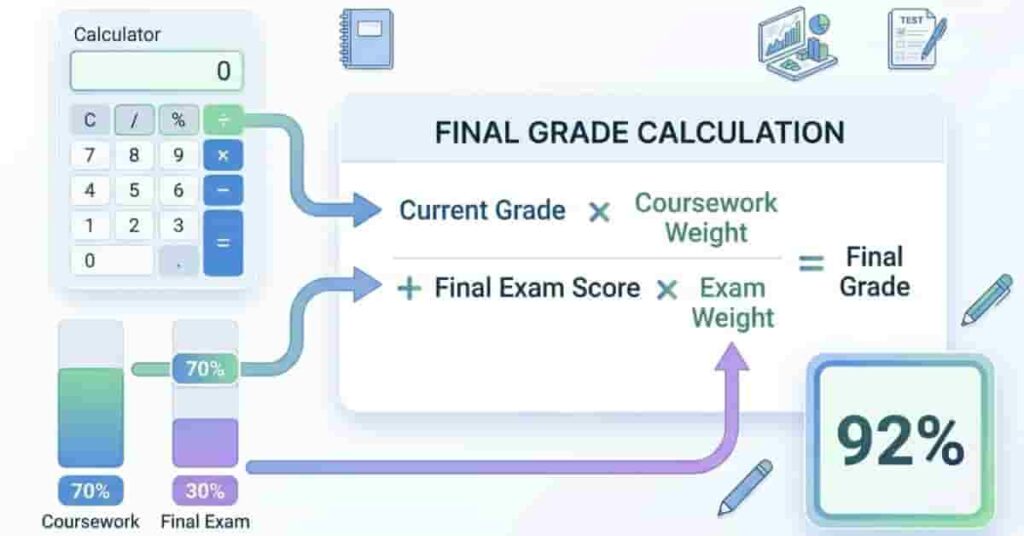
Most schools and colleges calculate final grades using a weighted average. This method gives different importance to coursework and the final exam based on the instructor’s grading policy.
For example, your coursework may count for 70% of the course grade, while the final exam counts for 30%. Instead of simply averaging the two scores, each score is multiplied by its assigned weight.
Once you understand the formula, calculating your final grade becomes much easier. You can estimate outcomes, set realistic goals, and determine how much your final exam will affect your overall result.
The Basic Final Grade Formula
The standard final grade formula is:
Final Grade = (Current Grade × Coursework Weight) + (Final Exam Score × Final Exam Weight)
This formula combines your current course performance with your final exam score. Each component contributes according to its assigned weight.
Example
Suppose:
- Current Grade = 85%
- Coursework Weight = 70%
- Final Exam Score = 90%
- Final Exam Weight = 30%
Calculation:
Final Grade = (85 × 0.70) + (90 × 0.30)
Final Grade = 59.5 + 27
Final Grade = 86.5%
In this example, the student’s final course grade would be 86.5%.
Understanding Each Part of the Formula
To use the formula correctly, you need to understand what each value represents.
Current Grade
Your current grade is the average score you have earned before taking the final exam. It usually includes homework, quizzes, projects, participation, and regular tests.
Most learning platforms and grade portals display this number automatically. If not, your teacher or course syllabus can help you find it.
Final Exam Score
The final exam score is the percentage you earn on your final assessment. If you have not taken the exam yet, you can enter an estimated score to predict your final grade.
This helps answer common questions such as “What happens if I score 80% on the final?” or “Can I still earn an A?”
Weights
Weights determine how much each part of the course affects your final grade. Higher weights have a greater impact on the result.
For example:
- Coursework Weight = 80%
- Final Exam Weight = 20%
In this case, coursework influences the final grade more than the exam.
Percentages
Weights must always add up to 100%.
Examples include:
- 70% coursework + 30% final exam
- 60% coursework + 40% final exam
- 80% coursework + 20% final exam
Using incorrect percentages is one of the most common grading mistakes. Always verify the weighting system listed in your course syllabus.
How to Calculate Final Grade Step by Step
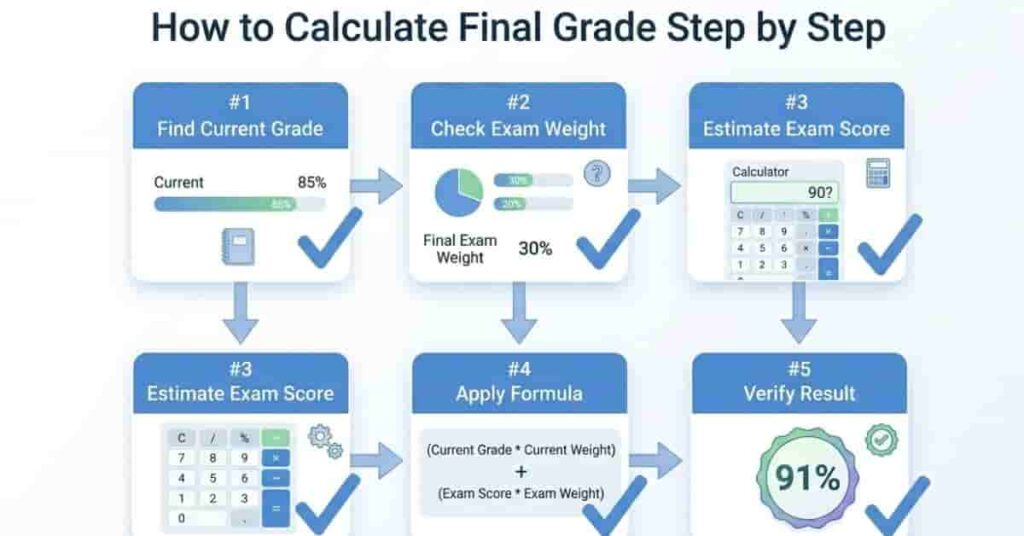
If you’re wondering how to calculate final grade results, the process is simpler than it looks. You only need a few numbers from your course and the final grade formula.
Before you begin, gather your current grade, final exam weight, and expected exam score. Once you have these values, you can estimate your final course grade in just a few minutes.
Follow the steps below to calculate your final grade accurately.
Step 1 – Find Your Current Grade
Your current grade is the average score you have earned before the final exam. It includes completed coursework such as assignments, quizzes, projects, and tests.
You can usually find this grade in your school’s learning management system, grade portal, or course dashboard. If your instructor provides a weighted grading system, make sure the displayed grade already reflects those weights.
For example, your current grade might be 88% before the final exam.
Pro Tip: Use the most recent grade available. Older grades may not include recently scored assignments.
Step 2 – Find the Final Exam Weight
Next, determine how much the final exam contributes to your overall course grade.
Most instructors list grading weights in the course syllabus. Common final exam weights include:
- 20%
- 25%
- 30%
- 40%
If the final exam is worth 30%, then the remaining coursework weight is 70%.
Always confirm these percentages before calculating your final grade. Using the wrong weight can produce inaccurate results.
Step 3 – Estimate or Enter Your Final Exam Score
If you have already completed the exam, enter your actual score.
If the exam has not happened yet, estimate the score you expect to earn. This allows you to predict possible outcomes and set realistic study goals.
For example, you might estimate:
- Current Grade = 88%
- Final Exam Score = 85%
- Final Exam Weight = 30%
Trying different exam scores can help you see how each result affects your final grade.
Pro Tip: Test several scenarios, such as 70%, 80%, and 90%, to understand your best- and worst-case outcomes.
Step 4 – Apply the Formula
Now plug your numbers into the final grade formula.
Final Grade = (Current Grade × Coursework Weight) + (Final Exam Score × Final Exam Weight)
Using the example above:
- Current Grade = 88%
- Coursework Weight = 70%
- Final Exam Score = 85%
- Final Exam Weight = 30%
Calculation:
Final Grade = (88 × 0.70) + (85 × 0.30)
Final Grade = 61.6 + 25.5
Final Grade = 87.1%
Your estimated final grade would be 87.1%.
Step 5 – Verify the Result
Before relying on the result, double-check your numbers.
Make sure:
- The weights add up to 100%.
- You entered percentages correctly.
- The current grade is up to date.
- The formula was applied accurately.
Even a small mistake can change the final outcome. Many students use a Final Grade Calculator to verify their calculations and avoid errors.
How to Calculate Final Grade Step by Step
If you’re wondering how to calculate final grade results, the process is simpler than it looks. You only need a few numbers from your course and the final grade formula.
Before you begin, gather your current grade, final exam weight, and expected exam score. Once you have these values, you can estimate your final course grade in just a few minutes.
Follow the steps below to calculate your final grade accurately.
Step 1 – Find Your Current Grade
Your current grade is the average score you have earned before the final exam. It includes completed coursework such as assignments, quizzes, projects, and tests.
You can usually find this grade in your school’s learning management system, grade portal, or course dashboard. If your instructor provides a weighted grading system, make sure the displayed grade already reflects those weights.
For example, your current grade might be 88% before the final exam.
Pro Tip: Use the most recent grade available. Older grades may not include recently scored assignments.
Step 2 – Find the Final Exam Weight
Next, determine how much the final exam contributes to your overall course grade.
Most instructors list grading weights in the course syllabus. Common final exam weights include:
- 20%
- 25%
- 30%
- 40%
If the final exam is worth 30%, then the remaining coursework weight is 70%.
Always confirm these percentages before calculating your final grade. Using the wrong weight can produce inaccurate results.
Step 3 – Estimate or Enter Your Final Exam Score
If you have already completed the exam, enter your actual score.
If the exam has not happened yet, estimate the score you expect to earn. This allows you to predict possible outcomes and set realistic study goals.
For example, you might estimate:
- Current Grade = 88%
- Final Exam Score = 85%
- Final Exam Weight = 30%
Trying different exam scores can help you see how each result affects your final grade.
Pro Tip: Test several scenarios, such as 70%, 80%, and 90%, to understand your best- and worst-case outcomes.
Step 4 – Apply the Formula
Now plug your numbers into the final grade formula.
Final Grade = (Current Grade × Coursework Weight) + (Final Exam Score × Final Exam Weight)
Using the example above:
- Current Grade = 88%
- Coursework Weight = 70%
- Final Exam Score = 85%
- Final Exam Weight = 30%
Calculation:
Final Grade = (88 × 0.70) + (85 × 0.30)
Final Grade = 61.6 + 25.5
Final Grade = 87.1%
Your estimated final grade would be 87.1%.
Step 5 – Verify the Result
Before relying on the result, double-check your numbers.
Make sure:
- The weights add up to 100%.
- You entered percentages correctly.
- The current grade is up to date.
- The formula was applied accurately.
Even a small mistake can change the final outcome. Many students use a Final Grade Calculator to verify their calculations and avoid errors.
Final Grade Calculation Examples
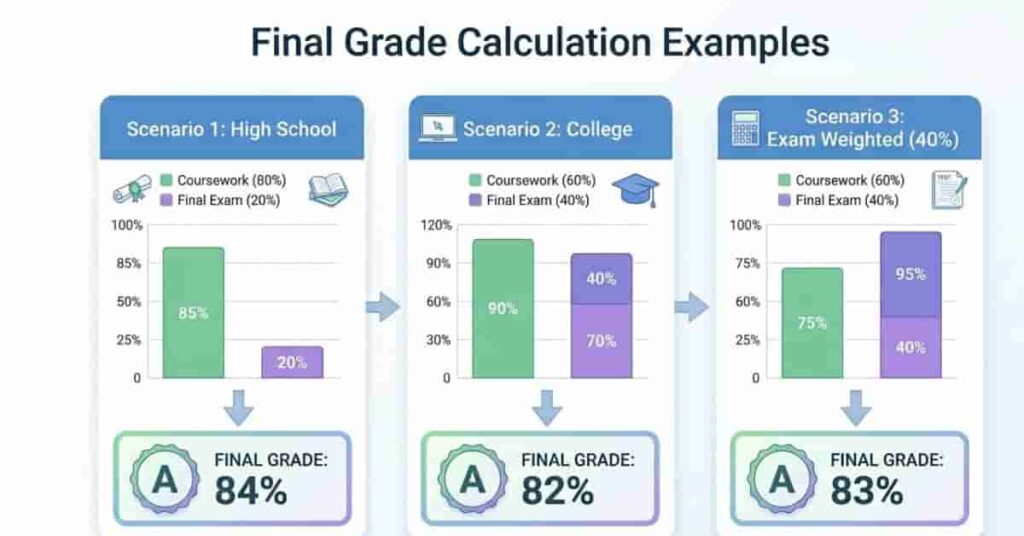
Learning the formula is helpful, but real examples make the process much easier to understand. The examples below show how final grade calculations work in common high school and college situations.
Follow each calculation step by step. You can use the same method with your own grades and course weights.
Example 1 – High School Student
Let’s say a high school student has a current grade of 90%. The teacher’s grading policy states that coursework counts for 80% of the final grade, while the final exam counts for 20%.
The student scored 85% on the final exam.
Formula:
Final Grade = (Current Grade × Coursework Weight) + (Final Exam Score × Final Exam Weight)
Calculation:
- Current Grade = 90%
- Coursework Weight = 80% (0.80)
- Final Exam Score = 85%
- Final Exam Weight = 20% (0.20)
Final Grade = (90 × 0.80) + (85 × 0.20)
Final Grade = 72 + 17
Final Grade = 89%
The student’s final course grade is 89%.
Pro Tip: When the final exam carries less weight, your current grade has a greater impact on the final result.
Example 2 – College Student
College courses often use different grading weights. In this example, coursework counts for 60% of the final grade, while the final exam counts for 40%.
A student has a current grade of 82% and earns 90% on the final exam.
Calculation:
- Current Grade = 82%
- Coursework Weight = 60% (0.60)
- Final Exam Score = 90%
- Final Exam Weight = 40% (0.40)
Final Grade = (82 × 0.60) + (90 × 0.40)
Final Grade = 49.2 + 36
Final Grade = 85.2%
The student’s final grade becomes 85.2%.
This example shows how a strong final exam score can significantly improve a course grade when the exam carries a higher weight.
Example 3 – Final Exam Worth 40%
Now let’s look at a complete calculation where the final exam is worth 40% of the course grade.
A student currently has 75% in the class and scores 88% on the final exam.
Given:
- Current Grade = 75%
- Coursework Weight = 60%
- Final Exam Score = 88%
- Final Exam Weight = 40%
Step 1: Multiply the current grade by the coursework weight.
75 × 0.60 = 45
Step 2: Multiply the final exam score by the exam weight.
88 × 0.40 = 35.2
Step 3: Add the two results together.
45 + 35.2 = 80.2
Final Grade = 80.2%
Because the final exam carried significant weight, the student’s strong performance on the exam increased the overall course grade by several percentage points.
Key Takeaways
- Final grade calculations use the same formula in both high school and college.
- Higher exam weights create a larger impact on the final result.
- Strong final exam scores can improve your overall course grade.
- Always convert percentages to decimals before calculating.
- Working through examples helps you avoid common mistakes.
How to Calculate the Grade You Need on the Final Exam
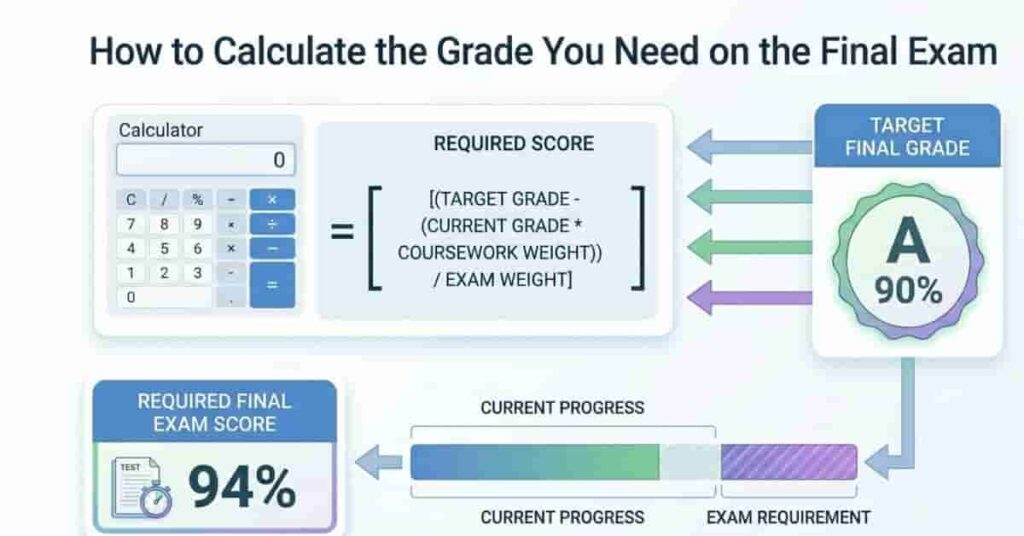
Many students already know their current grade but want to answer a different question: What grade do I need on my final exam?
Instead of calculating your final course grade, you work backward from your target grade. This approach helps you set a realistic goal before exam day and focus your study efforts where they matter most.
Whether you’re trying to earn an A, maintain a scholarship, or pass a course, knowing the required exam score can remove uncertainty and help you prepare with confidence.
Working Backward from Your Desired Grade
To find the score you need on the final exam, start with your desired course grade and current grade.
Use this formula:
Required Final Exam Score = (Desired Grade − (Current Grade × Coursework Weight)) ÷ Final Exam Weight
Let’s use a common example.
Suppose:
- Desired Grade = 90% (A)
- Current Grade = 88%
- Coursework Weight = 70%
- Final Exam Weight = 30%
The goal is to determine the exam score needed to finish the course with a 90%.
Pro Tip: Always convert percentages to decimals before using the formula.
Example Calculation
Using the values above:
Required Final Exam Score = (90 − (88 × 0.70)) ÷ 0.30
Step 1: Calculate the weighted coursework score.
88 × 0.70 = 61.6
Step 2: Subtract that value from the desired grade.
90 − 61.6 = 28.4
Step 3: Divide by the final exam weight.
28.4 ÷ 0.30 = 94.67
Required Final Exam Score ≈ 94.7%
In this situation, the student needs about 95% on the final exam to finish the course with an overall grade of 90%.
This method works for any target grade. You can calculate the score needed for an A, a B, a passing grade, a scholarship requirement, or a GPA goal.
Common Mistakes When Calculating Final Grades
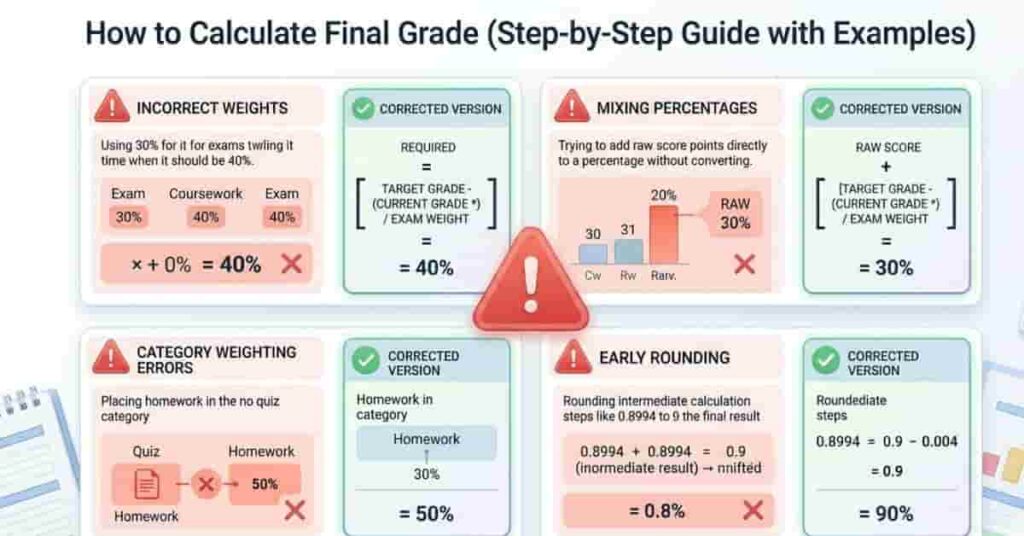
Even when students understand the final grade formula, small mistakes can lead to inaccurate results. A single error in weights, percentages, or calculations can make your predicted grade much higher or lower than it should be.
Before relying on any calculation, take a few minutes to check your numbers carefully. Avoiding the mistakes below can help you get a more accurate estimate of your final grade.
Using Incorrect Weights
One of the most common mistakes is using the wrong grading weights.
Many students assume the final exam counts for a certain percentage without checking the course syllabus. However, grading policies vary between teachers, schools, and colleges.
For example, one course may use:
- Coursework: 80%
- Final Exam: 20%
Another course may use:
- Coursework: 60%
- Final Exam: 40%
Using the wrong weights can significantly change your final grade calculation.
Pro Tip: Always verify grading weights in your syllabus or course portal before calculating.
Mixing Percentages and Points
Students sometimes confuse percentage grades with point-based grades.
For example, a score of 45 out of 50 points is not the same as 45%. Before using any formula, convert point totals into percentages.
Here’s a quick example:
- Score Earned: 45 points
- Total Possible Points: 50 points
Percentage = (45 ÷ 50) × 100 = 90%
Using raw point values instead of percentages can produce incorrect results.
Forgetting Category Weighting
Many classes use weighted grading categories rather than a simple average of all assignments.
For example:
- Homework: 20%
- Quizzes: 30%
- Exams: 50%
A student who averages all assignment scores equally may calculate the wrong final grade.
Weighted categories give more importance to certain types of assessments. Ignoring those weights can lead to inaccurate predictions.
Expert Tip: If your course uses category weighting, calculate each category’s average first before applying the overall course weights.
Rounding Too Early
Rounding numbers too soon can create small errors that affect the final result.
For example, a calculation may produce:
86.67%
If you round intermediate values before finishing the calculation, the final grade may differ slightly from the correct answer.
Instead, keep all decimal values throughout the calculation and round only the final result.
This approach provides the most accurate estimate possible.
Manual Calculation vs Final Grade Calculator
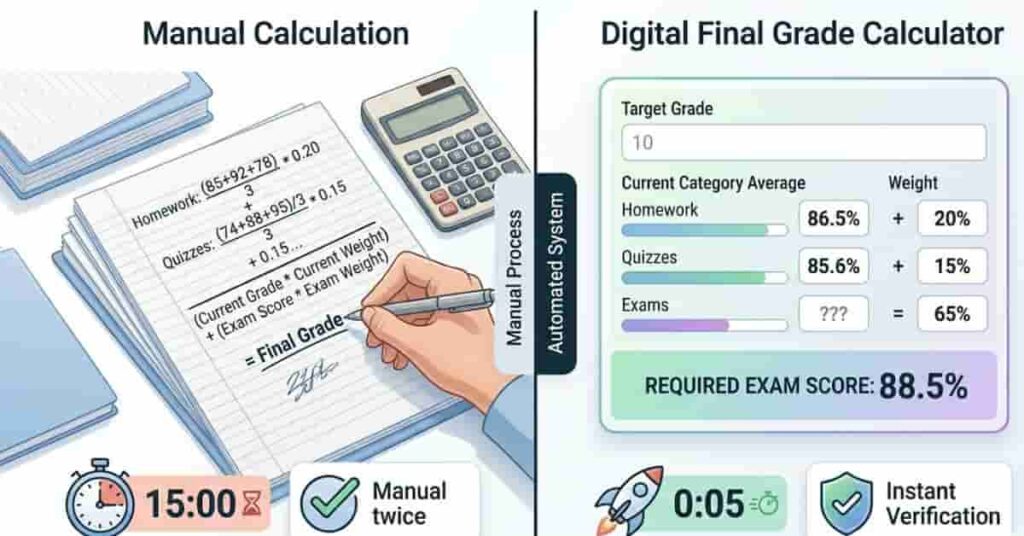
There are two common ways to calculate a final grade. You can do the math manually using the final grade formula, or you can use a Final Grade Calculator to get the answer automatically.
Both methods can produce accurate results when used correctly. The best choice depends on how comfortable you are with calculations and how quickly you need an answer.
Benefits of Manual Calculations
Calculating your final grade by hand helps you understand how grading systems work. It shows exactly how coursework, exams, and grading weights affect your overall result.
Manual calculations can also help you:
- Learn the final grade formula.
- Verify calculator results.
- Understand weighted grading systems.
- See how different exam scores change your outcome.
For students learning how final grades are calculated, working through a few examples manually can build confidence.
However, manual calculations require careful attention. A small mistake in percentages, weights, or decimals can lead to incorrect results.
Pro Tip: Use manual calculations when you want to understand the process, not just the answer.
Benefits of Using a Final Grade Calculator
A Final Grade Calculator simplifies the entire process. Instead of performing multiple calculations, you enter your grades and weights, and the tool calculates the result instantly.
Many students prefer calculators because they are:
Faster
You can calculate your final grade in seconds without writing formulas or performing manual math.
Fewer Mistakes
The calculator automatically handles percentages, weights, and calculations. This reduces the risk of human error.
Instant Results
You can test multiple scenarios quickly. For example, you can see how scoring 80%, 90%, or 95% on the final exam affects your overall grade.
This makes it easier to plan study goals and understand your options before exam day.
Expert Tip: Many students use both methods. They learn the formula once, then use a calculator for quick checks throughout the semester.
Try Our Final Grade Calculator
Want a faster way to calculate your results?
Use our Final Grade Calculator to:
- Calculate your final course grade instantly.
- Find the score needed on your final exam.
- Test different grading scenarios.
- Avoid common calculation mistakes.
- Save time during exam season.
Simply enter your current grade, final exam weight, and expected exam score to get immediate results.
Tips for Improving Your Final Grade
Improving your final grade does not always require perfect scores on every assignment. Small, strategic changes can make a meaningful difference over the course of a semester.
The key is to focus your time where it has the greatest impact. By understanding your grading system and tracking your progress, you can make smarter academic decisions and avoid last-minute surprises.
Focus on High-Value Assessments
Not all assignments affect your final grade equally. Some coursework categories carry much more weight than others.
For example, if quizzes count for 10% of your grade but exams count for 50%, improving exam performance will usually have a greater impact on your final result.
Before spending extra study time, identify:
- The highest-weighted assignments
- Upcoming exams and major projects
- Assessments that can significantly raise your grade
Focusing on high-value assessments helps you get the best return on your effort.
Pro Tip: Review your course syllabus and highlight assignments worth the largest percentage of your final grade.
Prioritize Weak Subjects
Many students spend most of their time on subjects they already understand. While that feels productive, it may not improve their overall academic performance.
Instead, identify courses or topics where your grades are lowest. Improving a weak area often creates the biggest increase in your GPA and final grades.
Start by:
- Reviewing recent test results
- Identifying recurring mistakes
- Seeking help from teachers or tutors
- Creating a study plan for difficult topics
Even modest improvement in a challenging course can have a noticeable impact on your academic record.
Track Grades Throughout the Semester
Waiting until the end of the term to check your grades can limit your options.
Regular grade tracking helps you spot problems early and adjust your study habits before major assessments occur.
Consider tracking:
- Assignment scores
- Quiz averages
- Exam results
- Missing work
- Overall course averages
Many students use spreadsheets or online grade calculators to monitor progress throughout the semester.
Expert Tip: Check your grades after every major assignment. Early awareness gives you more time to improve.
Know Your Grading Policy
Every teacher, professor, and school may use a different grading system. Understanding that system helps you make informed decisions about where to focus your effort.
Pay close attention to:
- Category weights
- Final exam percentages
- Extra credit opportunities
- Attendance policies
- Late assignment penalties
Students who understand their grading policy can often identify opportunities to improve their final grade before the semester ends.
Conclusion
Final grades combine your coursework and final exam using a simple weighted formula. In this guide, you learned how each part of the grading system works step by step. You also saw how to calculate results, predict required exam scores, and avoid common mistakes.
When you understand how to calculate final grade outcomes, you can plan better and reduce stress before exams. This helps you set realistic goals and protect your GPA throughout the semester. Even small improvements in key assignments can change your final result.
Use this knowledge regularly to track your progress during the course, not just at the end. It keeps you prepared and confident.
If you want faster results, try our Final Grade Calculator to save time and avoid manual errors. Share this guide with classmates or explore additional resources on weighted grades, teacher grading systems, and calculator accuracy to further improve your understanding.

Team ClassRank builds smart, student-friendly calculators to make grade and rank tracking simple and accurate. For questions or feedback, contact us at classrankcalculator@gmail.com.