


Table of Contents
Introduction
Ever calculated your final grade only to realize the result was different from expected?
Understanding how to calculate final grades with percentages and weighted grades is essential for students in the USA. Many schools and colleges use different grading systems that can confuse beginners. Small changes in weights or percentages can significantly change your final result.
This article explains the full process in simple, step-by-step steps so you can calculate your grades confidently. Many students struggle because they mix percentages with weighted category scores. This often leads to incorrect expectations before final exams.
Knowing the correct method helps you plan your study strategy better. You will also learn how teachers typically calculate final grades. We will break down formulas, examples, and real classroom scenarios.
By the end, you will be able to easily verify your own results. Let’s make grade calculations simple, clear, and stress-free for every student.
Want a faster way to check your results? Try our Final Grade Calculator to instantly calculate percentages, weighted grades, and exam scenarios without manual math.
What Is a Percentage-Based Final Grade?
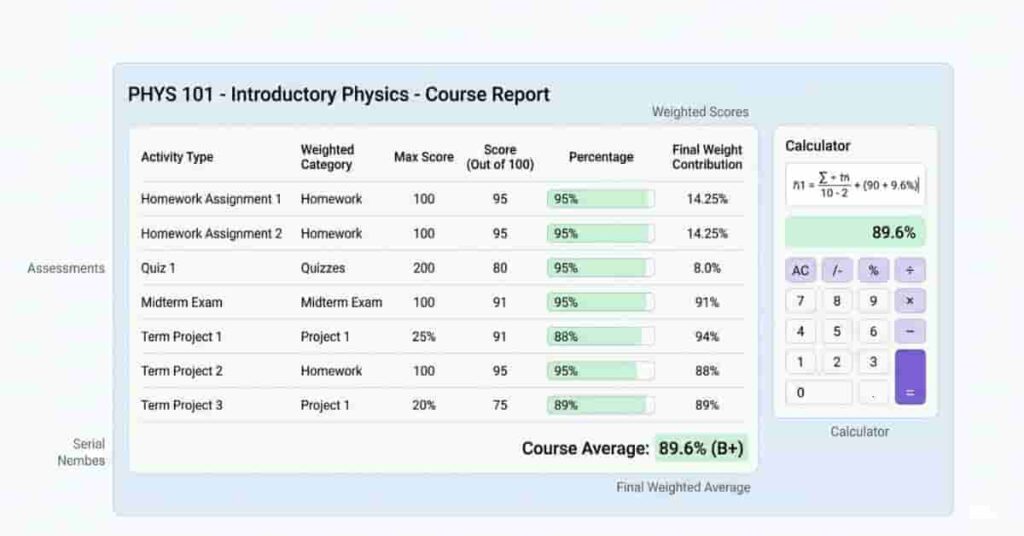
A percentage-based final grade is a system where your performance is shown as a score out of 100. The final grade, with percentages and weighted grades, helps students clearly see how well they performed throughout the course. Schools in the USA often use this method because it makes progress easy to track and compare. Instead of vague results, you see exact performance numbers that reflect your effort in each assignment or exam.
This system is common in high schools, colleges, and online courses. It gives students a clear picture of where they stand during the semester. It also helps teachers apply consistent grading standards across different classes. Because of its simplicity, beginners can quickly understand how their performance adds up over time.
How Percentage Grading Works
Percentage grading converts all scores to a value out of 100. Every test, quiz, or assignment contributes to your overall grade. Teachers then combine these scores to calculate your final result. This method works well because it removes confusion and keeps grading transparent.
Grades usually follow standard scales like:
- 90–100 = Excellent performance
- 80–89 = Good performance
- 70–79 = Average performance
- Below 70 = Needs improvement
Schools prefer this system because it is simple, fair, and easy for students at all levels to understand. It also allows quick comparison between different subjects and students.
Percentage Grade vs Letter Grade
Percentage grades show exact performance, while letter grades group scores into categories. For example, a score of 92% is more precise than simply “A.”
Common conversions include:
- 90–100 = A
- 80–89 = B
- 70–79 = C
- 60–69 = D
- Below 60 = F
Letter grades simplify evaluation, but they hide small differences in performance. Two students with 81% and 89% both get a “B,” even though their results differ. That’s why many schools first calculate percentages and then convert them into letter grades.
What Is a Weighted Grade?
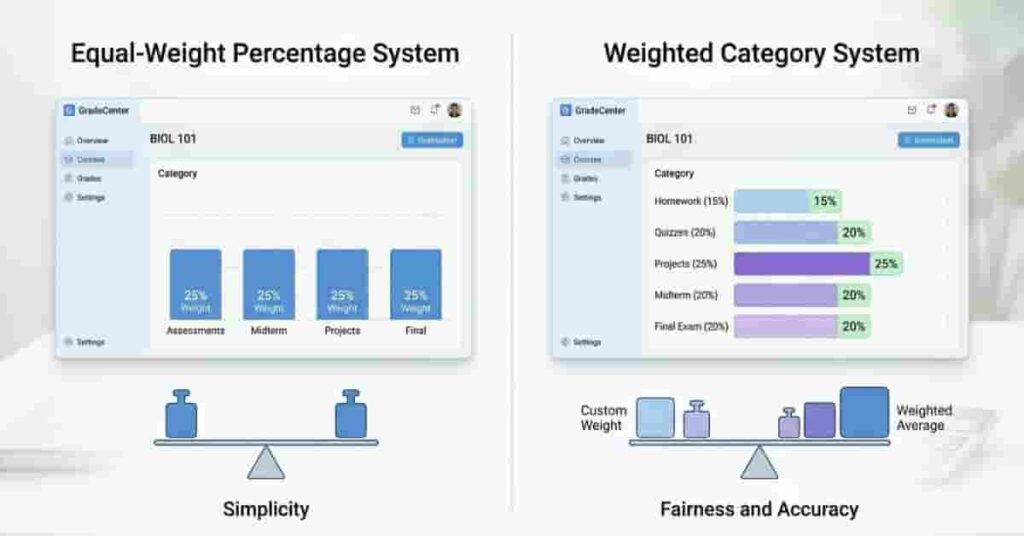
A weighted grade is a grading system where different assignments do not count equally toward your final result. The final grade, with percentages and weighted grades, is more accurate because it reflects the importance of each task. In this system, some work, such as exams or projects, carries more weight than quizzes or homework. This helps students understand how each part of the course affects their overall performance.
Weighted grading is widely used in U.S. schools and colleges. It ensures that major assessments have a stronger impact on your final score. This system can feel confusing at first, but it becomes clear once you understand how weights work together.
Weighted Grade Definition
A weighted grade means each assignment category has a different level of importance. Not all work contributes equally to your final score. For example, homework might count less, while a final exam carries more weight. Teachers assign these weights based on learning goals and course difficulty.
For instance:
- Homework may count for 20%
- Quizzes may count for 15%
- Final exams may count for 40% or more.
This structure ensures that important assessments influence your grade more than smaller tasks. It also encourages students to focus on long-term understanding rather than only on daily tasks.
Why Schools Use Weighted Grading Systems
Schools use weighted grading systems to make assessments fairer and more balanced. Not every assignment measures the same level of skill, so weights help reflect true performance.
Key reasons include:
- Fair assessment of student performance across different tasks
- Recognition of assignment importance based on difficulty and effort
- Final exams carry greater weight because they test overall understanding
This system also motivates students to prepare more seriously for major exams and projects. It rewards consistent effort while prioritizing key learning milestones.
Understanding Grade Weights

Grade weights show how much each part of your course contributes to your final score. In a final grade with percentages and a weighted grades system, each category has a fixed percentage value. This value decides how strongly it affects your overall result. Understanding these weights helps you plan your study time more effectively and avoid surprises at the end of the course.
Schools and colleges in the USA use weighted categories to balance daily work and major exams. Small tasks like homework matter, but big assessments like finals matter more. This structure makes grading fairer and more performance-based, rather than relying on a single test.
Common Weighted Categories
Most courses follow a similar structure when assigning weights. These percentages may change slightly by teacher or subject, but the idea stays the same.
| Category | Weight |
| Homework | 20% |
| Quizzes | 15% |
| Projects | 25% |
| Midterm | 15% |
| Final Exam | 25% |
This table shows how different parts of your course contribute to your final grade. The final exam and projects usually carry the highest weight because they measure overall understanding.
How Category Weights Affect Your Final Grade
Category weights directly change your final result, even if your scores look similar. A high score in a heavily weighted category improves your grade more than a low-weight task.
For example, if you score:
- 95% in homework (20%)
- 80% in quizzes (15%)
- 90% in projects (25%)
- 85% in midterm (15%)
- 88% in final exam (25%)
Each score is multiplied by its weight. The final exam and projects impact your result more than homework or quizzes. This means that improving performance in high-weight categories can significantly boost your final grade, even if your performance on smaller tasks is weaker.
Weighted Final Grade Formula
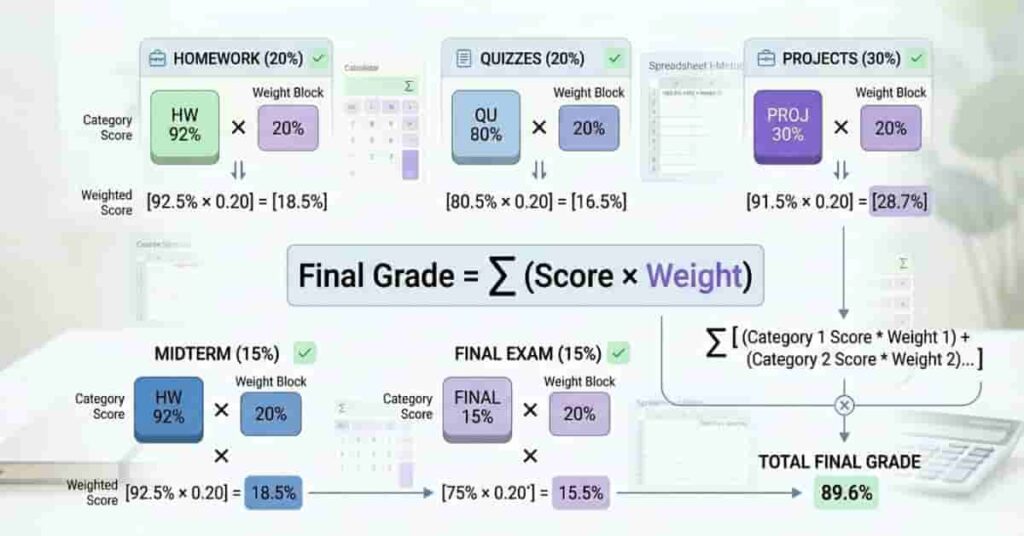
The final grade, including percentages and weighted grades, is calculated using a simple weighted-average formula. This formula helps combine all category scores based on their importance. Each assignment category contributes differently, depending on its assigned weight. Understanding this formula makes it easier to predict your final course result before the semester ends.
Formula
Weighted Final Grade = (Category Score × Category Weight) + (Category Score × Category Weight)
You continue adding each category until all weights are included.
A clearer version looks like this:
Final Grade = Σ (Score × Weight)
Each score must be expressed as a percentage, and each weight must be converted to decimal form (for example, 20% = 0.20). This ensures accurate calculation without errors.
How the Formula Works
The formula works by multiplying each category score by its weight, then adding all results together. Each part contributes differently based on importance.
For example:
- Homework score is multiplied by 0.20
- The quiz score is multiplied by 0.15
- The project’s score is multiplied by 0.25
- The midterm score is multiplied by 0.15
- Final exam score is multiplied by 0.25
After multiplying each category, you add all values to get your final grade. High-weight categories like exams have a stronger impact, while smaller tasks affect the result less. This is why improving performance in major assessments can significantly raise your overall grade.
How to Calculate Final Grades with Percentages
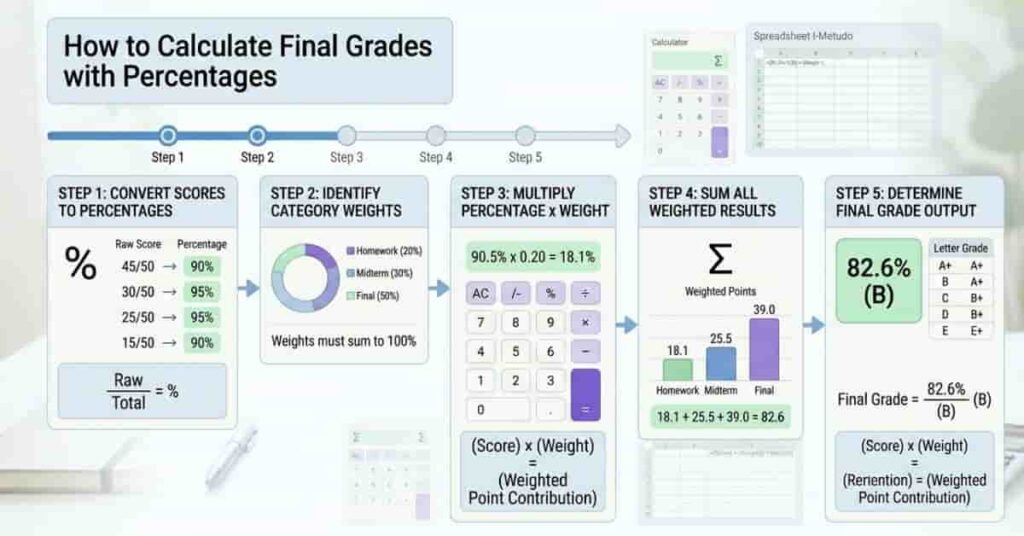
Calculating your final grade with percentages and weighted grades becomes easy when you follow a clear step-by-step process. This method helps you turn raw scores into a final percentage that reflects your full performance across all course activities. Many students in the USA use this approach to track their progress before final exams and avoid last-minute surprises.
When you understand each step, you can quickly estimate your final result even before your teacher publishes grades. This also helps you focus on the areas that matter most in your course.
Step 1 – Convert Scores Into Percentages
Start by converting all raw scores into percentages. For example, if you scored 45 out of 50, your percentage is 90%. This step is important because all categories must be in the same format before calculation. Without this, your final result will be incorrect.
Step 2 – Find Category Weights
Next, check how much each category contributes to your final grade. These weights are usually given in your syllabus. Common examples include homework, quizzes, projects, midterms, and final exams. Each category has a percentage value that shows its importance.
Step 3 – Multiply Each Grade by Its Weight
Now multiply each percentage score by its category weight. For example, a 90% homework score with a 20% weight becomes 18 (90 × 0.20). Repeat this for all categories. This step shows how much each section contributes to your final grade.
Step 4 – Add the Weighted Results
After multiplying, add all the results together. This gives you a combined score that reflects your total performance. Each category now contributes fairly based on its importance in the course.
Step 5 – Calculate Your Final Grade
The final sum is your overall grade. This number represents your final percentage score in the course. You can then convert it into a letter grade if needed. This method gives you a clear and accurate understanding of your academic performance.
Example 1 – Simple Percentage-Based Final Grade
A simple percentage-based final grade shows how students can calculate their total score when all assignments carry equal importance. In this method, each test or assignment carries the same weight in the final result. This makes it easier to understand the final grade in terms of percentages and the concept of weighted grades before moving to more advanced weighted systems.
This example uses a basic classroom scenario where all scores are treated equally. It helps beginners in the USA quickly learn how grades are combined into a single final percentage. Once you understand this method, weighted systems become much easier to manage.
Let’s say a student has the following scores:
- Homework: 90%
- Quiz: 80%
- Midterm: 85%
- Final Exam: 95%
Since all categories are equal, we simply add them and divide by the number of assignments.
Step-by-step calculation:
90 + 80 + 85 + 95 = 350
350 ÷ 4 = 87.5%
The final grade is 87.5%.
This means the student performed consistently across all assignments. No category is more important than any other in this method, so each score affects the result equally.
In real classrooms, teachers may use different weights, but this example builds a strong foundation. It also helps students understand how small changes in scores can affect the final outcome. Once you master this, moving to weighted systems becomes much easier and more accurate.
Example 2 – Weighted Final Grade Calculation
A weighted system yields a more accurate final grade by assigning different weights to each category. Instead of treating all scores equally, we multiply each score by its weight. This shows how much each part actually contributes to the final result. It is widely used in U.S. schools and colleges to reflect real academic performance.
In this example, we will use common course weights that add up to 100%. Since no midterm is included, the final exam carries a higher weight to complete the total.
Given Scores:
- Homework = 92%
- Quizzes = 85%
- Projects = 90%
- Final Exam = 88%
Step-by-Step Weighted Calculation:
First, convert weights into decimals:
- Homework = 0.20
- Quizzes = 0.15
- Projects = 0.25
- Final Exam = 0.40
Now multiply each score:
- Homework: 92 × 0.20 = 18.4
- Quizzes: 85 × 0.15 = 12.75
- Projects: 90 × 0.25 = 22.5
- Final Exam: 88 × 0.40 = 35.2
Now add all weighted values:
18.4 + 12.75 + 22.5 + 35.2 = 88.85%
Final Result:
The weighted final grade is 88.85%.
This shows that higher-weight categories, such as the final exam, have a stronger impact on the final score. Even small changes in the final exam can significantly affect the overall grade. Understanding this helps students focus their effort where it matters most.
Example 3 – College Course With Multiple Grade Categories
A college course often uses a detailed weighting system to calculate the final grade with percentages and weighted grades. This provides a more realistic view of student performance because it includes more types of assessment. Each category has its own weight, and every score contributes differently to the final result. This method is common in U.S. universities, especially in large lecture-based courses.
In this example, we will calculate a full college-grade breakdown using five categories. It shows how different assignments combine to form a final percentage.
Given Scores and Weights:
- Homework = 94% (20%)
- Quizzes = 82% (10%)
- Projects = 88% (20%)
- Midterm Exam = 79% (20%)
- Final Exam = 91% (30%)
Step-by-Step Calculation:
Now multiply each score by its weight:
- Homework: 94 × 0.20 = 18.8
- Quizzes: 82 × 0.10 = 8.2
- Projects: 88 × 0.20 = 17.6
- Midterm: 79 × 0.20 = 15.8
- Final Exam: 91 × 0.30 = 27.3
Now add all weighted results:
18.8 + 8.2 + 17.6 + 15.8 + 27.3 = 87.7%
Final Result:
The final college grade is 87.7%.
This example shows how even a lower midterm score can be balanced by strong performance in other categories. The final exam also plays a major role because of its higher weight. In college systems, understanding this balance helps students prioritize study time effectively and improve overall performance throughout the semester.
How to Calculate a Weighted Final Grade in Excel
Calculating the final grade with percentages and weighted grades in Excel is one of the fastest and most accurate methods for students. It eliminates manual errors and lets you test different scoring scenarios in seconds. Many U.S. students use Excel or Google Sheets to track their grades throughout the semester and predict final outcomes before exams.
Excel works especially well for weighted systems because it automatically multiplies scores by their weights and sums them. Once set up correctly, you only need to update your scores, and the final grade updates instantly.
Basic Formula
The basic Excel formula for a weighted grade is:
=SUMPRODUCT(score_range, weight_range)
This function multiplies each score by its weight, then automatically adds the results. It is the most efficient way to calculate a weighted final grade in Excel without doing manual steps.
For example, if:
- Scores are in column B
- Weights are in column C
Then the formula becomes:
=SUMPRODUCT(B2:B6, C2:C6)
Make sure your weights are in decimal form (e.g., 20% = 0.20). This ensures accurate results.
Example Spreadsheet Setup
A simple spreadsheet setup helps beginners understand how everything connects.
| Category | Score (%) | Weight |
| Homework | 92 | 0.20 |
| Quizzes | 85 | 0.15 |
| Projects | 90 | 0.25 |
| Midterm | 88 | 0.15 |
| Final Exam | 91 | 0.25 |
In Excel:
- Enter scores in one column.
- Enter weights in another column.
- Use the SUMPRODUCT formula to calculate the final result.
The final output cell will instantly show your weighted grade.
This setup is powerful because it allows students to quickly test “what if” scenarios. For example, you can change your final exam score and instantly see how it affects your overall grade. This makes Excel a practical tool for planning academic performance and improving results before final exams.
Common Weighted Grade Mistakes
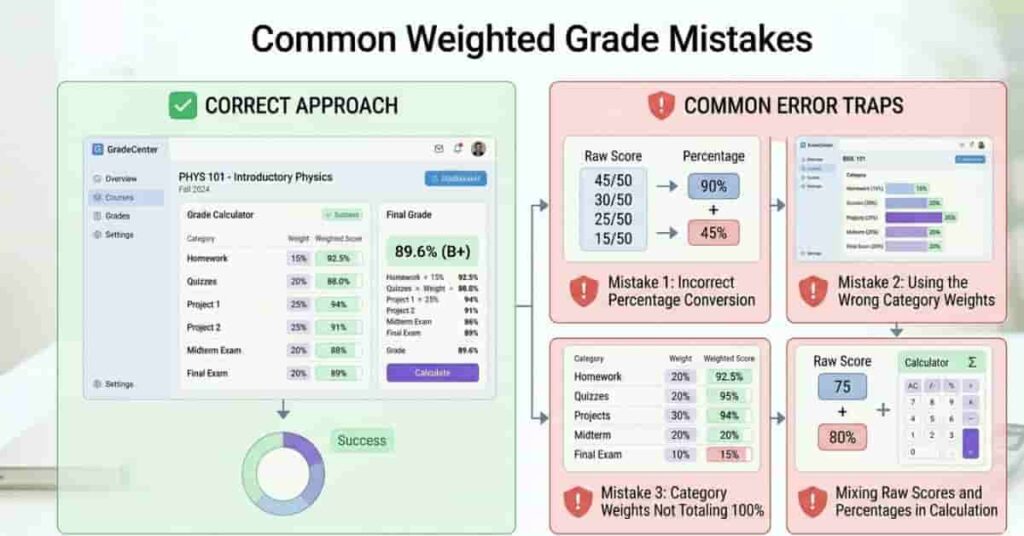
Many students struggle with final grades, percentages, and weighted grades because small mistakes can change the final result. Even when the formula is simple, incorrect inputs can lead to confusing or wrong answers. Understanding these common errors helps you calculate grades more accurately and avoid last-minute surprises.
Forgetting to Convert Percentages
One of the most common mistakes is not converting percentages into decimals before multiplying. For example, 20% should be written as 0.20, not 20. If you use 20 instead, your final grade will become extremely high and incorrect. This small step is often missed but has a big impact on accuracy.
Using Incorrect Weights
Another common issue is using the wrong weight for a category. Students sometimes copy values from memory instead of checking the syllabus. If a quiz is actually worth 10% but you use 15%, your final calculation will be wrong. Always confirm weights from official course guidelines before calculating.
Weights Not Adding Up to 100%
All category weights must total 100%. If they don’t, your final grade will be incomplete or misleading. For example, if weights add up to 90%, the calculation will not reflect your full performance. Always double-check that the total equals 1.00 or 100% before starting.
Mixing Raw Scores and Percentages
Mixing raw scores (like 45/50) with percentages (like 90%) is another serious mistake. Both formats must be converted into percentages first. If you combine them directly, your final result will be inaccurate. Always standardize all scores into percentage form before applying weights.
Percentage Grades vs Weighted Grades
Understanding the difference between percentage grades and weighted grades is key to mastering the final grade with the percentage and weighted grades system. Both methods measure student performance, but they calculate results differently. Knowing which system your school uses helps you track your progress more accurately and avoid confusion during the semester.
Key Differences
Percentage grades treat all assignments equally, while weighted grades assign different importance to each category. In a percentage system, every score contributes the same amount to the final result. In contrast, weighted grading multiplies each category by its importance before calculating the final score.
For example:
- Percentage system: All assignments are averaged equally
- Weighted system: Final exam may count more than homework
Weighted grading provides a more realistic reflection of performance by highlighting major assessments. Percentage grading is simpler but less precise when assignments vary in difficulty or importance.
Which Method Does Your School Use?
Most schools in the USA clearly state the grading system in their syllabi. If your course lists categories such as homework, quizzes, projects, and exams with different percentages, it uses a weighted system.
If your teacher simply averages all scores together, then it is a percentage-based system. Students should always check the syllabus at the start of the course. This helps you plan your study strategy and focus on high-impact assignments early.
When Weighted Grades Matter Most
Weighted grades matter most in courses with multiple types of assessments. This includes college classes, advanced high school courses, and STEM subjects.
They are especially important when:
- Final exams carry a large portion of the grade.
- Projects require long-term effort.
- Multiple quizzes and assignments are combined.
In these cases, improving performance in high-weight categories can significantly raise your final score. A strong final exam can even balance weaker homework scores. This makes weighted systems more strategic and performance-focused for students.
Use a Final Grade Calculator to Check Your Results
A final grade with percentages and weighted grades can be tricky to calculate manually, especially when multiple categories are involved. Even a small mistake in weights or percentages can change your final result. This is where a final grade calculator becomes a powerful tool for students in the USA. It helps you instantly check your results without having to do manual step-by-step calculations.
Instead of spending time on formulas, you simply enter your scores and weights. The calculator automatically applies the correct formula and shows your final grade in seconds. This is especially useful during exam season, when students want quick, accurate results to plan their study strategy.
A calculator also helps you understand how different scores affect your final outcome. You can change values and instantly see how your grade improves or drops. This makes it easier to set goals and focus on high-impact assignments like exams or projects.
Benefits of Using a Calculator
A final grade calculator offers several advantages for students seeking fast, accurate results.
- Faster calculations – Get your final grade in seconds without manual math
- Reduced errors – Avoid mistakes in weights, percentages, and formulas
- Easy scenario testing – Try different score combinations to predict outcomes
These benefits make it a reliable tool for both high school and college students. It simplifies the entire grading process and saves valuable time.
If you want to avoid confusion and improve your academic planning, try our Final Grade Calculator today. It gives instant results and helps you stay on track with your academic goals throughout the semester.
Conclusion
In this article, we covered how percentage-based and weighted grading systems work in real classrooms. You also learned how to calculate scores step by step using formulas, examples, and Excel methods. These methods help students clearly understand their academic performance and confidently predict final results.
Understanding final grades, including percentages and weighted grades, is important for every student in the USA. It helps you avoid confusion and plan your study time more effectively. Whether you are using simple averages or weighted categories, the right method makes a big difference in your results.
Try using these techniques to double-check your grades and improve accuracy. You can also explore our Final Grade Guide for deeper understanding or use the Final Grade Calculator for instant results. Share your experience in the comments and let others know what worked best for you.

Team ClassRank builds smart, student-friendly calculators to make grade and rank tracking simple and accurate. For questions or feedback, contact us at classrankcalculator@gmail.com.