


Table of Contents
Introduction
Ever looked at your report card and wondered how that final number was actually calculated? Most students do.
Many beginners struggle to understand how teachers calculate final grades in school and college, especially in the USA, where grading systems can vary widely. Each school, teacher, and course may follow different rules, weightings, and evaluation methods. This often leaves students confused about how their assignments, tests, and exams actually combine into one final score.
Understanding how teachers calculate final grades is important because it helps students track performance more accurately and avoid unexpected results at the end of the semester. It also makes it easier to plan study efforts based on what matters most in a course.
In this article, you will learn exactly how final grades are calculated in different education systems. We will break down weighted and point-based systems, explain high school and college grading structures, and show you how to estimate your own final grade with confidence.
How Do Teachers Calculate Final Grades?

Understanding how teachers calculate final grades helps students stay in control of their performance. The process is not random. Teachers follow a clear system that combines scores from different activities, such as tests, quizzes, homework, and exams. In most cases, schools in the USA use either a weighted system or a points-based system to form the final grade. This structure ensures that every student is evaluated fairly in accordance with the course rules.
Teachers usually start by collecting all student scores from assignments, quizzes, projects, and exams. They then organize this data into categories defined by the course syllabus. Each category may have a different level of importance, depending on the teacher’s grading policy. After that, they calculate averages for each category and apply weights if the course uses a weighted system. Finally, all values combine to produce the final course grade.
These steps help create a structured and transparent grading system. Students can better understand where they stand during the semester instead of waiting for the final report.
The Basic Process Teachers Follow
Teachers follow a consistent step-by-step method to calculate final grades. First, they collect scores from all assessments, including homework, quizzes, projects, and exams. Each score is recorded in a gradebook to track progress throughout the course.
Next, they apply grading rules defined in the syllabus. These rules explain how much each category contributes to the final grade. After that, teachers calculate category averages, such as quiz scores or homework performance.
If the course uses weighted grading, teachers apply specific percentages to each category. For example, exams may count more than homework. Finally, all weighted values combine to determine the final course grade. This process ensures a structured and fair evaluation for every student.
Why Final Grade Policies Matter
Final grade policies play a key role in maintaining fairness in education. They ensure every student gets evaluated using the same rules and standards. Without clear policies, grading could become inconsistent and confusing.
These policies also help maintain academic consistency across classes and schools. Students know exactly how their performance will be measured, which improves transparency. It also helps teachers apply the same expectations to every student.
Strong grading rules support academic standards by ensuring grades reflect real performance. They also reduce misunderstandings between students and teachers. When students understand the system, they can focus more on improving their results rather than guessing their final score.
What Components Make Up a Final Grade?

A final grade comes from multiple parts of your course, not just one test. Teachers in the USA design grading systems that combine different academic activities. These parts show how well a student performs over time, not just on exam day. Each course may include different components based on the subject and the teacher’s syllabus. Some classes focus more on exams, while others value continuous work, such as assignments and participation.
Understanding these components helps students focus on what matters most in their course. It also makes it easier to track progress throughout the semester rather than waiting for the final result.
Homework Assignments
Homework assignments form a steady part of most final grades. Teachers use them to check daily learning and understanding of lessons. These tasks often carry smaller weight but add up over time. Consistent homework completion can strongly improve your overall score. Skipping assignments can slowly lower your final grade without you noticing.
Quizzes and Classwork
Quizzes and classwork measure short-term understanding of topics. Teachers use quizzes to quickly assess knowledge after lessons. Classwork shows how actively you participate during class activities. These scores help teachers see your daily performance, not just exam results. Even small quizzes can impact your final grade if they are frequent.
Projects and Presentations
Projects and presentations test a deeper understanding of a subject. They often require research, creativity, and clear communication. Many teachers give higher weight to projects because they show real skills. Group or individual presentations can also affect collaboration and communication scores. Doing well in projects can significantly boost your overall grade.
Midterm Exams
Midterm exams evaluate your learning halfway through the course. They usually cover all topics taught in the first half of the term. These exams help teachers identify student progress early. A strong midterm score can improve your final grade position. Weak performance can be improved with better results in later assessments.
Final Exams
Final exams are one of the most important components of a final grade. They usually cover the entire course material. Many schools give them a higher weight than other assessments. A strong final exam score can raise your overall grade significantly. Poor performance may lower the final result, even if earlier scores were strong.
Every course may use a different mix of these components. Some subjects focus more on exams, while others emphasize assignments and projects. Always check your syllabus to understand how your final grade is built.
How Final Grades Are Calculated in High School

High school grading in the USA follows a structured system, but it can still vary by school district. Teachers calculate final grades using a mix of assignments, tests, and participation. The goal is to measure both daily effort and exam performance over the entire term. Understanding this system helps students focus on the right areas and improve their overall results.
Most high schools use either percentage-based or category-based grading. Each component contributes differently depending on the teacher’s syllabus. Some schools also include behavior or participation as part of the final grade, which can slightly change your overall score.
Typical High School Grading Systems
High school grades usually depend on several key factors. These include homework, participation, quizzes, tests, and final exams. Homework checks daily understanding, while quizzes test short-term learning. Tests and exams carry more weight because they evaluate deeper knowledge of the subject.
Participation also matters in many classes. Teachers may reward class involvement, group work, or attendance. Final exams usually have the highest impact and can strongly influence your final grade. Together, these components create a balanced view of student performance throughout the semester.
Weighted vs Unweighted High School Grades
High schools often use either weighted or unweighted grading systems. In an unweighted system, all assignments contribute equally or follow a simple percentage method. In a weighted system, some categories matter more than others, such as exams or projects.
Weighted grades can benefit students who perform well on major tests. Unweighted systems reward consistent performance across all tasks. Schools choose the system based on fairness and academic goals, but both aim to measure student performance accurately.
Semester and Year-End Grades
High schools often divide the academic year into semesters or grading periods. Each semester has its own set of grades that combine assignments, quizzes, and exams. At the end of the year, schools may average both semesters to form the final yearly grade.
Some schools also use a quarter system, in which each quarter contributes equally to the final result. Final exams may be included in the last grading period or added separately. This structure ensures consistent performance matters throughout the entire school year, not just at the end.
How Final Grades Are Calculated in College

College grading systems in the USA are more structured and often stricter than high school. Professors calculate final grades based on a clear breakdown shared at the start of the course. Each assignment type carries a specific value, and everything adds up to one final score. This system rewards consistency, but it also places strong importance on exams and major academic work.
Unlike high school, college grading depends heavily on the course syllabus. Students must follow it closely to understand how each task affects their final grade. Missing even small details can lower the overall result.
Common College Grading Structures
College courses usually include several types of graded work. These often include assignments, labs, research papers, midterms, and final exams. Assignments help students stay engaged with weekly lessons and build foundational understanding.
Labs are common in science subjects and test practical skills. Research papers evaluate deeper understanding and academic writing ability. Midterms and finals carry higher weight because they test overall knowledge of the course. Each component combines to form a complete picture of student performance.
Why College Courses Often Weight Exams More Heavily
College professors often give more weight to midterms and final exams. These exams test how well students understand the entire course, not just weekly topics. Since college courses move faster and cover more material in greater depth, exams help measure long-term understanding.
Exams also provide a fair way to compare students under the same conditions. While assignments may vary in effort or collaboration, exams test individual knowledge. This is why they usually have a stronger impact on the final grade.
Syllabus-Based Grading Policies
Every college course follows a syllabus, which acts as the official grading guide. The syllabus clearly defines how much each category contributes to the final grade. It also explains deadlines, grading rules, and penalty policies for late work.
Professors rarely change grading rules after the course begins. This makes the syllabus the most important document for students. By reviewing it early, students can plan their effort and focus on high-value tasks throughout the semester.
The Role of Midterm and Final Exams
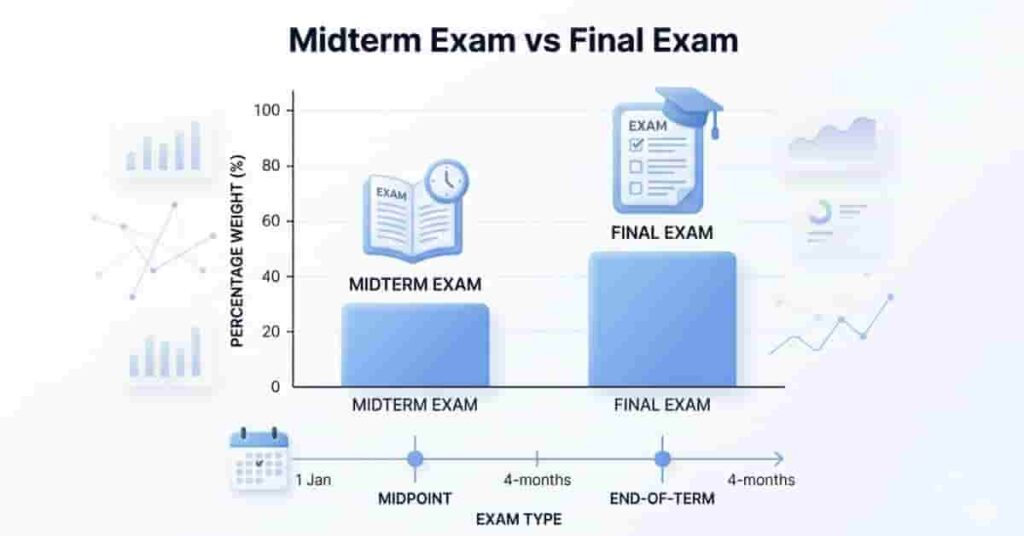
Midterm and final exams play a major role in how teachers calculate final grades in school and college. These exams test your overall understanding of the subject, not just small topics. Many courses in the USA give these exams higher weight because they reflect long-term learning. If you perform well, they can boost your grade. If you perform poorly, they can also lower it quickly.
Understanding their role helps students plan better study strategies. Rather than focusing solely on homework, students must prepare for these major exams early.
Why Midterms Matter
Midterm exams check your progress halfway through the course. Teachers use them to see how well students understand early topics. They also help identify weak areas before the final exam.
A strong midterm score can reduce pressure later in the semester. It gives you a solid base that supports your final grade. On the other hand, a low midterm score is not the end, but it does mean you need stronger performance in later assessments.
How Final Exams Affect Overall Grades
Final exams often carry the highest weight in a course. Many schools and colleges assign 20% to 50% of the total grade to the final exam. This makes it one of the most important assessments.
Since finals cover the entire course, they test full understanding. A strong final exam can significantly improve your overall grade. However, weak performance can also lower your final result even if earlier grades were good.
Can a Final Exam Significantly Change Your Grade?
Yes, a final exam can significantly affect your grade, especially in weighted systems. The impact depends on how much the exam is worth and your current grade.
For example, if your current grade is 75% and the final exam is worth 40%, scoring high on the exam can raise your final grade to the B range. But if you score low, your grade can drop to a C or lower.
In another case, a student with an 88% average may still fall to a B if the final exam score is very low. This shows why final exams are critical for protecting or improving your overall performance.
Weighted and Point-Based Grading Systems

Teachers use different methods to calculate final grades in school and college. The two most common systems are weighted grading and point-based grading. Both systems aim to measure student performance fairly, but they calculate results differently. Understanding the difference helps students predict their final grade more accurately.
These systems decide how much each assignment, test, or exam contributes to your overall score. Some courses focus more on major exams, while others value consistent performance across all tasks.
Weighted Grading Systems
In a weighted grading system, each category has a fixed percentage of the final grade. For example, homework may count for 20%, quizzes for 20%, midterms for 30%, and final exams for 30%.
This system places greater emphasis on major assessments, such as exams and projects. Even if you score well on homework, a low exam score can still lower your final grade. Weighted grading is common in both high school and college because it reflects different skill levels and learning outcomes.
Point-Based Grading Systems
In a point-based system, every assignment has a specific point value. Your final grade depends on the total points you earn compared to the total points available.
For example, if a course has 1,000 total points and you earn 850, your grade is 85%. All tasks contribute based on their assigned points, so larger assignments naturally have more impact. This system rewards consistency across all work instead of focusing on category weights.
Which System Is More Common?
Both systems are widely used in the USA, but weighted grading is more common in college courses. High schools often use a mix of both, depending on the teacher or district policy.
Weighted systems are preferred for structured evaluation of exams and major projects. Point-based systems are simpler and easier for students to track. The choice depends on the course design and learning goals defined in the syllabus.
How Letter Grades Are Assigned
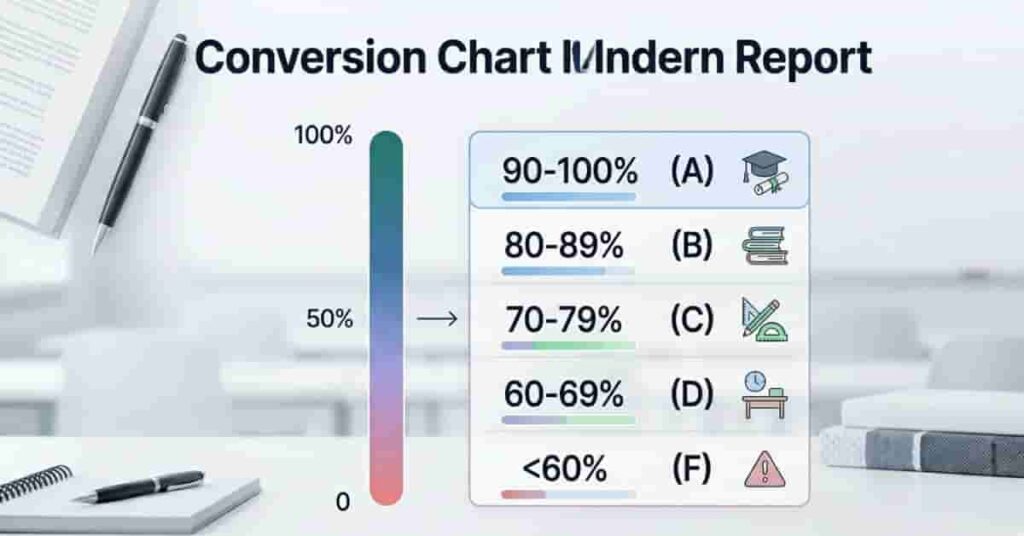
Letter grades show your final performance in a simple format like A, B, C, D, or F. Teachers convert your final percentage into a letter grade using a grading scale. This is a key part of how teachers calculate final grades in school and college because it turns raw scores into an easy-to-understand result. Most schools in the USA use a standard scale, but exact cutoffs can vary by institution or instructor.
The process starts after all assignments, exams, and activities are combined into one final percentage. Teachers then compare that percentage to the grading chart defined in the syllabus or school policy. For example, a score of 90% or above is often an A, while lower ranges fall into B, C, D, or F categories. This system helps standardize performance across different subjects and classes.
Understanding letter grade conversion is important because small percentage changes can move you between grade levels. A few points can make the difference between a B and an A, especially in weighted courses. That’s why students should always track their percentages throughout the semester.
Percentage to Letter Grade Conversion
Teachers use a percentage-to-letter system to translate final scores into grades. While exact ranges may differ, most schools in the USA follow a similar structure. An A usually represents excellent performance, often starting around 90% or higher. A B reflects good performance, typically in the 80–89% range. A C shows average performance, usually between 70–79%. An A indicates above-average understanding, often around 60–69%, while an F means failing the course.
This system helps simplify final results for students, parents, and colleges. Instead of reviewing detailed scores, they can quickly understand performance through a single letter. However, even small percentage changes can shift a student between grades. For example, moving from 89% to 90% can change a B into an A in strict grading systems. This is why students should track every assignment carefully during the semester.
Why Grading Scales Differ Between Schools
Grading scales are not the same in every school or college. Each institution sets its own policy based on academic standards, difficulty level, and evaluation goals. Some schools use stricter cutoffs, while others allow more flexible ranges.
For example, one school may set an A at 90%, while another may require 93% or higher. Colleges often define these rules in the course syllabus, and professors must follow them. Differences also appear between subjects, especially in competitive or technical courses where grading standards may be tighter.
These variations exist to match different learning environments. A strict scale may encourage higher performance, while a flexible scale may reduce pressure on students. Understanding your school’s grading scale helps you avoid confusion and plan your academic goals more effectively.
Factors That Can Affect Final Grades
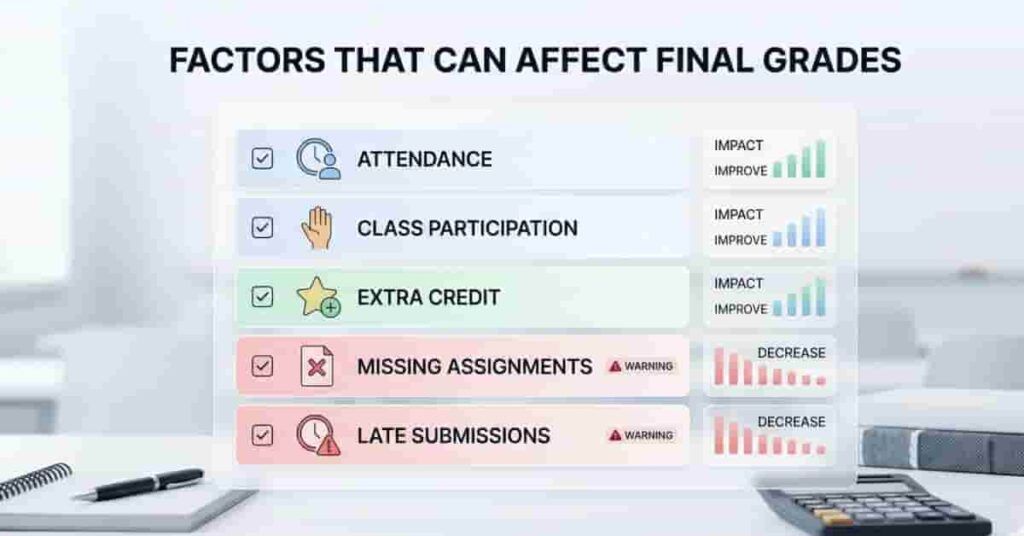
Final grades do not depend only on tests and exams. Teachers also consider several academic and behavioral factors when they calculate final grades in school and college. These factors can raise or lower your overall score, even if your exam performance is strong. Understanding them helps students avoid unexpected grade drops and stay consistent throughout the semester.
Most schools in the USA include policies in the syllabus that explain how attendance, participation, and assignment rules affect the final grade. These rules ensure fairness and encourage consistent effort instead of last-minute studying.
Attendance Policies
Attendance can directly impact your final grade in many classes. Some teachers include attendance as a percentage of the total grade, while others use it indirectly through participation or classwork. Missing too many classes can lower your score, even if your exam results are good.
Regular attendance helps you stay up to date with lessons and assignments. It also shows responsibility and engagement in the course. In some classes, poor attendance may even lead to grade penalties or loss of eligibility for higher grades.
Participation Requirements
Participation measures how actively you engage in class activities. This can include answering questions, joining discussions, and working in groups. Teachers often use participation to evaluate effort and understanding beyond written tests.
Strong participation can improve your overall grade, especially in borderline cases. However, low participation may reduce your final score, even if your academic performance is average. Many teachers use participation as a small but important part of grading.
Extra Credit Opportunities
Extra credit gives students a chance to improve their final grade. These opportunities may include bonus assignments, special projects, or additional quizzes. Not all teachers offer extra credit, and it usually depends on the course policy.
Extra credit can help slightly raise a low or borderline grade. However, it should not be seen as a replacement for regular coursework. Teachers usually use it as a reward for extra effort, not as a way to fix missing work.
Missing Assignments
Missing assignments can significantly lower your final grade. Each missed task reduces your total score and affects category averages. Even small assignments add up over time and impact your final result.
Teachers often assign a zero for missing work, which can heavily reduce your overall percentage. Completing all assignments on time is one of the easiest ways to protect your grade.
Late Submission Penalties
Late submissions usually incur a grade penalty. Teachers may deduct a fixed percentage for each day an assignment is late. Some courses also have strict deadlines where late work is not accepted at all.
These penalties can quickly reduce your overall score, especially for high-value assignments. Submitting work on time helps you avoid unnecessary grade loss and maintain stable performance throughout the course.
Factors That Can Affect Final Grades
Final grades are not based only on exams and quizzes. Teachers also look at behavior, consistency, and class engagement. These factors can raise or lower your final grade in school and college. Most teachers in the USA explain these rules in the syllabus before the course begins. Understanding them helps you avoid surprise grade drops at the end of the term.
Even small habits, like missing classes or turning in late work, can slowly affect your overall score. That’s why it’s important to follow all course rules, not just study for tests.
Attendance Policies
Attendance often plays a direct or indirect role in your final grade. Some teachers include it as a separate percentage, while others connect it to participation or classwork. Missing too many classes can lower your grade, even if your test scores are strong.
Regular attendance keeps you up to date on lessons, homework, and announcements. It also shows responsibility and commitment to the course. In strict grading systems, poor attendance can even prevent you from reaching higher grade levels.
Participation Requirements
Participation measures how actively you take part in class activities. This includes answering questions, joining discussions, and working in group tasks. Teachers use it to judge effort and understanding beyond written exams.
Good participation can help improve your final grade, especially if your scores are close between two letter grades. Low participation may reduce your overall performance score, even if your academic work is decent.
Extra Credit Opportunities
Extra credit gives students a chance to earn additional points. Teachers may offer bonus assignments, optional projects, or small quizzes for this purpose. However, not every course includes extra credit options.
Extra credit can slightly improve your final grade, especially if you are close to the next letter grade. Still, it should not replace regular assignments or studying. It works best as a small boost, not a recovery plan.
Missing Assignments
Missing assignments can seriously affect your final grade. Each missed task usually counts as zero, which lowers your overall percentage. Even small assignments matter because they add up over time.
Too many missing tasks can drop your grade quickly, even if you perform well on exams. Completing all assignments on time is one of the easiest ways to protect your final result.
Late Submission Penalties
Late submissions often come with grade deductions. Many teachers reduce marks for each day an assignment is late. Some courses may not accept late work at all.
These penalties can lower your score fast, especially for major assignments. Submitting work on time helps you maintain a stable and higher final grade throughout the course.
Common Student Misunderstandings About Final Grades
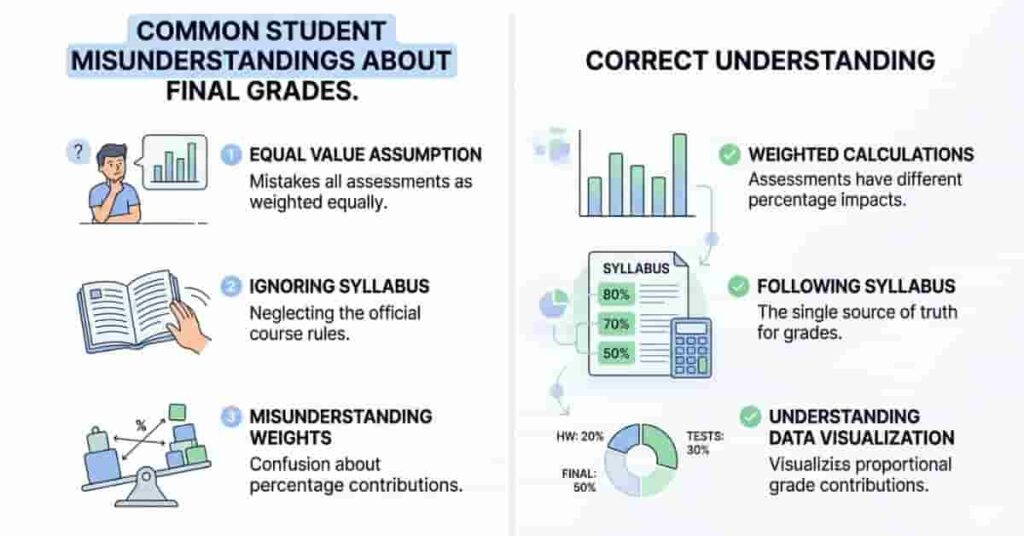
Many students in school and college misunderstand how final grades are actually calculated. These mistakes often lead to confusion and unexpected results at the end of the semester. In the USA, grading systems follow clear rules, but students sometimes overlook key details in the syllabus. Understanding these common mistakes helps you avoid losing easy points.
Most problems happen when students focus only on scores without understanding weight, structure, or policy rules. A clear understanding of how teachers calculate final grades in school and college can prevent these issues early.
Assuming Every Assignment Has Equal Value
One common mistake is thinking all assignments carry the same importance. In reality, some tasks have much higher weight than others. For example, a final exam often matters more than weekly homework.
When students treat every task equally, they may focus too much on low-value work. This can hurt their overall performance. Understanding assignment weight helps you prioritize your study time more effectively.
Ignoring the Course Syllabus
Many students ignore the syllabus, but it is the most important grading document. It explains how final grades are calculated, including weights, deadlines, and policies.
Skipping the syllabus can lead to surprises later in the course. Students may miss key grading rules or penalties. Reading it early helps you plan better and avoid unnecessary mistakes.
Misunderstanding Weighted Categories
Weighted grading can confuse students accustomed to simple percentage systems. In a weighted system, categories like exams or projects may count more than homework.
A high homework score cannot always balance a low exam score. Students often misjudge their performance because they do not understand category weights. Learning how weights work helps you estimate your real grade more accurately.
Expecting Extra Credit to Fix Everything
Extra credit is helpful, but it is not a complete solution. Some students rely on it to fix poor performance or missing work. This is a risky strategy.
Teachers usually offer extra credit in small amounts. It can slightly improve your grade but cannot replace consistent effort. The best approach is to complete all regular assignments on time and use extra credit only as a bonus.
Conclusion
This article explained how teachers calculate final grades in school and college. You learned about grading systems, key components, and how different policies affect your final score. Understanding these methods makes it easier to predict your academic results with confidence.
Knowing how teachers calculate final grades helps you stay in control of your performance. It also reduces confusion when grades change due to weightings, exams, or participation rules. Every school and instructor may use slightly different grading methods, so checking your syllabus is always important.
Stay proactive by tracking your grades throughout the semester. Use a Final Grade Calculator to estimate your results and plan improvements early. If this guide helped you, share it with classmates or leave a comment with your experience to help others learn too.

Team ClassRank builds smart, student-friendly calculators to make grade and rank tracking simple and accurate. For questions or feedback, contact us at classrankcalculator@gmail.com.