

Table of Contents
Introduction
Have you ever wondered why two students with similar grades end up with different GPAs?
Understanding how to calculate high school GPA is important for every student in the USA. Your GPA affects college admissions, scholarship chances, and even class ranking in some schools. Many beginners feel confused because grading systems can change from school to school. Some use a weighted GPA, while others follow a simple 4.0 scale.
This confusion often leads to mistakes when students try to estimate their academic performance. That is why learning the correct method matters early in high school. It helps you stay on track and set realistic academic goals.
In this guide, you will learn how GPA works in US high schools in a simple way. We will break down the 4.0 scale, explain step-by-step calculations, and show real examples. By the end, you will clearly understand your grades and be able to calculate your GPA in minutes with confidence.
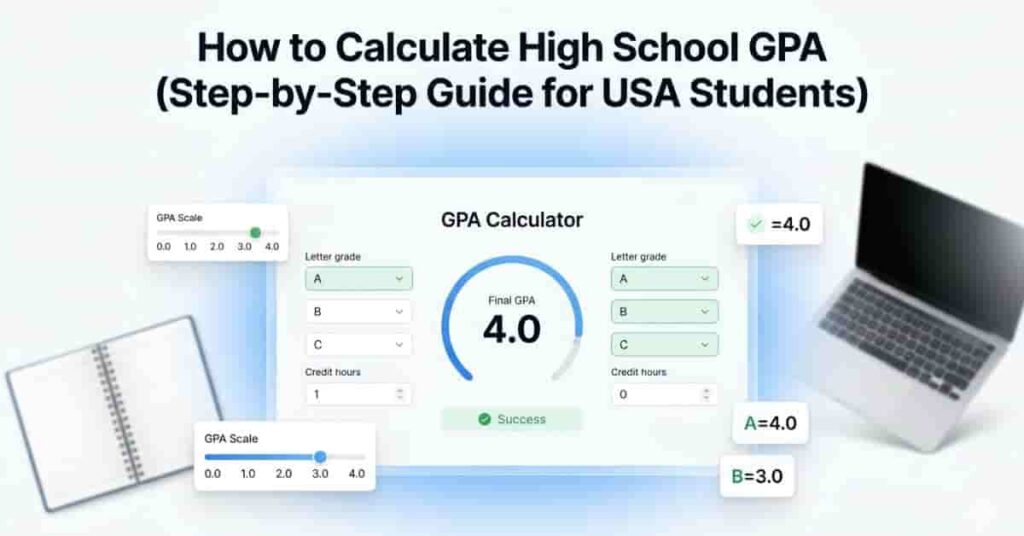
If you don’t want to calculate manually, you can quickly check your result using our High School GPA Calculator.
What Is a High School GPA?
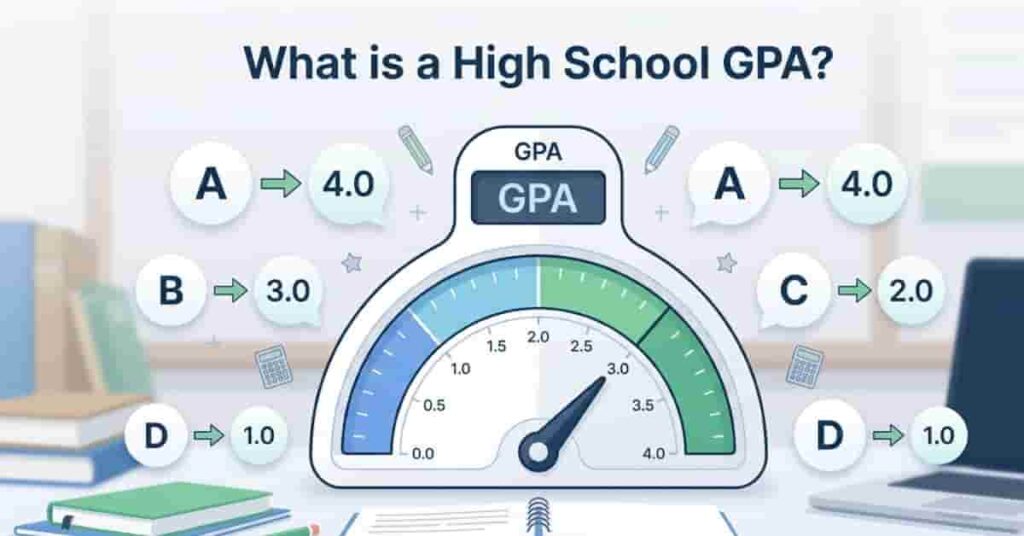
A high school GPA, or Grade Point Average, is a number that represents your overall academic performance. Schools calculate it by converting your letter grades into grade points and averaging them across your classes. Colleges, scholarship programs, and academic organizations often use GPA to evaluate students.
Most U.S. high schools use a 4.0 GPA scale. On this scale, an A typically equals 4.0 points, a B equals 3.0 points, a C equals 2.0 points, and so on. The higher your GPA, the stronger your academic record appears. This simple system helps schools compare student performance across different subjects.
However, not every school calculates GPA in the same way. Some schools use an unweighted GPA, in which all classes carry equal weight. Others use a weighted GPA system that gives extra points for more challenging courses, such as Honors, Advanced Placement (AP), or International Baccalaureate (IB) classes.
Because grading policies vary, two students with similar grades may have different GPAs. That is why it is important to understand your school’s GPA system before calculating your results or comparing them with others.
Types of GPA in High School
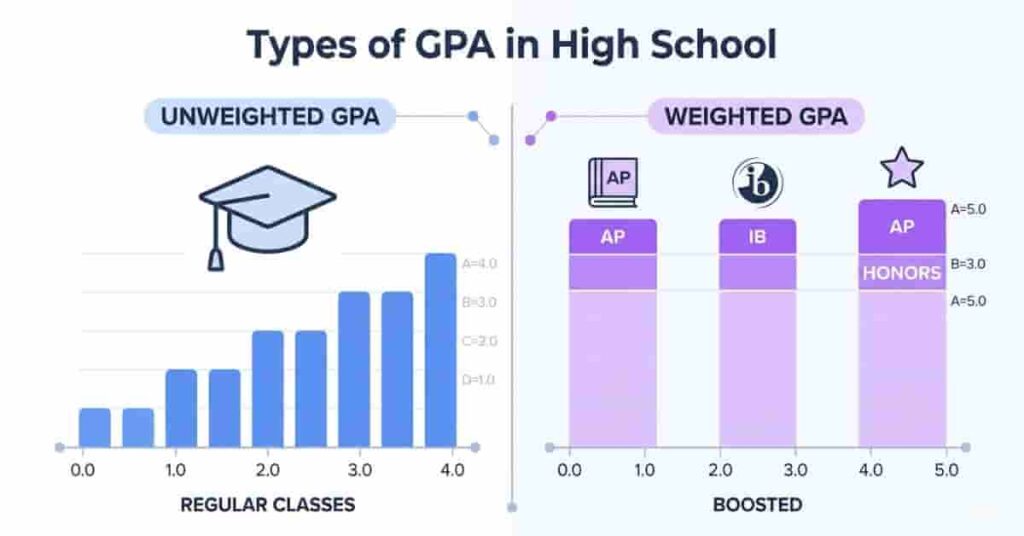
Most U.S. high schools use one of two GPA systems: unweighted GPA or weighted GPA. Both measure academic performance, but they calculate grades differently. Understanding the difference can help you interpret your GPA correctly and compare it with college admission requirements.
Some schools report only one GPA, while others provide both weighted and unweighted GPAs on transcripts. Knowing which system your school uses is important when evaluating your academic progress.
Unweighted GPA
An unweighted GPA uses the standard 4.0 scale and treats all classes equally. It focuses only on the grades you earn, not the difficulty of the courses you take.
In a typical unweighted GPA system:
- A = 4.0
- B = 3.0
- C = 2.0
- D = 1.0
- F = 0.0
For example, an A in a regular English class carries the same value as an A in an AP English class. The system does not reward students for taking more challenging courses.
Because of its simplicity, many colleges review unweighted GPA to get a consistent view of a student’s academic performance.
Pro Tip
When calculating an unweighted GPA, focus on earning strong grades across all subjects. Course difficulty does not change the grade point value.
Weighted GPA
A weighted GPA gives extra value to more challenging courses. Schools often use this system to recognize students who take advanced classes and maintain strong grades.
Weighted GPA systems commonly apply to:
- Honors courses
- AP (Advanced Placement) courses
- IB (International Baccalaureate) courses
In many schools, an A in a regular class equals 4.0 points, while an A in an Honors or AP class may be worth 4.5 or 5.0 points. As a result, students can earn a GPA higher than 4.0.
The exact weighting system varies by school. Some schools use a 5.0 scale, while others use different point adjustments for advanced courses.
Pro Tip
Always check your school’s grading policy before calculating a weighted GPA. Weight values can differ significantly between districts.
GPA Scale Explained (USA System)
Most U.S. high schools use a 4.0 GPA scale to measure academic performance. This system converts letter grades into numerical values called grade points. Schools then use these grade points to calculate a student’s Grade Point Average (GPA).
The 4.0 scale provides a simple way to compare academic achievement across different classes and grade levels. While some schools use slight variations, the standard scale below is the most common.
| Letter Grade | Grade Points |
| A | 4.0 |
| B | 3.0 |
| C | 2.0 |
| D | 1.0 |
| F | 0.0 |
For example, if you earn an A in Math and a B in English, those grades convert to 4.0 and 3.0 grade points before GPA calculations begin. Schools average these values based on the credits assigned to each course.
Some schools also use plus and minus grades, such as A-, B+, or C+. These grades may carry slightly different point values depending on the school’s grading policy.
Understanding the Weighted 5.0 Scale
Many high schools offer advanced courses that use a weighted GPA system. Instead of limiting top grades to 4.0 points, schools may award additional points for more rigorous classes.
A common weighted scale looks like this:
| Course Type | A Grade Value |
| Regular Course | 4.0 |
| Honors Course | 4.5 |
| AP or IB Course | 5.0 |
This means a student who excels in challenging classes can earn a GPA above 4.0. For example, a weighted GPA of 4.3 or 4.5 is possible in schools that reward advanced coursework.
Because weighting policies vary, always check your school’s grading handbook before calculating a weighted GPA.
Step-by-Step — How to Calculate GPA
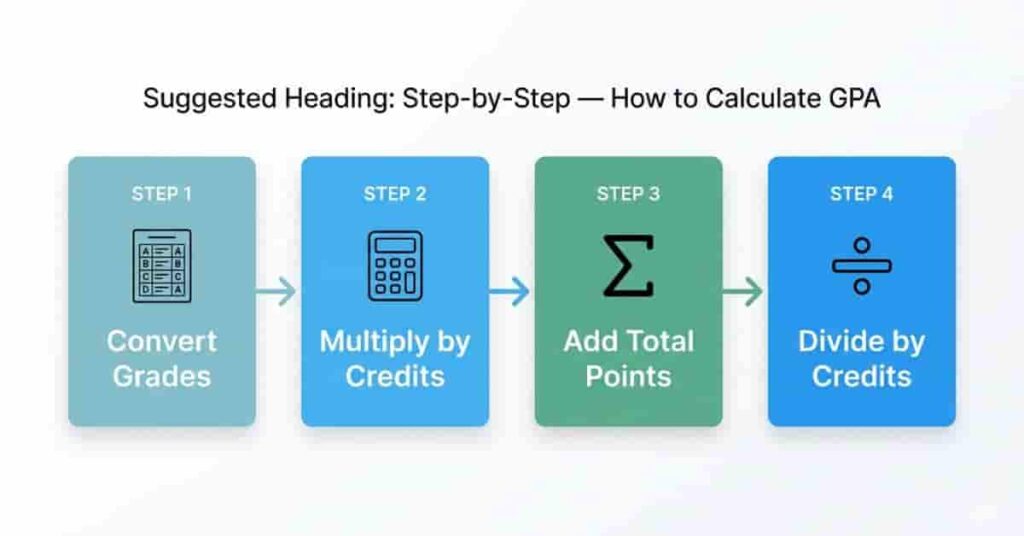
Learning how to calculate GPA is easier than many students think. Most high schools use the same basic process. You convert your grades into grade points, account for course credits, add everything together, and then calculate the average.
Whether you want to check your academic progress, prepare for college applications, or verify your transcript, these four simple steps will help you calculate your GPA accurately.
If you don’t want to calculate manually, you can quickly check your result using our High School GPA Calculator.
Step 1 — Convert Grades into Grade Points
Start by converting each letter grade into its corresponding grade point value. Most schools using an unweighted 4.0 scale follow a system similar to the one below:
| Letter Grade | Grade Points |
| A | 4.0 |
| B | 3.0 |
| C | 2.0 |
| D | 1.0 |
| F | 0.0 |
For example, if you earned an A in Math and a B in English, those grades become 4.0 and 3.0 grade points. Repeat this process for every class included in your GPA calculation.
Pro Tip
Check your school’s grading policy before converting grades. Some schools assign different values to plus and minus grades.
Step 2 — Multiply by Credits
After converting grades into grade points, multiply each grade point value by the course credit value.
Credits represent the weight of a class. A course worth two credits has a greater impact on your GPA than a course worth one credit.
For example:
- Math: A (4.0) × 1 credit = 4.0 grade points
- Science: B (3.0) × 2 credits = 6.0 grade points
This step ensures that higher-credit courses contribute proportionally to your GPA.
Pro Tip
Always use the official credit values listed on your transcript or course schedule.
Step 3 — Add Total Grade Points
Next, add all grade points earned from every course.
Using the previous example:
- Math = 4.0 grade points
- Science = 6.0 grade points
Total Grade Points = 10.0
If you are calculating GPA for a semester or school year, include every eligible course in the total.
This step provides the cumulative grade points required for the final calculation.
Pro Tip
Double-check your math before moving forward. Small calculation errors can affect your final GPA.
Step 4 — Divide by Total Credits
The final step is to divide your total grade points by your total credits earned.
GPA Formula
GPA = Total Grade Points ÷ Total Credits
Using the example above:
- Total Grade Points = 10.0
- Total Credits = 3
GPA = 10.0 ÷ 3 = 3.33
The result is your Grade Point Average. Most schools round GPA values to two decimal places.
Key Takeaways
- Convert each letter grade into grade points.
- Multiply grade points by course credits.
- Add all grade points together.
- Divide total grade points by total credits.
- Use your school’s grading system for the most accurate result.
GPA Formula (Simple)
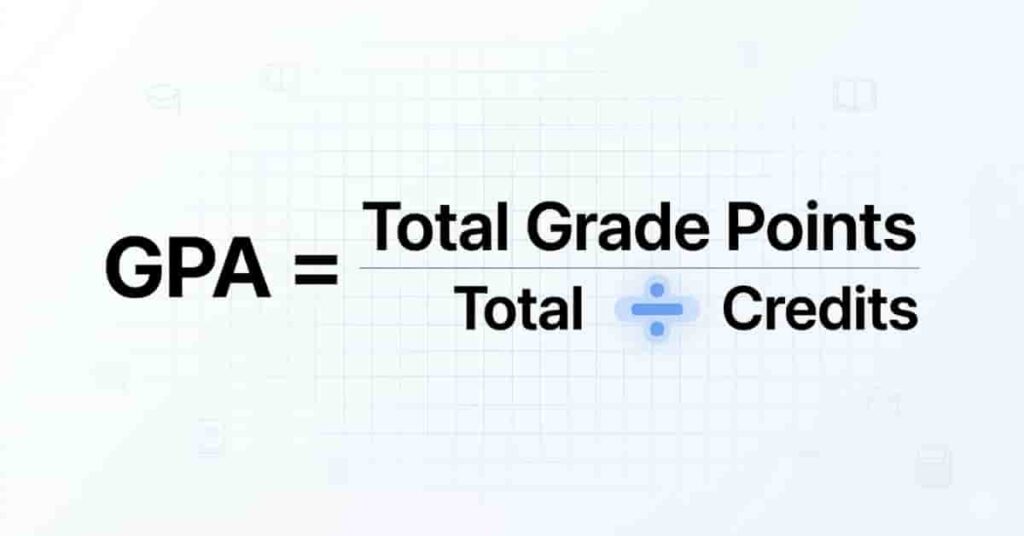
The GPA formula is the core of the entire calculation process. Once you convert your grades into grade points and apply course credits, this formula gives you your final Grade Point Average. It is simple, but it holds great importance for students in the U.S. education system.
Most high schools follow the same standard approach, especially when calculating unweighted GPA. You only need two values: total grade points and total credits. This makes the process consistent and easy to apply across different subjects and semesters.
The formula below is used in nearly all GPA calculations. Understanding it helps you double-check your results and avoid mistakes when calculating manually.
GPA Formula
GPA = Total Grade Points ÷ Total Credits
This means you add all your weighted or unweighted grade points first, then divide by the total number of credits you have completed.
For example, if your total grade points are 45 and your total credits are 15, your GPA would be 3.0.
You can also use the High School GPA Calculator to see your GPA instantly in seconds.
Pro Tip
Always make sure your credits match the courses that count toward your grade points. A mismatch can give you an incorrect GPA.
Example Calculation (Real Student Case)
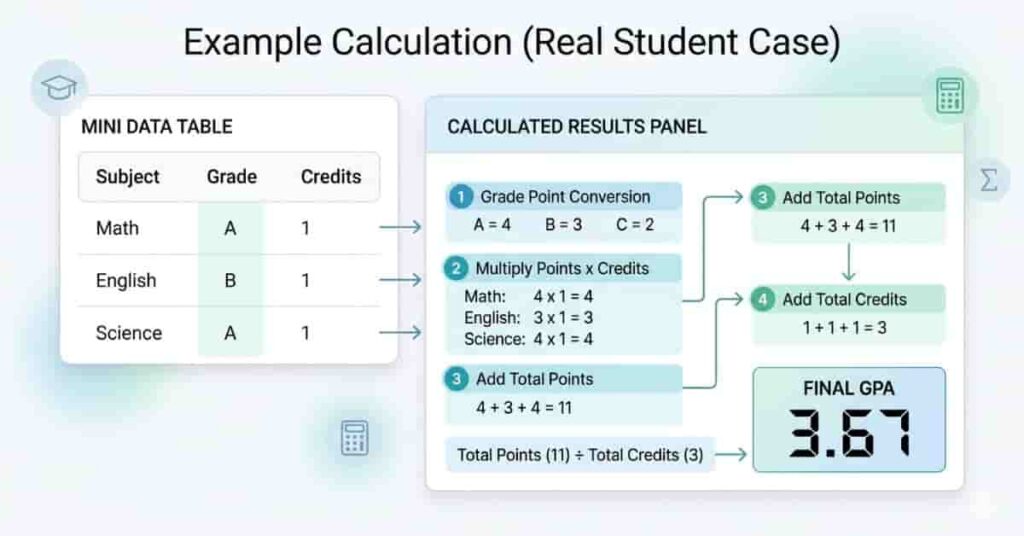
Seeing a real example makes the GPA calculation much easier to understand. In this section, we will walk through a simple student case using three common subjects. Each class has the same credit value, so the process stays straightforward and beginner-friendly.
This example uses the standard unweighted 4.0 GPA scale. We will convert grades into grade points, apply credits, and calculate the final GPA step by step.
Student Grades
- Math: A (1 credit)
- English: B (1 credit)
- Science: A (1 credit)
Step 1 — Convert Grades into Grade Points
First, we convert each letter grade into grade points:
- Math: A = 4.0
- English: B = 3.0
- Science: A = 4.0
Now we have all values in GPA format.
Step 2 — Multiply by Credits
Each subject has 1 credit, so we multiply grade points by credits:
- Math: 4.0 × 1 = 4.0
- English: 3.0 × 1 = 3.0
- Science: 4.0 × 1 = 4.0
Step 3 — Add Total Grade Points
Now we add all grade points together:
Total Grade Points = 4.0 + 3.0 + 4.0 = 11.0
Total Credits = 3
Step 4 — Divide to Get GPA
Now apply the GPA formula:
GPA = Total Grade Points ÷ Total Credits
GPA = 11.0 ÷ 3 = 3.67
Final Result
The student’s final GPA is 3.67 on a 4.0 scale.
Pro Tip
If all classes have equal credit values, GPA is calculated as the simple average of grade points. This is common in many high schools.
Weighted vs Unweighted GPA Difference
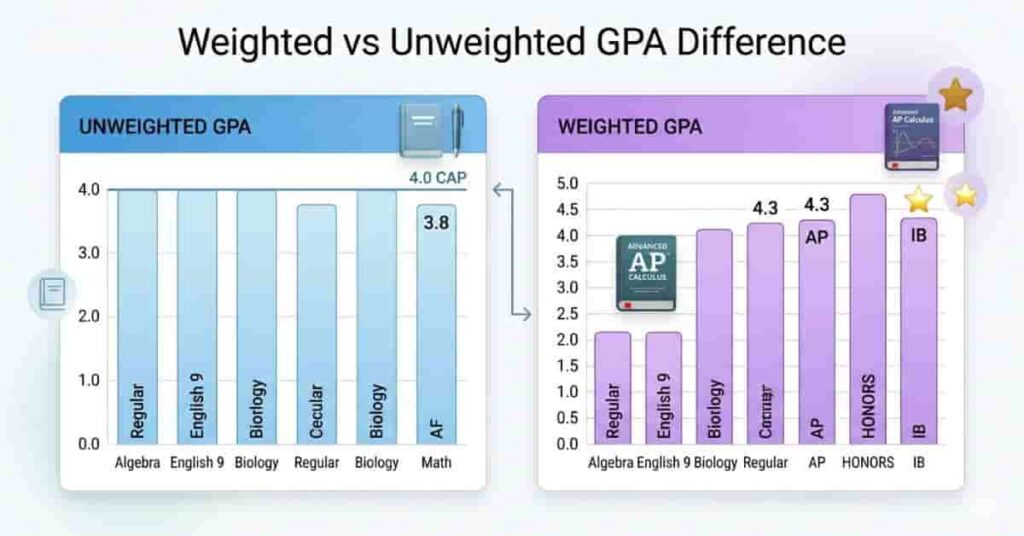
Understanding the difference between weighted and unweighted GPA is important for every high school student. Both measure academic performance, but they do it in different ways. Colleges often review both to understand how challenging your course load is and how well you performed.
An unweighted GPA focuses only on grades. A weighted GPA also considers course difficulty. This means two students with similar grades can still have different GPAs depending on the classes they take.
Side-by-Side Comparison
| Feature | Unweighted GPA | Weighted GPA |
| Scale | 4.0 max | Can exceed 4.0 |
| Focus | Grades only | Grades + course difficulty |
| Advanced classes | No extra value | Extra points added |
| Difficulty impact | Not considered | Fully considered |
An unweighted GPA provides a simple view of academic performance. Weighted GPA provides a more detailed picture by rewarding students who take more challenging classes, such as AP or IB courses.
When Weighted GPA Is Higher
Weighted GPA becomes higher when a student takes advanced courses and performs well in them. For example, an A in an AP class may count as 5.0 instead of 4.0 in some schools. This increases the overall GPA compared to unweighted calculations.
Students who take more Honors or AP classes usually see a noticeable boost in their weighted GPA. However, the exact increase depends on the school’s grading policy.
Why Colleges Care
Colleges look at both GPA types to get a full picture of academic ability. The unweighted GPA reflects consistent performance across subjects. Weighted GPA reflects the academic challenge a student has taken on.
A student with a slightly lower unweighted GPA but a strong weighted GPA may still stand out. It shows they handled difficult coursework successfully.
Common Mistakes Students Make
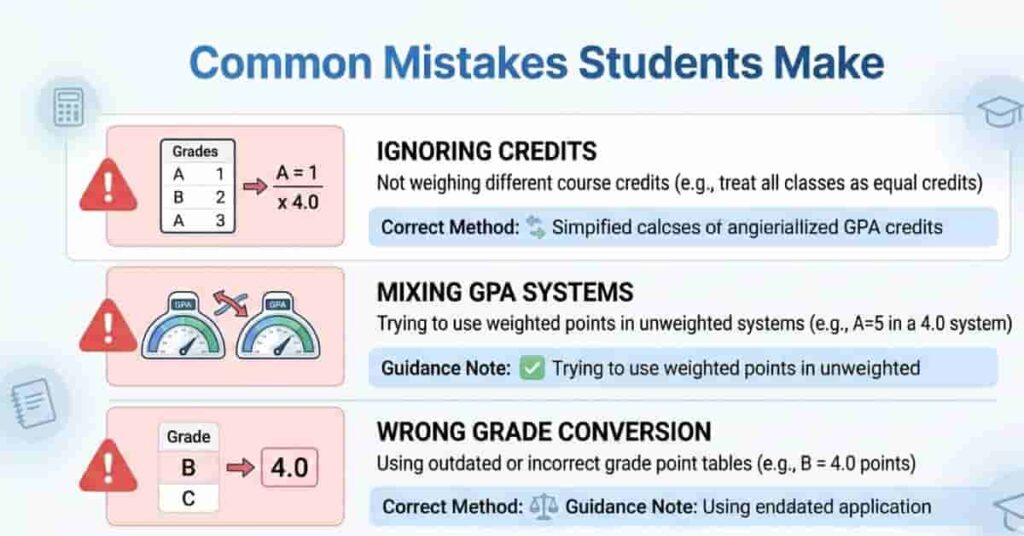
Many students calculate their GPA incorrectly because they miss small but important details. These mistakes can lower accuracy and create confusion when comparing grades or planning for college. Understanding these errors helps you calculate your GPA correctly the first time.
Most mistakes happen during grade conversion, credit handling, or mixing different GPA systems. Even a small error can change your final GPA, especially when you have many courses.
Ignoring Credits
One of the most common mistakes is ignoring course credits. Not all classes carry the same weight. A class with more credits has a bigger impact on your GPA than a single-credit course.
When students skip this step, they often treat all classes equally. This leads to an incorrect GPA because it does not reflect the real academic weight of each subject.
Always check your transcript or course list for credit values before calculating.
Confusing Weighted and Unweighted GPA
Another frequent mistake is mixing weighted and unweighted GPA systems. These two systems follow different rules.
Unweighted GPA uses a standard 4.0 scale. Weighted GPA awards extra points for advanced classes, such as Honors or AP courses. If you mix both systems, your final result will be inaccurate.
Students often overestimate their GPA by applying weighted values to unweighted systems. This can cause problems during college applications if the numbers do not match official records.
Wrong Grade Conversion
Incorrect grade conversion is another common issue. Each letter grade must be converted into the correct grade point value before doing any calculations.
For example, A = 4.0 and B = 3.0 in most schools. If you assign the wrong values, your GPA will be completely off.
Some students also forget plus and minus grading variations, which can slightly change the final result depending on school policy.
Visual GPA Understanding (Optional Embed Section)
A visual chart makes GPA conversion much easier to understand. Instead of memorizing rules, you can clearly see how each letter grade turns into a GPA value. This helps beginners quickly understand the 4.0 scale system used in most U.S. high schools.
The chart below shows how common letter grades convert into GPA points. It focuses on the standard unweighted scale, where each grade has a fixed value. This is the foundation of all GPA calculations, whether you calculate manually or use a GPA calculator.
This visual makes one thing very clear: every step down in grade reduces your GPA by one point on the standard scale. An A carries the highest value, while an F contributes zero points. This simple structure is why GPA calculations stay consistent across most schools.
Understanding this relationship helps you predict how future grades will affect your overall GPA. Even a single grade improvement can make a noticeable difference over time, especially when credits are involved.
Pro Tip
Focus on turning C grades into B grades first. That small improvement often creates the biggest GPA boost over a semester.
Why GPA Matters for Students
Your GPA is more than just a number on your report card. It plays a major role in shaping your academic future in the United States. Colleges, scholarship programs, and schools use GPA to quickly understand how consistent and strong your academic performance is over time.
A good GPA can open doors to better opportunities. A low GPA does not end your chances, but it may limit your options. That is why understanding how GPA works helps you plan your academic path more effectively.
College Admissions
Most colleges in the U.S. use GPA as a key factor in admission decisions. It helps them compare students from different schools and backgrounds in a standardized way.
Admissions officers consider both your GPA and the difficulty of your courses. A strong GPA shows consistency, discipline, and academic readiness. Competitive colleges often expect higher GPAs, especially in core subjects like math, science, and English.
Even if your GPA is slightly lower, strong extracurricular activities or test scores can help balance your application.
Scholarships
Many scholarships use GPA as an eligibility requirement. Some awards require a minimum GPA, while others give higher funding to students with stronger academic performance.
A higher GPA can increase your chances of qualifying for merit-based scholarships. These awards often help reduce college costs and financial stress for students and families.
Because of this, maintaining a strong GPA from early high school years can have long-term financial benefits.
Class Ranking
Some schools use GPA to determine class ranking. Class rank shows how your academic performance compares with other students in your grade.
While not all schools publish class rankings, it is still commonly used for honors recognition and college applications. A higher GPA usually improves your class standing.
However, class rank is only one part of your academic profile and should not be the only focus.
Conclusion
This guide explained what GPA means, how the 4.0 scale works, and how schools calculate it. We also covered weighted vs unweighted GPA, step-by-step methods, and real examples. Now you can clearly understand how your grades turn into a final number.
Understanding how to calculate high school GPA helps you track your academic progress with confidence. It also makes college planning and scholarship preparation much easier. Small improvements in grades can create a real difference over time.
Stay consistent with your studies and focus on steady improvement each semester. Use a GPA calculator to save time and avoid mistakes when checking your results.
For a faster way, just try the High School GPA Calculator and understand your grades easily.
If you found this guide helpful, share it with other students or leave a comment with your questions. You can also explore more tools on our website to better plan your academic goals.

Team ClassRank builds smart, student-friendly calculators to make grade and rank tracking simple and accurate. For questions or feedback, contact us at classrankcalculator@gmail.com.