


Introduction
Ever wondered, “What do I need on my final exam to get the grade I want?” You’re not alone.
Many students check their grades near the end of the semester and realize that one exam could make a big difference. Whether you’re aiming for an A, trying to pass a course, or hoping to boost your GPA, knowing your required final exam score can help you plan smarter and reduce stress. This is where learning how to calculate what you need on your final exam becomes important.
The good news is that the process is simpler than most students think. With your current grade, target grade, and final exam weight, you can quickly estimate the score you need. Some students also use a Final Exam Calculator to get instant results and avoid math mistakes.
In this guide, you’ll learn the exact formula, follow step-by-step examples, and understand how weighted grades affect your results. By the end, you’ll know exactly where you stand and what score you need to reach your goal.
What Does “What You Need on Your Final Exam” Mean?

When students ask what they need on their final exam, they want to know the minimum score required to reach a specific course grade. This target grade could be an A, B, C, or simply a passing grade. Knowing this number helps you set realistic goals before exam day.
Your final exam often has a significant impact on your overall course grade. Many colleges and high schools in the United States assign a percentage weight to final exams. For example, a final exam might count for 20%, 30%, or even 50% of your total grade. The higher the exam weight, the more influence it has on your final result.
A student with an 88% course average may only need a moderate score to keep an A. Another student with a 72% average may need a much higher score to reach a B. The required score depends on three key factors:
- Your current course grade
- Your desired final grade
- The weight of the final exam
Calculating your required final exam score before test day helps you avoid surprises. It also allows you to create a study plan based on your actual grade goal instead of guessing. Many students use a Final Exam Calculator to get quick and accurate results, but understanding the calculation can help you make better academic decisions throughout the semester.
If you prefer a quicker solution instead of doing the calculations yourself, our guide on what grade you need on your final exam can help you find the answer in seconds.
Information You Need Before Calculating Your Final Exam Score

Before you calculate what you need on your final exam, gather a few important details. Even a small mistake in these numbers can lead to an incorrect result. Most schools provide this information in their learning management systems, course syllabi, or gradebooks.
Current Course Grade
Your current course grade is the average you have earned before taking the final exam. It includes completed assignments, quizzes, projects, and previous tests. Check your gradebook to find the most up-to-date percentage.
For example, if your current average is 84%, that number becomes the starting point for your calculation. Always use the latest grade available for the most accurate estimate.
Desired Final Course Grade
Next, decide what final course grade you want to achieve. Your goal may be to earn an A, maintain a scholarship requirement, improve your GPA, or simply pass the class.
Common grade goals include:
- 90% or higher for an A
- 80% or higher for a B
- 70% or higher for a C
- Passing grade requirements set by your school
Choose a realistic target based on your current standing and course requirements.
Final Exam Weight
The final exam weight shows how much the exam contributes to your overall course grade. In many U.S. courses, final exams count for 10% to 50% of the total grade.
For example:
- 20% weight = final exam affects one-fifth of your grade
- 40% weight = final exam has a much larger impact
- 50% weight = half of your course grade depends on the exam
You can usually find this information in your course syllabus.
Grading Scale Requirements
Different schools and instructors may use different grading scales. One course may consider 90% an A, while another may require 93% or higher.
Before calculating your required final exam score, confirm the grading scale used in your class. This step helps ensure that your target grade matches your instructor’s requirements.
Final Exam Score Formula Explained
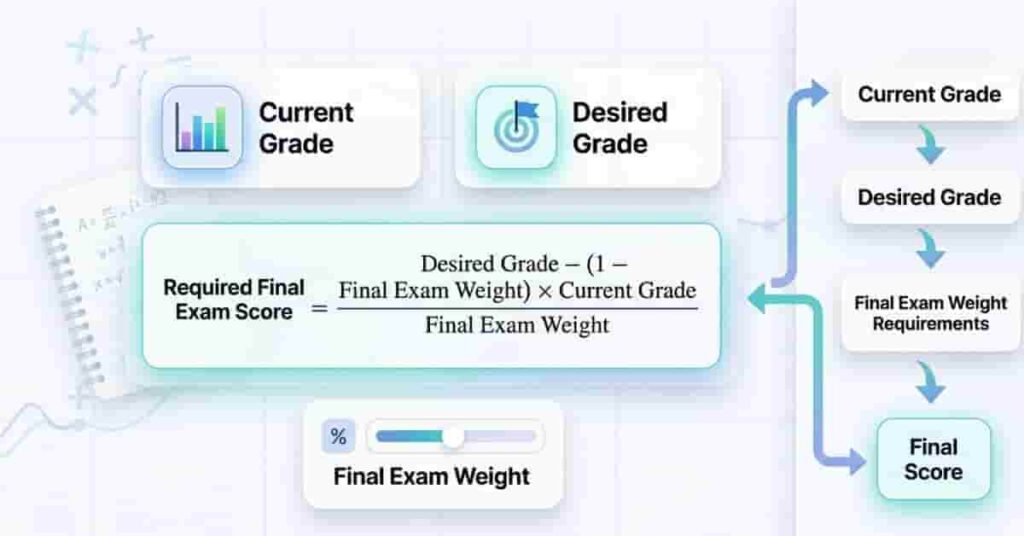
Once you know your current grade, target grade, and final exam weight, you can calculate the score needed on your final exam. This formula helps students estimate the minimum score required to reach a specific course grade.
The calculation works by comparing your current performance with your desired final outcome. It then determines how much your final exam must contribute to closing the gap.
Formula
Make sure you convert the final exam weight into decimal form before using the formula. For example, 30% becomes 0.30 and 40% becomes 0.40.
What Each Variable Means
Understanding each part of the formula makes the calculation much easier.
Current Grade
Your current grade is the average you have earned before taking the final exam. This number includes all completed coursework, such as assignments, quizzes, projects, and tests.
For example, if your course average is 85%, your current grade is 85.
Desired Grade
The desired grade is the final course grade you want to achieve after the exam. This could be a grade needed for graduation, a scholarship, or a personal academic goal.
For example, if you want to finish the course with a 90% average, your desired grade is 90.
Final Exam Weight
The final exam weight represents the percentage of your overall course grade that comes from the final exam. Courses often assign weights ranging from 10% to 50%.
Examples include:
- 20% exam weight = 0.20
- 30% exam weight = 0.30
- 50% exam weight = 0.50
Using the correct weight is critical. Even a small mistake can significantly change the final result.
After learning the formula, you can use our calculator guide to quickly determine the exact score required to reach your desired course grade.
Pro Tip
Before using the formula, double-check that all grades use the same format. If your grades are percentages, keep everything in percentages. Do not mix percentage values with point totals unless you convert them first.
Example #1: Current Grade and Final Exam Weight
Examples make the formula easier to understand. Let’s start with a common situation where a student wants to improve an already strong course grade.
Scenario
- Current grade: 85%
- Desired course grade: 90%
- Final exam weight: 30% (0.30)
Step-by-Step Calculation
Using the formula:
First, calculate the weighted portion of the current grade:
- 85 × 0.70 = 59.5
Next:
- 90 − 59.5 = 30.5
Finally:
- 30.5 ÷ 0.30 = 101.67
Final Result Explained
The student would need about 101.7% on the final exam to finish with a 90% course grade.
Since most exams are capped at 100%, this goal may not be achievable without extra credit opportunities. This example shows why checking your required score early is important.
Pro Tip
If your required score exceeds 100%, consider adjusting your target grade and focusing on realistic goals.
Example #2: Percentage-Based Grade Calculation
Many students use percentage grades throughout the semester. The calculation process remains the same regardless of the grading system.
Scenario
- Current grade: 72%
- Desired grade: 80%
- Final exam weight: 40% (0.40)
Calculation Process
Insert the values into the formula:
Calculate the current grade contribution:
- 72 × 0.60 = 43.2
Subtract from the target grade:
- 80 − 43.2 = 36.8
Divide by the exam weight:
- 36.8 ÷ 0.40 = 92
Final Result
The student needs a 92% on the final exam to earn an overall course grade of 80%.
While challenging, this target is still realistic with focused preparation and a strong study plan.
Example #3: What If Your Final Exam Is Worth 50%?
When a final exam counts for half of your course grade, it has a much greater impact on your outcome. High-weight finals can significantly raise your grade, but they can also lower it if you perform poorly.
Why High-Weight Finals Matter
A 50% final exam means half of your grade is still undecided. Students who struggled earlier in the semester may have a chance to recover. Students with strong grades must protect their progress.
This is why many college courses place extra emphasis on final exam preparation.
Sample Calculation
Assume:
- Current grade: 78%
- Desired grade: 85%
- Final exam weight: 50% (0.50)
Apply the formula:
Calculate:
- 78 × 0.50 = 39
- 85 − 39 = 46
- 46 ÷ 0.50 = 92
The student must score 92% on the final exam to finish the course with an 85% average.
Key Takeaways
- Higher exam weights create larger grade changes.
- A 50% final can dramatically improve or reduce your final grade.
- Calculating your target score helps you create a realistic study strategy.
- Checking your required score early gives you more time to prepare.
Weighted Grades vs Unweighted Grades

Before calculating what you need on your final exam, it helps to understand whether your course uses weighted or unweighted grades. This difference affects how assignments, quizzes, tests, and final exams contribute to your overall course grade.
Many colleges and high schools in the United States use weighted grading systems. However, some courses still use a simple unweighted average.
What Is a Weighted Grade?
A weighted grade gives different levels of importance to different course components. For example, a final exam may count for 30% of your grade, while homework counts for only 10%.
In a weighted course, larger assignments have a greater impact on your final average.
A typical weighted grading structure might look like this:
- Homework: 15%
- Quizzes: 20%
- Midterm Exam: 35%
- Final Exam: 30%
Because each category has its own weight, improving your score in a high-value category can make a noticeable difference.
What Is an Unweighted Grade?
An unweighted grade treats all assignments equally unless the instructor states otherwise. Every score contributes to the final average without separate percentage weights.
For example, if you complete ten assignments, each assignment has the same impact on your overall grade.
This system is often easier to understand because it relies on a straightforward average rather than category percentages.
Which One Does Your Course Use?
The easiest way to find out is to check your course syllabus or grading policy. Most instructors clearly explain how grades are calculated at the beginning of the semester.
Look for phrases such as:
- Assignment categories
- Grade weights
- Percentage breakdown
- Final exam weight
If your syllabus lists percentages for homework, quizzes, tests, or exams, your course uses a weighted grading system. If all assignments count equally toward the final grade, it likely uses an unweighted system.
Pro Tip
Always confirm your grading method before using a final exam calculator or formula. Using the wrong grading system can produce misleading results and unrealistic grade targets.
Points-Based Grading vs Percentage-Based Grading

Students often confuse points-based grading with percentage-based grading. While both systems measure academic performance, they calculate final grades differently. Understanding which system your course uses can help you avoid mistakes when estimating your final exam score.
Points System Explained
In a points-based course, every assignment, quiz, test, and exam is worth a specific number of points. Your final grade depends on the total points you earn compared to the total points available.
For example:
- Homework: 100 points
- Quizzes: 200 points
- Midterm: 300 points
- Final Exam: 400 points
If the course offers 1,000 total points and you earn 850, your final grade is 85%.
Many instructors prefer this system because it is simple to track throughout the semester.
Percentage System Explained
In a percentage-based course, each assignment category contributes a specific percentage to your overall grade. The final grade is based on weighted averages rather than total points.
For example:
- Homework: 20%
- Quizzes: 20%
- Midterm: 30%
- Final Exam: 30%
In this system, strong performance in a heavily weighted category can have a larger impact than several smaller assignments.
Most final exam formulas and calculators use percentages and category weights when estimating required scores.
Common Student Confusion
A common mistake is treating points and percentages as the same thing. Students may see an 80-point assignment and assume it equals 80%, which is not always correct.
Another source of confusion occurs when students enter point totals into a percentage-based calculator. This can produce inaccurate results and unrealistic grade targets.
Before calculating your required final exam score, confirm whether your instructor uses:
- Total points earned
- Weighted percentages
- A combination of both systems
Students who are mainly concerned about passing the class should also read our guide on finding the minimum score needed to pass a final exam.
Common Mistakes When Calculating Final Exam Scores
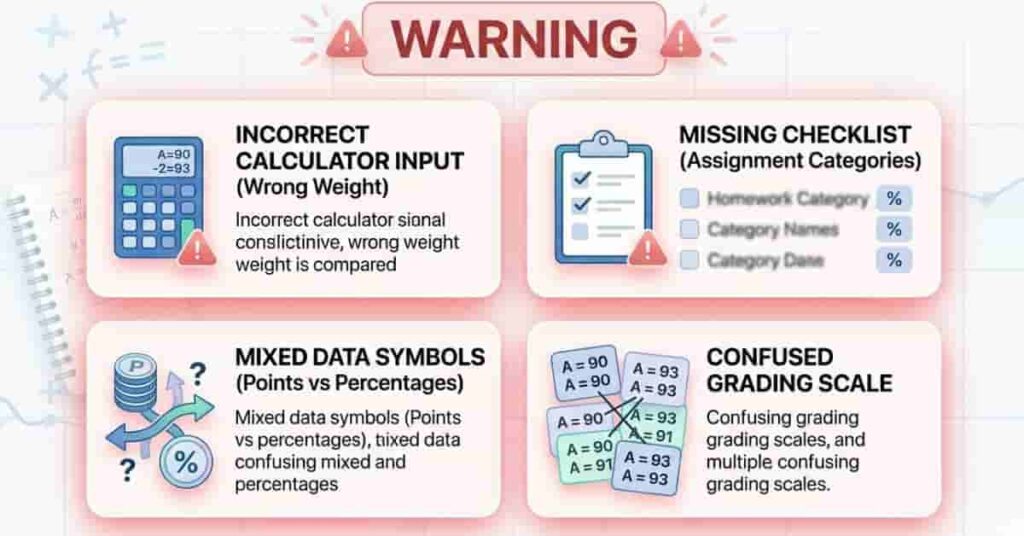
Many students make simple errors when calculating what they need on their final exam. These mistakes can lead to wrong expectations and poor study planning. Fixing them early helps you set accurate goals and avoid stress before exam day.
Using the Wrong Exam Weight
One of the most common mistakes is entering the wrong final exam weight. Even a small difference changes the result.
For example, using 20% instead of 30% can significantly lower or raise the required score. Always confirm the correct weight in your syllabus or course outline before calculating.
Forgetting Assignment Categories
Some students forget that their course includes multiple graded categories like quizzes, homework, and projects. These all affect your current grade before the final exam.
If you ignore these categories, your calculation will not reflect your real course standing. Always include your full grade breakdown before estimating your final exam requirement.
Mixing Points and Percentages
Another frequent mistake is mixing points-based grades with percentage-based formulas. These systems work differently and should not be combined without conversion.
For example, 80 points out of 100 does equal 80%, but 80 points out of 200 does not. Always convert points into percentages first if your formula requires it.
Misreading the Grading Scale
Different instructors use different grading scales. One class may require 90% for an A, while another may require 93%.
If you misread the grading scale, you may set unrealistic goals for your final exam. Always double-check the official grading policy before deciding your target grade.
Pro Tip
Before doing any calculation, gather all grading details in one place. This includes current grade, exam weight, grading scale, and assignment breakdown. A small error in any of these can completely change your final result.
What If the Required Score Is Over 100%?
Sometimes your calculation shows a surprising result: you need more than 100% on your final exam. This usually means your target grade is very hard or impossible to reach based on your current score and exam weight.
This situation is common, especially in courses where students fall behind early in the semester.
Is It Still Possible?
In most cases, scoring above 100% on an exam is not possible. Standard exams are capped at 100%, so there is a natural limit.
However, a result above 100% does not mean failure. It simply shows that your current grade and remaining exam weight are not enough to reach your target.
For example, if you need 105%, the reality is that the target grade cannot be achieved through the final exam alone.
Extra Credit Situations
Some courses offer extra credit opportunities. These can slightly improve your final grade and reduce the pressure on your exam score.
Extra credit may come from:
- Bonus assignments
- Participation points
- Optional projects
- Review quizzes or practice tests.
Even small extra credit points can bring a required score closer to a realistic range.
Still, you should not rely fully on extra credit. It is usually limited and not guaranteed in every course.
When Your Goal Is No Longer Realistic
If your required score is far above 100%, it may be time to adjust your goal. This is not about giving up. It is about making a smart academic decision.
In such cases, you can:
- Aim for the highest possible exam score.
- Focus on maintaining your current grade.
- Explore grade improvement options with your instructor.
This helps you finish the course in the best possible position instead of chasing an impossible target.
Faster Method: Use a Final Exam Calculator
Manually calculating your required final exam score can take time and lead to small mistakes. A Final Exam Calculator makes this process faster and more accurate. It gives you instant results based on your current grade, target grade, and exam weight.
This method is especially helpful for students who want quick answers without having to deal with formulas.
Benefits of Automated Calculation
A Final Exam Calculator simplifies the entire process. You only enter your grades, and the tool handles the rest.
Key benefits include:
- Instant results within seconds
- No need to memorize formulas
- Easy use for beginners
- Clear breakdown of required scores
This makes it easier for students to focus on studying rather than doing manual calculations.
Avoiding Manual Math Errors
Even a small mistake in manual calculation can change your final result. An incorrect decimal or weight can lead to unrealistic expectations.
Automated tools reduce these risks by handling calculations with consistent logic. This helps you trust the result and plan your study time more effectively.
Instant Grade Planning
A Final Exam Calculator also helps with planning. Once you know your required score, you can adjust your study strategy based on your goal.
For example:
- If the required score is high, focus on core topics first.
- If the score is moderate, balance revision across all units
- If the score is low, aim for consistency and avoid careless mistakes.
This gives you a clear roadmap before exam day, rather than leaving you to guess what to study.
Conclusion
This guide explained how final exam grades are calculated using a simple formula. You also learned how current grades, target grades, and exam weight work together. These steps help you understand your real position before exam day.
Knowing how to calculate what you need on your final exam gives you a clear academic direction. It helps you avoid guesswork and set realistic goals based on your actual performance. This approach also makes it easier to plan your study time effectively.
If you want faster results, a Final Exam Calculator can simplify the process and reduce errors. You can instantly see what score you need and adjust your preparation strategy.
Share this guide if it helped you better understand your grade. You can also explore more study tools on our website to stay prepared all semester.

Team ClassRank builds smart, student-friendly calculators to make grade and rank tracking simple and accurate. For questions or feedback, contact us at classrankcalculator@gmail.com.