

Introduction
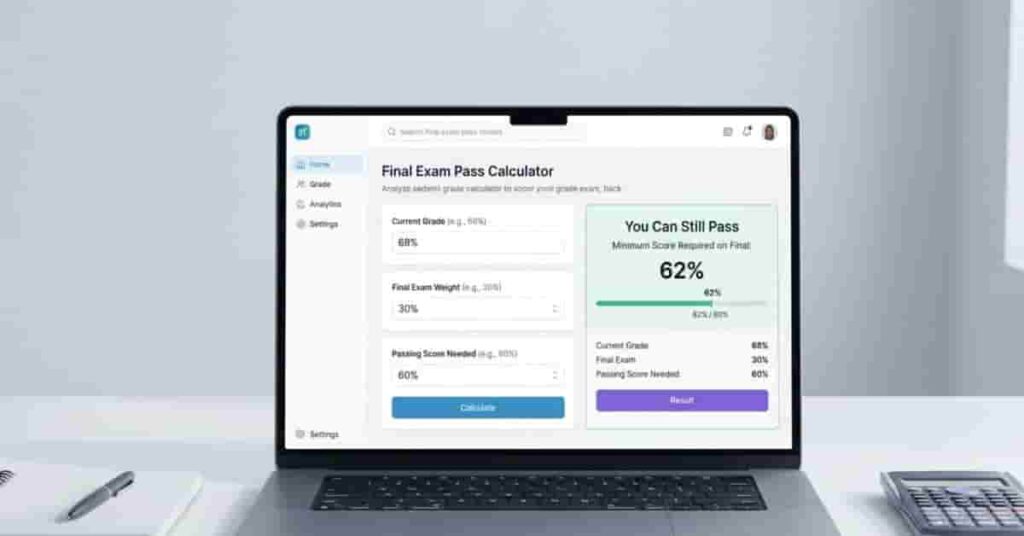
Ever wondered if you can still pass your final exam the night before results feel uncertain? Can I Still Pass My Final Exam? Find the Minimum Score You Need guide helps you quickly understand your chances using simple grade logic and a final exam pass calculator.
Many students in the USA feel stressed because grading systems include weights, percentages, and different categories. It becomes hard to know what score is actually needed to pass. Small misunderstandings about grades often lead to unnecessary panic. This is especially common for beginners who are new to college grading systems.
We will break everything into simple steps so you can estimate your minimum required score with confidence. You will also learn how to check if passing is still realistic and how to plan your final exam preparation smarter. This saves time and helps you focus only on what matters most.
Can You Still Pass Your Final Exam?
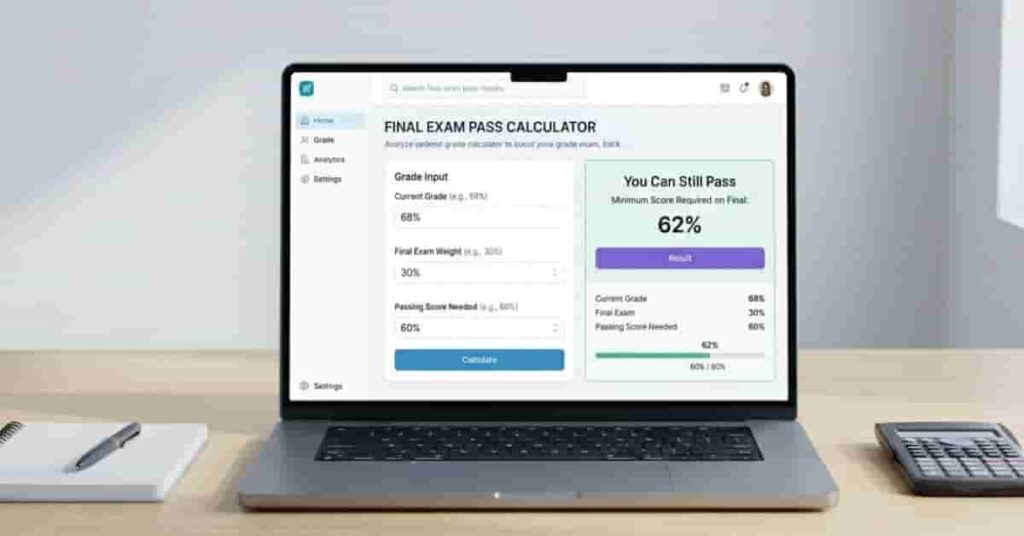
Many students ask this question when stress starts building before finals: Can I still pass my final exam, or is it already too late? The truth is, your situation is usually not as hopeless as it feels. In most classes, your final grade depends on a mix of your current performance and how much the final exam is worth. That means even a low or average grade can still be recovered if the grading system allows it. A final exam pass calculator helps you quickly understand where you stand instead of guessing.
What really matters is not panic, but clarity. You need three key pieces of information: your current grade, the weight of the final exam, and the minimum passing requirement set by your school or college. Once you know these, you can estimate whether passing is realistic or if you need a very high score to recover. This simple breakdown removes confusion and gives you a clear direction before you start studying.
The Short Answer
It depends on three core factors that decide your final outcome. Your current grade reflects how well you have performed so far and sets your starting point. The final exam weight tells you how much influence the exam has on your overall grade. Some finals count for 30%, while others can be 50% or more, which completely changes your required score. The passing requirement is the last piece, usually set at 50%, 60%, or sometimes higher depending on the institution.
When these three factors combine, they determine whether passing is easy, difficult, or mathematically impossible. In many cases, students still have a chance even if their current grade looks weak. That is why using a final exam pass calculator is important—it removes guesswork and gives you a clear target score in seconds.
Why Many Students Underestimate Their Chances
Most students assume they are already failing as soon as their grade drops, but that is often not true. One major mistake is ignoring how much the final exam can improve the overall grade. A heavily weighted final can significantly shift your result even if your current performance is low.
Another common issue is misunderstanding grading systems. Many students forget that assignments, quizzes, and projects all contribute differently to the final score. Without calculating properly, they assume the worst-case scenario instead of checking the actual numbers. This leads to unnecessary stress and poor study decisions.
In reality, many students are still in a “borderline zone” where passing is possible with focused preparation. A quick calculation often reveals that they need a realistic score, not an impossible one.
How to Know If Passing Is Still Possible
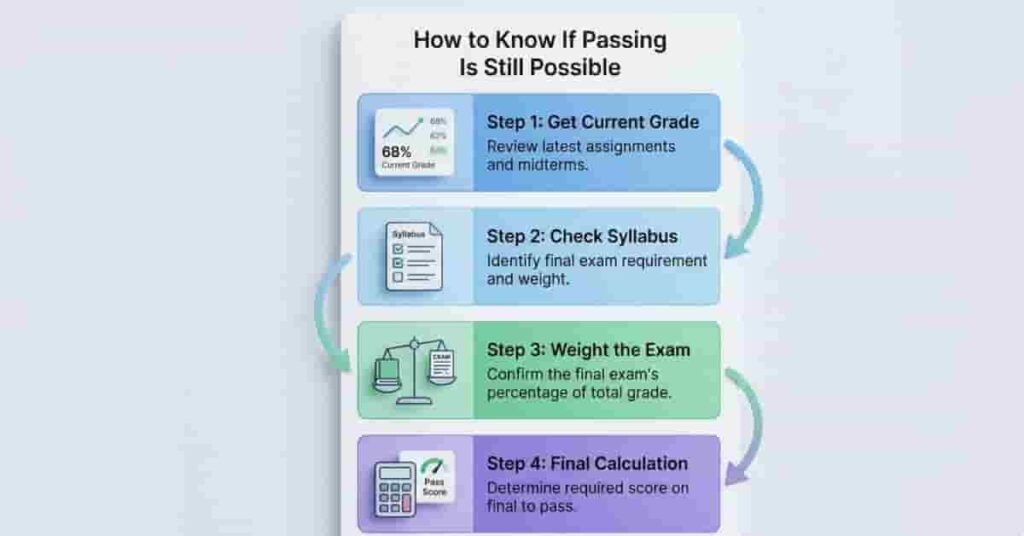
Before you panic about finals, you need a clear method to check your situation. Most students guess their chances, which leads to wrong decisions and extra stress. A final exam pass calculator or manual check can quickly show if passing is still realistic. The goal is simple: understand your numbers before you start studying. Once you know your position, you can focus only on what actually matters for your final score.
This process works for any subject because it only depends on three basic grading factors. Your current grade, passing requirement, and final exam weight decide everything. When you combine them correctly, you get a clear picture of your minimum needed score. Follow the steps below carefully to avoid mistakes and get accurate results.
If you’re aiming for a specific letter grade rather than simply passing, our guide on what grade you need on your final exam can help you calculate your exact target score.
Step 1: Find Your Current Grade
Start by checking your current overall grade in the course. This includes all completed assignments, quizzes, and exams. Most schools show this percentage in your LMS or gradebook.
If your grade is not visible, calculate it from completed work. This number becomes your starting point for all future calculations. Without it, you cannot estimate your final exam requirement correctly.
Step 2: Check Your Course Passing Requirement
Every course has a minimum passing score. In many schools, it is 50%, 60%, or sometimes higher. You must know this number before calculating anything else.
If you ignore this step, your final estimate will be wrong. The passing requirement defines your target, so treat it as the baseline for success.
Step 3: Identify Your Final Exam Weight
Next, check how much the final exam contributes to your overall grade. Some exams are worth 20%, while others can be 50% or more.
This weight is very important because it controls how much your final can change your grade. A higher weight means more impact on your result, both positive and negative.
Step 4: Calculate the Minimum Score Needed
Now combine all three values: the current grade, the passing requirement, and the exam weight. This tells you the minimum score you need on your final exam.
You can calculate it manually or use a final exam pass calculator for instant results. This step removes guesswork and shows exactly what you must aim for in the exam.
What Grade Do You Need to Pass?
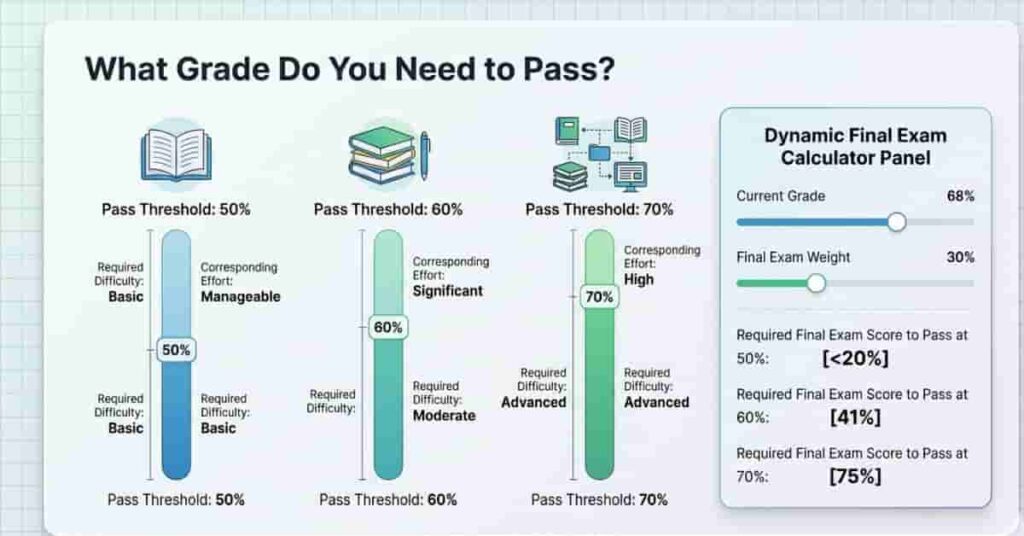
Before you can understand your final exam target, you need to know the passing benchmark. Every school or college sets its own minimum grade requirement. This number decides whether you pass or fail, even before your final exam is counted. A final exam pass calculator uses this value to estimate your exact minimum score needed.
Passing requirements may look simple, but they change your entire strategy. A student aiming for 50% has a very different target compared to someone needing 70%. That gap can completely change how hard you need to prepare. Once you understand your passing threshold, you can plan your study time more effectively and avoid wasting effort on the wrong areas.
In most cases, your current grade and exam weight combine with this requirement to determine your final outcome. That is why even small differences in passing standards can significantly affect the minimum score you need.
Understanding how the numbers are calculated can make planning much easier, which is why we recommend reviewing our step-by-step final exam calculation guide.
Typical Passing Grades by School or College
Most schools use a standard passing range, but it is not the same everywhere. In many USA-based systems, the passing grade is often set at 60%, while some institutions allow 50% as the minimum. Competitive programs may require 70% or higher to pass a course.
These differences matter because they directly impact your study pressure. A lower passing grade gives you more flexibility, while a higher one increases your required final exam score. Students often assume all schools use the same system, but that is not true. Always confirm your course policy before making assumptions.
A final exam pass calculator becomes especially useful here because it adjusts your target based on your specific institution’s rules. Without knowing your exact passing grade, your estimate will always be incomplete.
How Passing Requirements Affect Your Target Score
Your passing requirement is the final goal you must meet. If your target is 50%, you may only need a moderate score on your final exam. However, if the requirement is 70%, your required score increases sharply, especially if your current grade is low.
This is where many students get surprised. A small change in passing percentage can increase the minimum score you need by a large margin. For example, moving from 60% to 70% may turn a safe situation into a borderline one.
Understanding this relationship helps you avoid unrealistic expectations. Instead of guessing, you can use your current grade and exam weight to calculate a realistic target. This is exactly what a final exam pass calculator is designed to do.
Examples of Common Passing Thresholds
Here are some typical passing thresholds used in schools and colleges:
- 50%: Common in easier grading systems or basic courses
- 60%: Standard passing grade in many USA institutions
- 70%: Used in stricter or competitive academic programs
Each threshold changes your required final exam score. A student close to passing at 50% may only need a small improvement. But at 70%, the required effort increases significantly.
These examples show why you should never assume that a single fixed rule applies everywhere. Always check your course requirements before calculating your minimum score needed.
Pro Tips
Always verify your passing grade with official sources, such as your syllabus or LMS. Never rely on assumptions or classmates’ guesses. A small mistake in this number can completely change your calculation.
If your grade is borderline, focus first on high-weight topics instead of trying to cover everything. This gives you a better return on study time. Also, use a final exam pass calculator to test different scenarios. Try changing your current grade or exam weight to see how your target score shifts. This helps you prepare smarter, not harder.
Scenario-Based Examples of Passing Outcomes
These real examples help you understand how your current grade and final exam weight affect your chances. We assume a 60% passing requirement, which is common in many USA-based courses. A final exam pass calculator uses the same logic to give instant results without manual math. Each scenario shows how your situation changes with simple grade changes.
Scenario #1: Current Grade = 60%, Final Exam Weight = 40%
If your current grade is 60% and your final exam is worth 40%, your situation is balanced. You are not failing, but you are not fully safe either. This is a classic borderline case where your final exam plays a major role in your overall result.
Can You Still Pass?
Yes, you can still pass if you perform steadily in the final exam.
Minimum Score Required
You need about 60% on the final exam to reach a passing grade of 60% overall.
Risk Level Analysis
This is a moderate-risk zone. You already have a solid base, but the final exam still decides your outcome. A small drop in performance can push you below the passing mark. Focus on revision instead of new topics to stay stable.
Scenario #2: Current Grade = 70%, Final Exam Weight = 30%
This is a strong position. Your current performance already gives you a cushion before the final exam. Even if the exam is challenging, you still have room to secure a passing grade.
Can You Still Pass?
Yes, passing is very likely in this case.
Minimum Score Required
You only need around 37% on the final exam to pass the course overall.
Risk Level Analysis
This is a low-risk zone. Your strong current grade reduces pressure significantly. However, avoid ignoring the exam completely. A very low score could still affect your final result if expectations are high.
Scenario #3: Current Grade = 50%, Final Exam Weight = 50%
This is a high-pressure situation because your final exam carries the same weight as your current grade. Your performance so far has been weak, so the final exam is extremely important.
Can You Still Pass?
Yes, but only with a strong performance on the final exam.
Minimum Score Required
You need about 70% on the final exam to reach a 60% passing overall grade.
Risk Level Analysis
This is a high-risk zone. You still have a fair chance, but the final exam carries heavy responsibility. You must focus on key topics and prioritize high-weight areas to improve your score quickly.
Safe Zone vs Borderline Zone vs Danger Zone
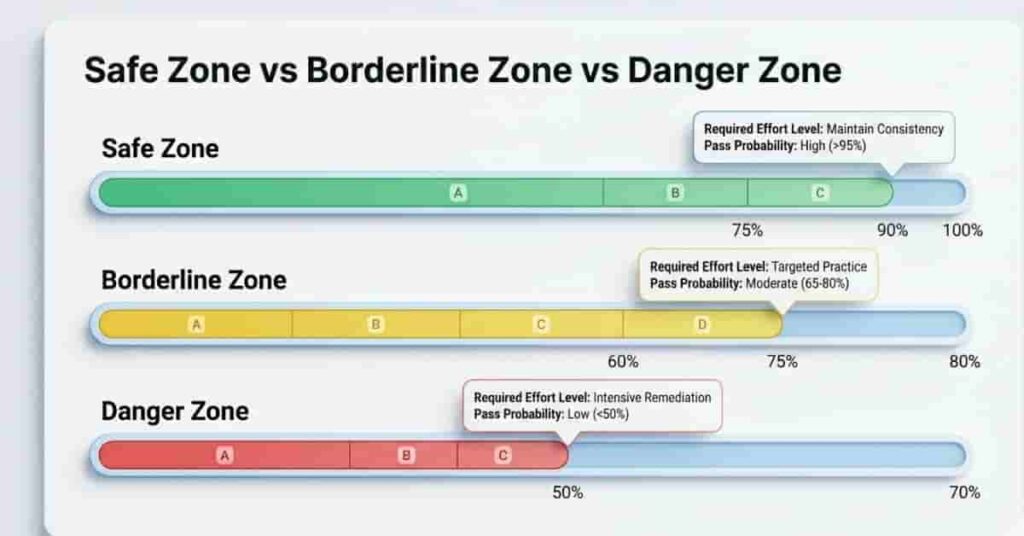
Not all students face the same situation before finals. Your chances of passing depend on how much pressure your final exam carries and how strong your current grade is. A final exam pass calculator helps you quickly identify which zone you fall into so you can plan smarter. Instead of guessing, you can clearly see whether you are safe, at risk, or in danger of failing.
These three zones help simplify your situation into clear categories. The Safe Zone means you already have a strong base grade and only need a small effort in the final exam. The Borderline Zone means your passing is still possible, but you must perform well in the exam. The Danger Zone means your current grade is low, and you need a very high score to recover.
Understanding these zones helps you stop panic thinking and start focused preparation. Once you know your zone, you can adjust your study strategy based on reality, not fear.
Below is a quick visual comparison of how these zones usually relate to required effort levels.
Safe Zone
The Safe Zone means your current grade is already strong enough to support passing. You usually need a low-to-moderate score on your final exam. In many cases, even an average performance is enough to secure your overall grade.
Students in this zone should focus on maintaining consistency rather than extreme preparation. You should revise key topics and avoid unnecessary stress. However, ignoring the exam completely is still risky because final exams can still affect your grade balance.
A final exam pass calculator will usually show that your required score is comfortably achievable in this zone. This gives you confidence and helps you focus on smart revision rather than panic-studying.
Borderline Zone
The Borderline Zone is where most students find themselves. Your current grade is neither strong nor weak, so your final exam becomes very important. A small improvement or drop in performance can change your overall result.
In this zone, preparation matters a lot. You need to focus on high-weight topics and past exam patterns. Time management becomes important because you cannot afford to study everything equally.
A final exam pass calculator will often show a moderate required score here. That means passing is still possible, but it depends heavily on your performance on the final exam.
Danger Zone
The Danger Zone means your current grade is low, and your final exam carries heavy responsibility. You may need a very high score to pass the course, depending on exam weight.
This does not always mean failure, but it does mean high pressure. You must focus only on the most important topics that carry maximum marks. Smart preparation is more important than covering everything.
In this zone, a final exam pass calculator may show a high required score, sometimes close to the upper limit. This helps you decide whether to push hard for recovery or explore alternative options like extra credit.
Quick Self-Assessment Table
Here is a simple way to quickly understand your zone and what it means for your final exam preparation:
- Safe Zone: Low required score, strong chance of passing
- Borderline Zone: Moderate required score, depends on preparation
- Danger Zone: High required score, very difficult recovery
This quick check helps you decide how urgently you need to prepare and how much effort your final exam will require.
What If You Need More Than 100% to pass?
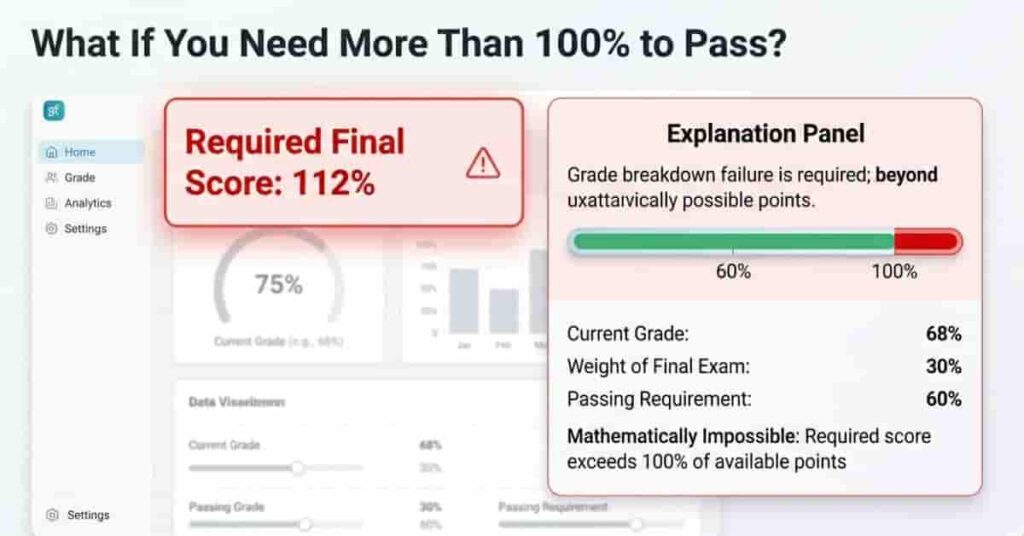
Sometimes your calculation shows something shocking: you need more than 100% on your final exam to pass the class. This usually feels impossible, but it actually comes from a simple grading math issue. A final exam pass calculator shows this result when your current grade is too low compared to the passing requirement and the final exam weight is not high enough to recover it.
This situation does not always mean you have already failed. It means the numbers are heavily stacked against you. Your current performance has a bigger impact than the final exam can compensate for. When this happens, it is important to stop guessing and clearly understand what options still exist.
In many cases, students reach this point because they ignore early grading results or assume the final exam will fix everything. But weighted systems have limits. Once your required score exceeds 100%, recovery becomes mathematically impossible unless extra credit or grading adjustments are available. That is why understanding this early is very important.
Below are the key scenarios and what you should do next if you ever reach this stage.
What This Usually Means
If your required score is above 100%, it means your current grade is too low for recovery under normal conditions. Even a perfect score on the final exam would not be enough to reach the passing threshold.
This often happens when:
- Your current grade is below 40–50%
- The final exam weight is low (10–30%)
- The passing requirement is high (60–70%)
A final exam pass calculator highlights this clearly so you can stop wasting time on unrealistic expectations. Instead, you can focus on damage control or alternative solutions.
Can Extra Credit Help?
Extra credit can sometimes change the outcome, but it depends entirely on your instructor. If extra credit is available, it may reduce your required final exam score or add bonus points to your overall grade.
However, you should not assume it will exist. Many courses do not offer extra credit at all, especially during final grading. Even when it does exist, it usually provides only a small improvement, not a full recovery from a very low grade.
If your final exam pass calculator shows more than 100%, check your syllabus immediately for any mention of bonus assignments or grade adjustments.
When Passing Is Mathematically Impossible
Passing becomes mathematically impossible when even the maximum possible score cannot reach the required grade. This is the point where no amount of exam performance can change the final outcome.
This usually happens when:
- Your current grade is extremely low.
- The final exam weight is too small.
- No extra credit or curve is available.
In this case, your focus should shift from “can I pass” to “what can I still salvage.” Understanding this early helps you avoid false hope and make better academic decisions.
Common Reasons Students Miscalculate Their Chances
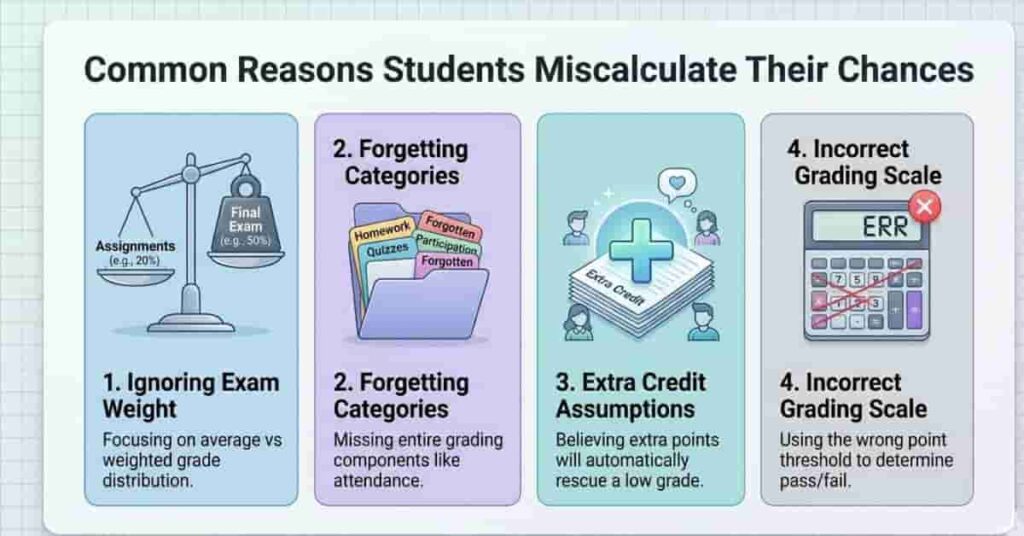
Many students think they are either “safe” or “failing” before finals, but their math is often wrong. A final exam pass calculator helps remove guesswork, yet most mistakes happen when students skip key grading details. These errors can make your chances look better or worse than they really are.
Understanding these common mistakes helps you get a realistic picture of your situation. Once you fix these errors, your minimum required score becomes much clearer. This also helps you avoid unnecessary stress or false confidence before your final exam.
Ignoring Exam Weight
One of the biggest mistakes students make is ignoring how much the final exam actually counts. Some exams are worth 20%, while others can be 50% or more. This difference completely changes your required score.
If you assume all finals have the same weight, your calculation will be wrong. A small weight means you need a much higher score to recover your grade. A final exam pass calculator always uses weight correctly, but manual estimates often miss this detail.
Forgetting Assignment Categories
Most courses are divided into categories such as quizzes, homework, projects, and exams. Each category has its own weight. Students often forget to include all of them when estimating their grade.
If you only look at your overall percentage without checking category breakdowns, your estimate will be inaccurate. A missing category can easily shift your final result by several percentage points. Always include every part of your grading system before calculating your chances.
Assuming Extra Credit Is Included
Extra credit is not guaranteed in most courses, but students often assume it is already part of their grade. This leads to overly optimistic calculations.
In reality, extra credit varies by instructor and is usually optional or limited. If you include it incorrectly in your estimate, you may think you need a lower score than you actually do. Always calculate your grade without extra credit first, then add it separately if it exists.
Using the Wrong Grading Scale
Another common mistake is using the wrong passing standard. Some students assume 50% is enough, while their course actually requires 60% or 70%. This small misunderstanding can completely change the outcome.
Even a 10% difference in the passing requirement can increase your required final exam score significantly. A final exam pass calculator adjusts for this automatically, but manual estimates often ignore it.
Always double-check your syllabus or LMS before making any final decision about your chances.
How to Improve Your Chances Before the Final Exam
Once you know your required score, the next step is simple: improve your chances. A final exam pass calculator tells you the target, but your preparation decides the result. You don’t need to study everything. You need to study smart and focus on what actually increases your marks.
At this stage, time matters more than effort. Many students waste hours on low-value topics instead of focusing on high-impact areas. A better strategy is to identify what carries the most marks and prepare around it. This approach works even if your current grade is low.
Focus on High-Value Topics
Start with topics that carry the most marks in your exam. These usually come from repeated questions, important chapters, or core concepts your teacher emphasizes.
Do not try to cover everything equally. Instead, spend more time on sections that directly affect your score. This gives you faster improvement in less time. A final exam pass calculator becomes more realistic when you improve high-weight areas first.
Review Past Exams
Past exams are one of the best tools for preparation. They show you question patterns, difficulty level, and commonly repeated topics.
Practice these papers under time conditions if possible. This helps you understand how the real exam will feel. It also improves your speed and accuracy, which are critical for scoring well under pressure.
Prioritize Weak Areas
Instead of studying what you already know, focus on your weak subjects. These are the areas where you lose the most marks.
Make a simple list of topics you struggle with and revise them first. Even small improvements in weak areas can significantly increase your overall score. This strategy is more effective than repeating easy material.
Create a Last-Minute Study Plan
A structured plan is essential when time is limited. Divide your remaining days into focused study blocks. Assign specific topics to each session instead of studying randomly.
Keep your plan realistic. Do not overload your schedule. Include short breaks to avoid burnout. A clear plan helps you stay consistent and improves retention.
A final exam pass calculator shows your target, but your study plan is what helps you actually reach it.
Use Our Final Exam Pass Calculator
A final exam pass calculator gives you a clear answer in seconds. Instead of guessing your chances, you can instantly see if you are likely to pass or fail. This removes confusion and helps you focus on the right preparation strategy. It works by combining your current grade, the final exam weight, and the passing requirement into a single result.
Most students lose marks not because they don’t study, but because they miscalculate what they actually need. Manual math often leads to errors, especially when grading systems include weights and multiple categories. Using a calculator removes this risk and gives you a more accurate target score for your final exam.
Once you know your exact requirement, you can stop wasting time on unnecessary topics. You can focus only on the areas that matter most for your grade improvement. This makes your study time more efficient and less stressful.
Instant Pass/Fail Estimation
The calculator quickly shows whether passing is still possible. It removes doubt and gives you a direct yes-or-no result based on your inputs. This helps you understand your current situation in seconds, instead of having to do complex calculations.
Calculate Minimum Score Needed
One of the most useful features is the ability to calculate the exact score you need on your final exam. This number becomes your target and helps you plan your revision effectively.
Instead of studying blindly, you know exactly what to aim for. This makes your preparation more focused and realistic. A final exam pass calculator ensures you don’t underestimate or overestimate your required effort.
Avoid Manual Errors
Manual calculations often lead to mistakes, especially when dealing with weighted grades. A small error can completely change your expected result.
By using a calculator, you eliminate these mistakes. It ensures accuracy and saves time. This is especially useful when your grade is borderline and every percentage point matters.
Plan Your Study Strategy
Once you know your required score, you can build a focused study plan. If your target is low, you can revise key topics. If it is high, you can prioritize weak areas and high-weight chapters.
A final exam pass calculator doesn’t just give you a number—it helps you decide how to study smarter, reduce stress, and improve your chances of passing.
Conclusion
In this article, we explained how your current grade, exam weight, and passing requirement affect your final result. You also learned how to identify your risk zone and calculate your minimum required score with clear steps. These insights help you understand your real chances before the final exam.
A final exam pass calculator removes guesswork and shows exactly what you need to pass. Instead of stress and confusion, you get a clear target to focus your preparation. This makes your study plan more effective and goal-driven.
If you are unsure about your situation, try the calculator and see your exact score requirement today. Share your experience in the comments and let others know how you are preparing. You can also explore more study guides and tools on our website to improve your academic performance.

Team ClassRank builds smart, student-friendly calculators to make grade and rank tracking simple and accurate. For questions or feedback, contact us at classrankcalculator@gmail.com.