


Introduction
Ever wondered what you need on your final exam to get an A or even just pass your course? Many students in the USA face this question during finals season. The question “what grade do I need on my final exam?” often becomes stressful when every percentage point starts to matter in your overall grade.
In the USA, most courses use weighted grading systems with exams, quizzes, and assignments. This means your final exam can significantly change your overall result. Even a small score difference can shift your grade from a B to an A or the other way around. That is why understanding your target grade is so important for planning ahead and reducing exam pressure.
In this guide, you will learn exactly how to calculate your required final exam score step by step. You will also understand how target grades work and how to set realistic academic goals. Plus, you can use a final exam calculator to get instant, accurate results without manual mistakes.
What Grade Do You Need on Your Final Exam?
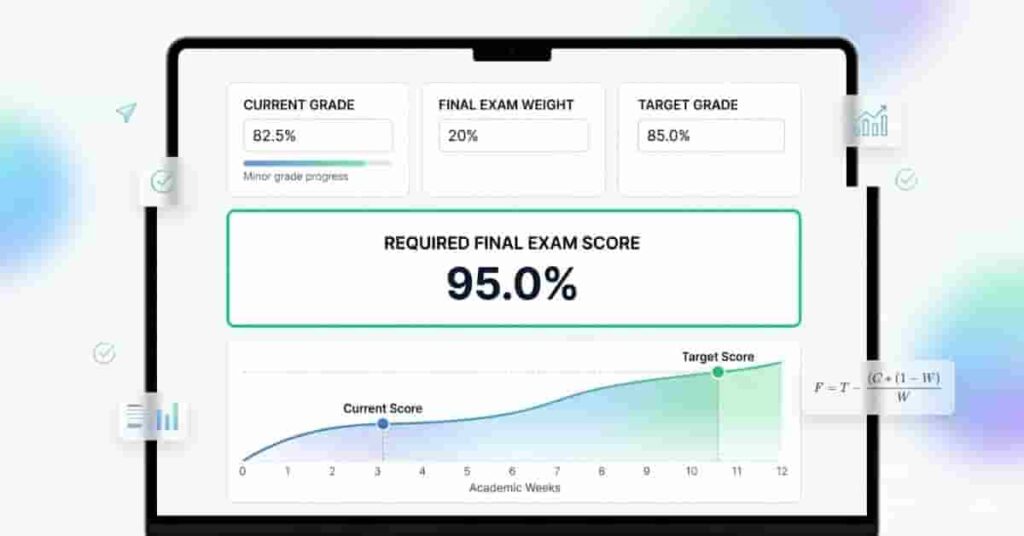
When students search for What grade do I need on my final exam, they usually want a fast and clear answer. The truth is simple. You need a specific score on your final exam to reach your target course grade. This score depends on your current performance and the weight of the final exam. Small changes in weight can make a big difference in your required score.
Not sure what score you need? Use our Final Exam Calculator to instantly calculate your target grade based on your current score and exam weight.
The Short Answer
You need to calculate how many points you still need to reach your overall grade. Then you divide that need based on the final exam weight. If your current grade is strong, you may only need a low score. If your grade is weak, you may need a very high score or even above 100%. That is why many students use a calculator for the final exam to avoid manual errors.
Factors That Affect Your Required Score
Your required final exam score is not fixed. It changes based on a few key factors:
- Current course grade: Your existing average before the final exam
- Desired final grade: The grade you want to achieve in the course
- Final exam weight: How much the exam contributes to your total grade
- Grading system: Some schools use weighted grades, others use point-based systems
Understanding these factors helps you predict your outcome more accurately and plan your study time better.
If you’re worried about simply passing the course rather than hitting a specific grade target, you may also want to check our guide on the minimum score needed to pass your final exam.
How to Determine Your Target Final Exam Score
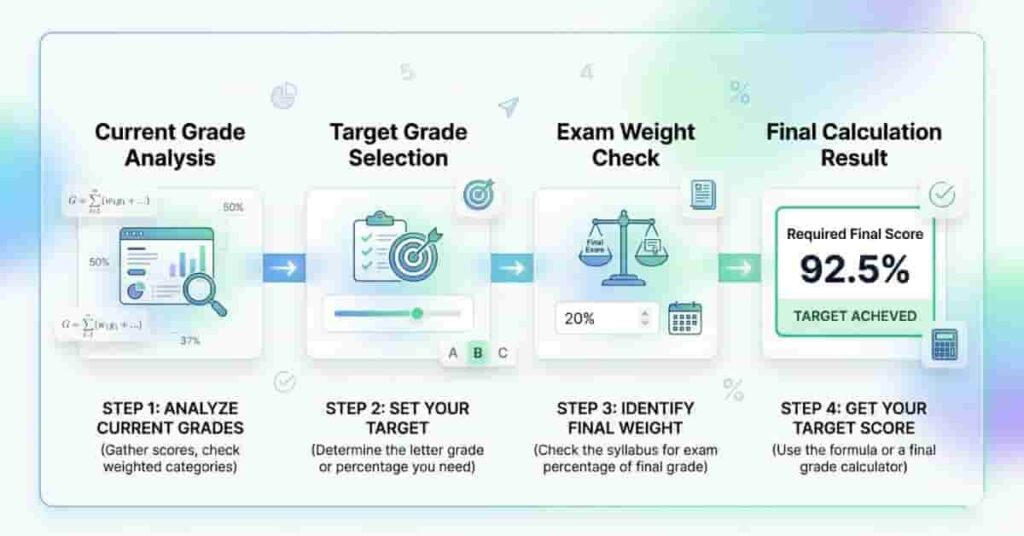
Finding your target final exam score helps you plan smarter for exams. Instead of guessing, you calculate the exact score you need. This removes stress and gives you a clear study goal. When students search for ” What grade do I need on my final exam, this step-by-step method gives them a real answer they can trust.
Step 1: Find Your Current Grade
Start by checking your current course grade before the final exam. This includes assignments, quizzes, and midterms. Most schools show this in your LMS or grade report. Make sure the percentage is accurate because even a small error can change your final result.
Step 2: Decide on Your Desired Course Grade
Now choose your goal grade. This could be an A, B, or just passing the course. Be realistic based on your current performance. A clear target helps you focus your study effort instead of preparing blindly.
Step 3: Check Your Final Exam Weight
Look at how much your final exam counts toward your total grade. It is usually between 10% and 50%. A higher weight means your final exam has more impact on your result. This step is very important for accurate calculation.
Step 4: Calculate Your Required Score
Now combine all values to find your required score. Use a formula or a final exam calculator for accuracy. Manual mistakes are common, so digital tools are often safer and faster.
Grade Goal Examples
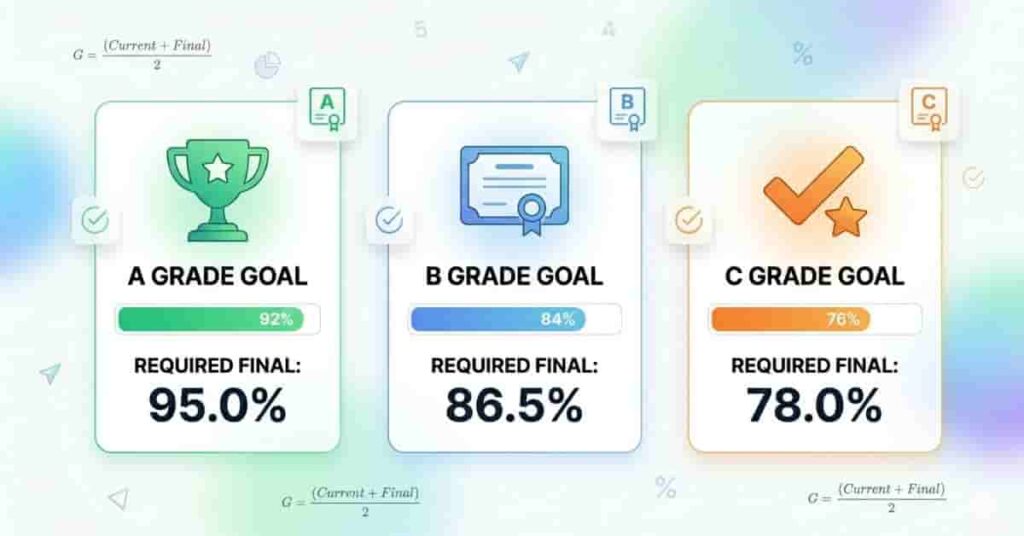
Understanding real examples makes it easier to figure out what grade I need on my final exam in your own situation. Every student has different goals, but the logic stays the same. Your final exam score depends on your current grade, your target grade, and the exam weight. Below are simple examples to help you understand how it works in real life.
What Do I Need on My Final to Get an A?
To get an A, you usually need a strong current grade before the final exam. If your grade is already high, you may only need a moderate score on the final. But if your grade is average, you might need a very high score to reach an A. In some cases, you may even need near-perfect performance depending on the exam weight.
What Do I Need on My Final to Get a B?
A B grade is more achievable for most students. If your current grade is close to B level, your required final exam score will be moderate. A balanced study plan can help you reach this target without extreme pressure.
What Do I Need on My Final to Get a C?
A C is often the minimum passing target in many courses. If your current grade is low, you may still reach a C with a reasonable final exam score. However, you must avoid major mistakes in the exam.
What Do I Need on My Final to Maintain My Current Grade?
Sometimes your goal is just to keep your current grade. In this case, you only need to match the required score that balances your existing average. This is usually the easiest target if you are already doing well in class.
Want a quick answer? Enter your current grade, target grade, and exam weight into the Final Exam Calculator to get accurate results in seconds.
Scenario-Based Final Exam Examples
These real-life scenarios help you understand what grade I need on my final exam in different situations. Each case shows how your current grade and final exam weight affect your required score. This makes it easier to plan your study strategy with clear expectations.
Scenario #1: Current Grade 90%, Final Worth 20%
In this case, you already have a strong academic standing. Your current grade gives you a big advantage before the final exam. Since the final only counts for 20%, it has a limited impact on your overall result.
Required Score Analysis
You will likely need a low-to-moderate score on the final exam to maintain or slightly improve your grade. Even if you do not perform perfectly, your strong current grade helps balance the outcome.
Is the Goal Easily Achievable?
Yes, this goal is usually very achievable. Students in this situation can focus more on revision instead of intense cramming. However, careless mistakes can still affect your final grade.
Scenario #2: Current Grade 80%, Final Worth 30%
This is a common situation for many students. Your current grade is solid, but the final exam has more weight, so it can significantly change your result.
Required Score Analysis
You will need a moderate to strong score on your final exam to maintain or improve your grade. A weak performance can quickly drop your overall percentage because the exam carries a 30% weight.
Study Planning Recommendations
Focus on high-impact topics first. Practice past papers and time-based tests. Avoid last-minute studying, as consistency will improve your final score more effectively.
Scenario #3: Current Grade 70%, Final Worth 40%
This scenario is more challenging. Your current grade is lower, and the final exam has a high impact on your total score.
Required Score Analysis
You will need a high score on the final exam to significantly improve your grade. In some cases, you may need exceptional performance depending on your target grade.
Risk Assessment
This is a high-risk situation. Small mistakes can greatly affect your final result. You should focus on weak areas and prioritize topics that carry more marks.
Many students ask whether passing is still possible with their current grade, so we put together a detailed guide that explains exactly how to calculate the lowest score you can earn and still pass the class.
How Final Exam Weight Changes Your Required Score
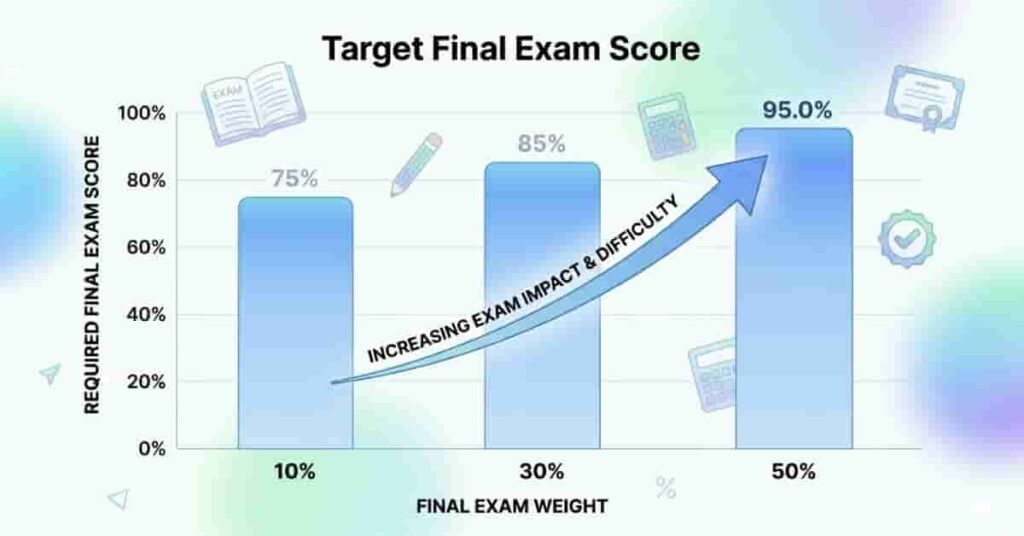
Your final exam weight plays a major role in what grade I need on my final exam calculations. A small change in weight can significantly increase or decrease the score you need. This is because heavier exams have more impact on your overall course grade, while lighter exams give you more flexibility.
Finals Worth 10–20%
When your final exam is worth 10–20%, your current grade has the most influence. This means your performance during the semester carries more weight than the final. Even a low or average score on the final may still keep your grade stable. Students in this range often feel less pressure, but consistency still matters.
Finals Worth 30–40%
At this level, the final exam becomes a major factor in your overall grade. Your current grade still helps, but it cannot fully protect you from a weak exam score. You will need a balanced performance to maintain or improve your results. Careful revision becomes very important here.
Finals Worth 50% or More
When the final exam is worth 50% or higher, it becomes the most important part of your course. Your entire grade can change based on one exam. A strong final score can significantly boost your result, while a weak score can drop it quickly. This situation requires serious preparation and time management.
Why Heavier Finals Matter More
Heavier finals have more influence because they represent a larger portion of your total grade. This means each correct or incorrect answer has a bigger effect. Understanding this helps you prioritize study time and focus on high-value topics. In these cases, planning is just as important as studying.
Need a personalized estimate? Try our Final Exam Calculator and explore different grade scenarios before test day.
What If You Need More Than 100%?
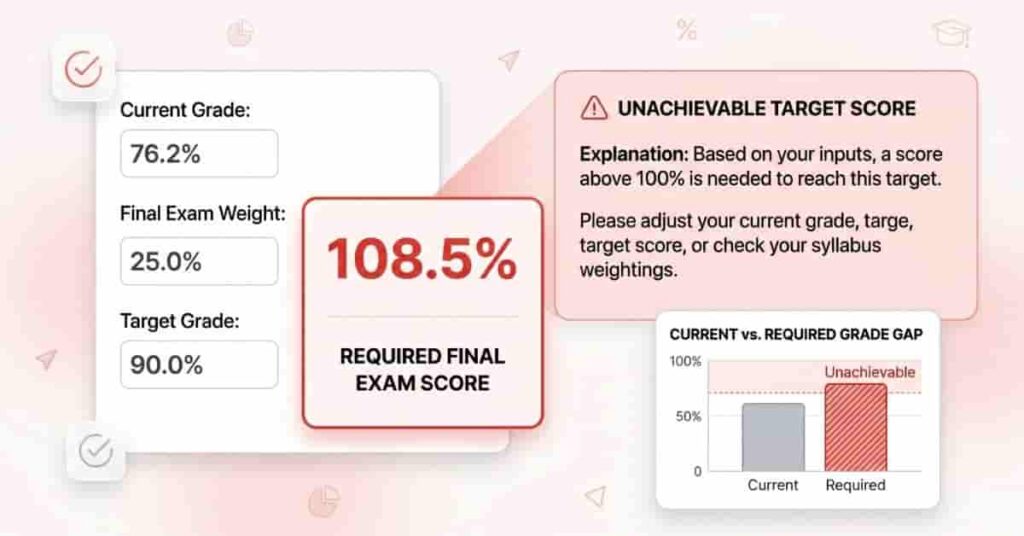
Sometimes your calculation shows a required score above 100%. This often happens when your current grade is too low compared to your target grade. When students search for ” What grade do I need on my final exam, this is one of the most confusing and stressful results they see.
In simple terms, needing more than 100% means your goal is not achievable with the final exam alone. It does not mean you failed. It only shows that the math does not support that target under current conditions. This is common when the final exam carries less weight or when your current grade is significantly below your desired grade.
Understanding Unrealistic Grade Goals
A score above 100% means your target grade is mathematically out of reach with normal grading rules. Even a perfect exam score will not be enough. This usually happens when:
- Your current grade is too low.
- Your final exam is worth a small percentage.
- Your target grade is very high.
This result helps you reset expectations early, rather than guessing until the end.
Extra Credit Possibilities
Some courses offer extra credit or bonus assignments. These can help improve your final grade beyond normal limits. However, not all instructors provide this option. You should always check your syllabus or ask your teacher directly.
Adjusting Expectations
If your required score is above 100%, you may need to adjust your goal. Focus on improving your current grade where possible. Even small improvements before the final can reduce the pressure on your exam score. A realistic target helps you perform better overall.
Common Mistakes When Estimating Final Exam Scores
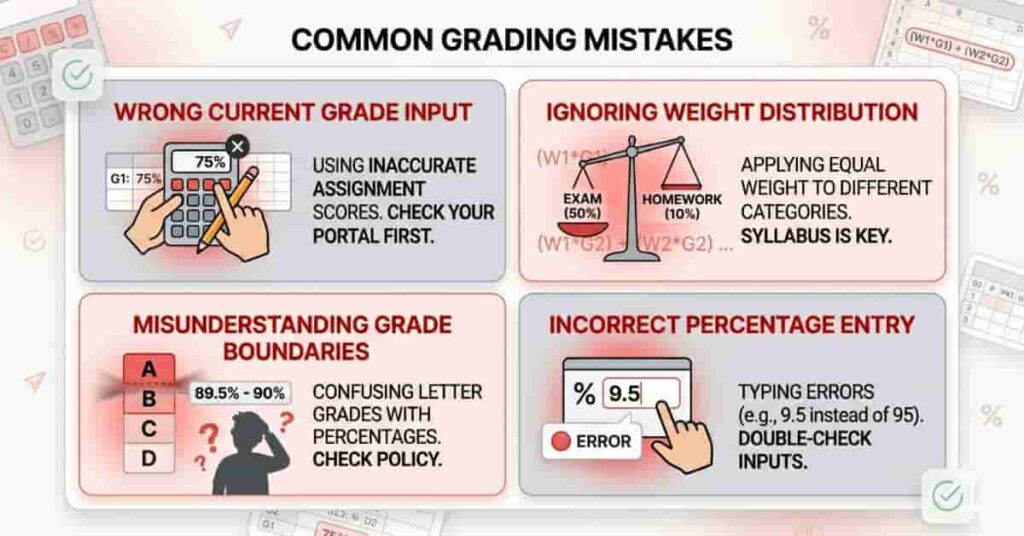
Many students make small errors while calculating what grade I need on my final exam. These mistakes can lead to wrong expectations and poor study planning. Understanding them helps you avoid confusion and focus on the right target score.
Using the Wrong Current Grade
One of the most common mistakes is using an outdated or incorrect current grade. Students often forget that grades change after every assignment or quiz. Even a small difference can change your required final exam score. Always check your latest grade before calculating.
Ignoring Weighted Categories
Some courses use weighted grading systems. This means homework, quizzes, and exams all have different values. If you ignore these weights, your calculation will be incorrect. Always confirm how each category contributes to your final grade.
Misunderstanding Grade Boundaries
Different schools use different grading scales. For example, an A might start at 90% in one class and 93% in another. If you misunderstand these boundaries, you may set the wrong target. Always check your course syllabus for exact grade cutoffs.
Entering Incorrect Percentages
A simple input mistake can completely change your result. Students often mix up decimals and percentages or enter wrong exam weights. Double-check all values before calculating to avoid inaccurate outcomes.
How to Improve Your Chances of Reaching Your Target Grade
Once you know what grade I need on my final exam, the next step is improving your chances of actually reaching it. A clear plan helps you study smarter, not harder. Instead of covering everything, you focus on what gives the highest return in marks.
Focus on High-Impact Topics
Start with topics that carry the most marks. These areas usually appear more often in exams. Review past papers or course outlines to identify them. Spending time here gives you faster improvement in your score.
Prioritize Weak Areas
Do not ignore your weak subjects. Many students repeat only what they already know. This creates false confidence. Instead, spend extra time on topics you struggle with. Small improvements in weak areas can quickly boost your overall grade.
Practice Under Exam Conditions
Practice as if you are in a real exam. Set a timer and avoid distractions. This helps you manage time and reduce stress during the actual test. It also improves accuracy and speed, both of which are important for final exams.
Create a Final Week Study Plan
In the last week, organize your study schedule carefully. Divide topics into daily goals and revise consistently. Avoid learning new complex topics at the last moment. Focus on revision, practice tests, and quick reviews to strengthen memory.
Use Our Final Exam Calculator
If you still feel unsure about what grade I need on my final exam, a calculator can make things simple. Instead of doing manual math, you get instant and accurate results. This helps you focus more on studying and less on guessing your target score.
Instantly Calculate Your Target Score
The final exam calculator quickly shows the exact score you need. Just enter your current grade, exam weight, and target grade. Within seconds, you get a clear result. This saves time and removes confusion during exam season.
Avoid Manual Errors
Manual calculations often lead to mistakes. A small error in percentages can change your entire result. The calculator removes this risk by automatically using accurate formulas. This ensures your target score is always correct.
Plan Realistic Grade Goals
Once you know your required score, you can set realistic academic goals. If the score is too high, you can adjust your expectations early. If it is achievable, you can confidently plan your study strategy.
Track Multiple Grade Scenarios
You can also test different situations. Try different target grades or exam weights to see how your result changes. This helps you understand your options and choose the best path for your final exam preparation.
Conclusion
In this article, we explained how to calculate your target final exam score step by step. You also learned how grades, exam weight, and goals affect your final result. These insights help you make smarter academic decisions with less stress.
Understanding what grade I need on my final exam removes guesswork and builds confidence before finals. Even small changes in exam weight or current grade can greatly impact your required score. Using a final exam calculator makes this process faster and more accurate.
If this guide helped you, share it with classmates who are preparing for finals. You can also explore more study tools on our website to plan your grades better.

Team ClassRank builds smart, student-friendly calculators to make grade and rank tracking simple and accurate. For questions or feedback, contact us at classrankcalculator@gmail.com.