


introduction
Calculating weighted grades can feel confusing at first. Many students struggle when assignments, quizzes, projects, and final exams all have different percentages. A small mistake in the math can change your final grade and create unnecessary stress.
The good news is that calculating weighted grades becomes simple once you understand the formula. You only need to multiply each score by its weight and add the results together. After a few examples, the process quickly starts to make sense.
In this guide, you’ll learn how to calculate weighted grades step by step using easy formulas, percentage examples, and real classroom scenarios. We’ll also explain how weighted percentages work and how teachers use them in schools and colleges across the USA.
If you want faster results and fewer calculation mistakes, you can also use our Weighted Grade Calculator to instantly calculate your final grade with different weights and percentages.
What Is a Weighted Grade?

A weighted grade is a grading system where each assignment category has a different level of importance. Instead of treating every score equally, schools assign percentages, called weights, to quizzes, homework, projects, and exams.
For example, a final exam usually affects your grade more than a homework assignment. That means the exam carries a higher weight in the overall calculation. This system helps teachers measure student performance more fairly across the entire course.
In most schools and colleges, weighted grades are calculated as percentages that add up to 100%. A common setup may look like this:
- Homework: 20%
- Quizzes: 20%
- Midterm Exam: 25%
- Final Exam: 35%
In this case, the final exam has the greatest impact on your overall grade because it carries the highest weight.
Here’s a simple real-life example. Imagine a student earns:
- 90% in homework
- 85% in quizzes
- 80% on the midterm
- 75% on the final exam
Even though the homework score is high, the final exam still strongly affects the final grade because it carries more weight.
Weighted grading is very common in high schools, colleges, online courses, and advanced placement classes in the USA. Teachers use it to focus more on important tests, long-term projects, and overall course understanding.
Key Takeaways
- Weighted grades give different importance to assignments and exams.
- Higher-weight categories affect the final grade more.
- Final exams often carry the largest percentage.
- Most weighted grading systems total 100%.
Pro Tip
Before calculating your final grade, always check that all assignment weights add up to 100%. Missing percentages can lead to incorrect results.
Weighted Grade Formula
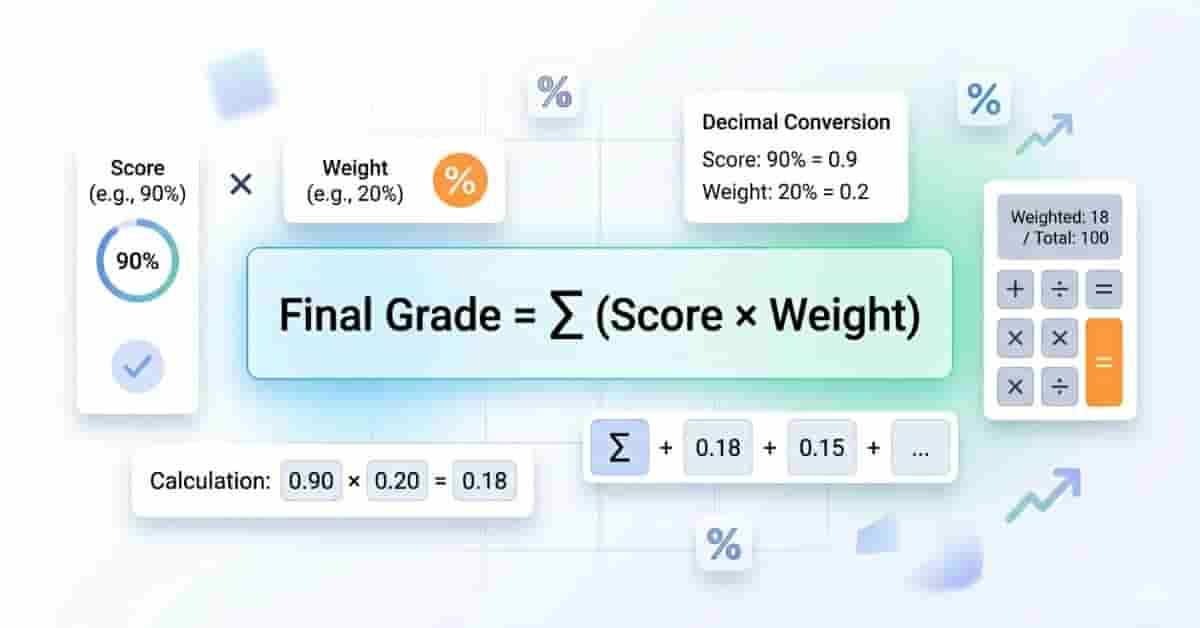
The weighted grade formula helps you calculate your final grade when assignments have different weight percentages. Schools and colleges use this method to give more importance to major exams, projects, or coursework.
The basic weighted grade formula is:
Weighted Grade Formula
Multiply each score by its weight and then add all results to get the final grade.
This means you multiply each score by its weight, then add all the weighted scores together.
For example, if homework is worth 20% and you scored 90%, you would calculate:
- 90 × 0.20 = 18
You repeat this process for every category and add the totals to get your final weighted grade.
One common mistake students make is confusing percentages with decimals. Before using the formula, convert each percentage weight to a decimal.
Here’s a quick conversion guide:
| 10% | 0.10 |
| 25% | 0.25 |
| 50% | 0.50 |
| 100% | 1.00 |
For example:
- 30% becomes 0.30
- 40% becomes 0.40
- 75% becomes 0.75
Using decimals correctly keeps your calculations accurate and prevents grade mistakes.
A teacher may use this grading setup:
- Assignments: 30%
- Quizzes: 20%
- Final Exam: 50%
If you accidentally use 30 instead of 0.30, your final answer will be completely wrong. Always convert percentages before multiplying scores.
Pro Tip
Use a calculator or spreadsheet when working with multiple assignments. It reduces math errors and saves time during grade calculations.
Step-by-Step Calculation
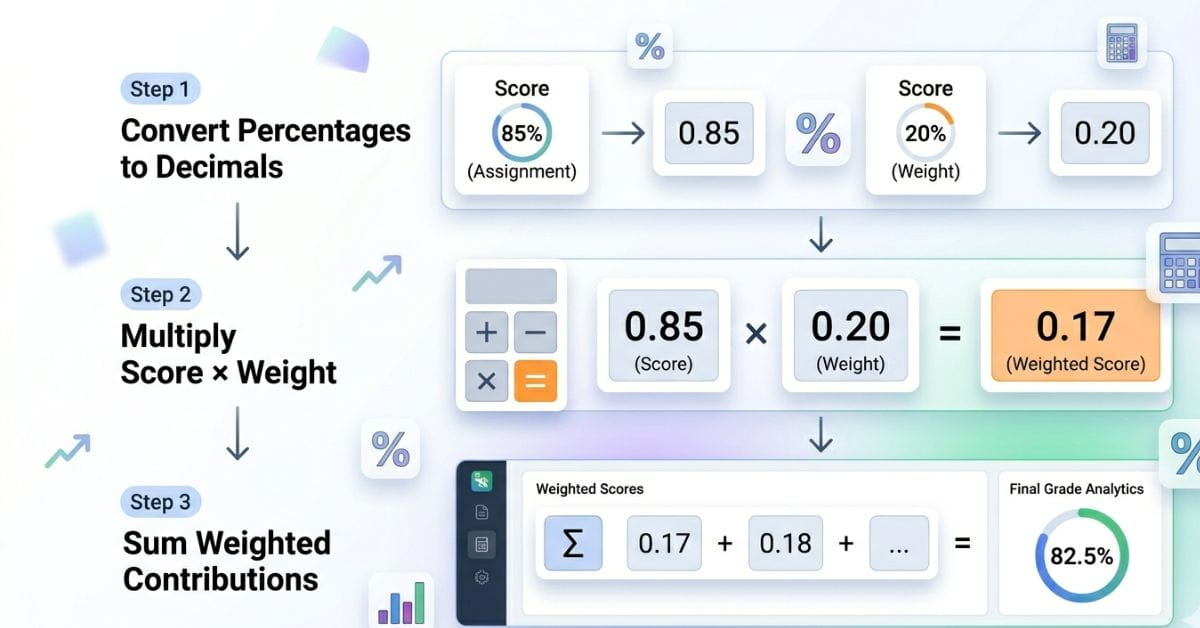
Calculating weighted grades becomes much easier when you break the process into small steps. You do not need advanced math skills. You only need your scores, assignment weights, and a calculator.
Many students feel confused because different assignments carry different percentages. The key is to handle one category at a time. Once you multiply each score by its weight, the final calculation becomes simple.
Below is the easiest way to calculate weighted percentages and grades.
Step 1: Convert Scores to Percentages
Start by turning every assignment score into a percentage if it is not already in percentage form.
For example:
- 45 out of 50 = 90%
- 18 out of 20 = 90%
- 72 out of 100 = 72%
You can calculate this using the formula:
Percentage Formula
Convert your score into a percentage by dividing earned marks by total marks, then multiply by 100.
Most online grade systems already show percentages, but teachers sometimes provide raw scores instead. Converting them first helps avoid mistakes in the weighted grade formula later.
Pro Tip
Always double-check your percentages before moving to the next step. A small error early in the process affects the final grade.
Step 2: Multiply by Weights
After converting your scores into percentages, multiply each score by its assignment weight.
Example:
- Homework: 90% × 0.20 = 18
- Quiz: 80% × 0.30 = 24
- Final Exam: 85% × 0.50 = 42.5
Remember to convert percentage weights into decimals before multiplying.
This step shows how much each category contributes to the final grade. Higher-weight assignments affect the result more strongly than smaller categories.
Pro Tip
Use decimal weights rather than percentages in calculations. For example, use 0.25 instead of 25%.
Step 3: Add All Contributions
The final step is simple. Add all the weighted contributions together to find your weighted average grade.
Example:
- Homework Contribution = 18
- Quiz Contribution = 24
- Final Exam Contribution = 42.5
Final Grade:
18+24+42.5=84.518 + 24 + 42.5 = 84.518+24+42.5=84.5
Your final weighted grade is 84.5%.
This method works for high school classes, college courses, online learning programs, and semester grading systems.
Example Calculation
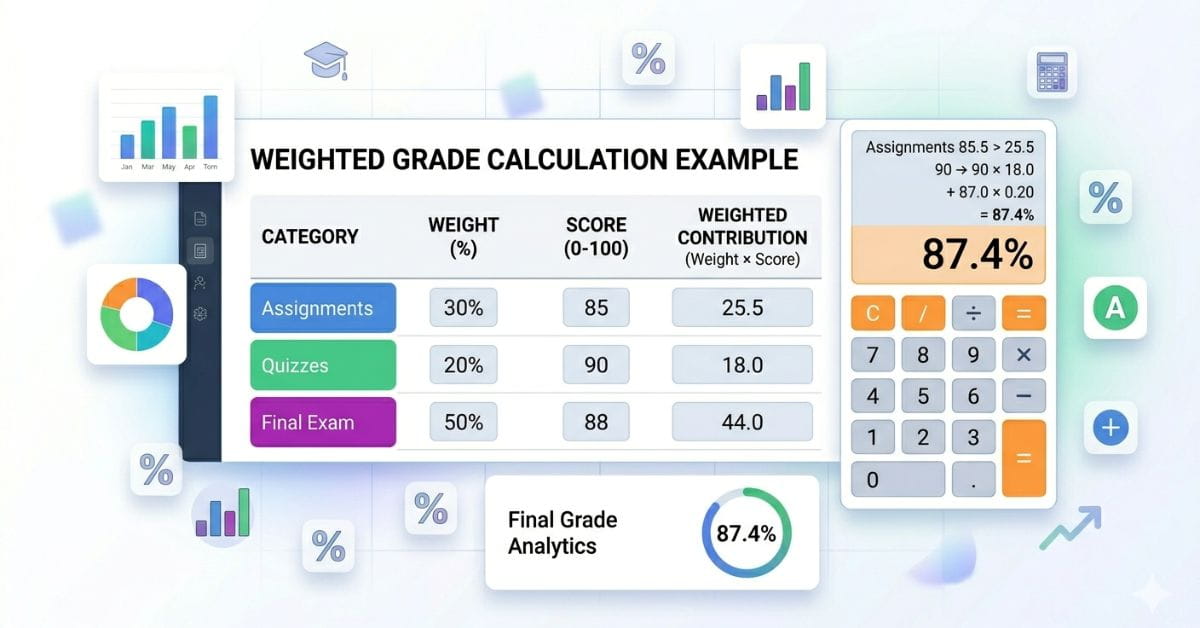
Let’s look at a real weighted grade example commonly used in US schools and colleges. This example shows how assignments, quizzes, and final exams work together in a weighted grading system.
Imagine your course uses this grading structure:
| Assignments | 30% |
| Quiz | 20% |
| Final Exam | 50% |
Now suppose you earned these scores:
- Assignments: 88%
- Quiz: 75%
- Final Exam: 92%
To calculate your weighted grade, multiply each score by its decimal weight.
Step 1: Convert Weights to Decimals
Before solving, convert each percentage weight into decimal form:
- 30% = 0.30
- 20% = 0.20
- 50% = 0.50
This helps you apply the weighted grade formula correctly.
Step 2: Multiply Scores by Weights
Now, calculate each weighted contribution.
Assignments
88×0.30=26.488 \times 0.30 = 26.488×0.30=26.4
Quiz
75×0.20=1575 \times 0.20 = 1575×0.20=15
Final Exam
92×0.50=4692 \times 0.50 = 4692×0.50=46
Step 3: Add All Weighted Contributions
Now add all category contributions together:
26.4+15+46=87.426.4 + 15 + 46 = 87.426.4+15+46=87.4
Your final weighted grade is 87.4%.
This example shows why the final exam has the biggest impact on the overall grade. Even though the quiz score was lower, the strong final exam score helped raise the final average because it carried 50% of the course weight.
Mini Case Study
A college student improved their course grade from a B to an A- after scoring well on the final exam. Since the exam accounted for half the total course weight, the higher score made a major difference in the final average.
Weighted Percentages Explained
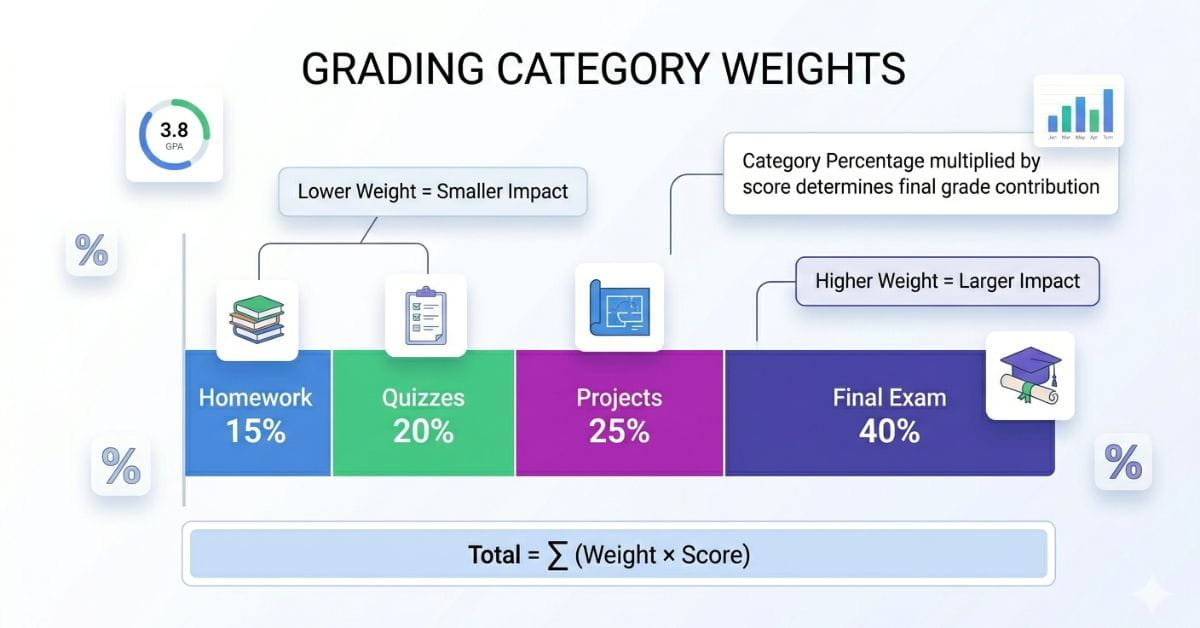
Weighted percentages decide how much each assignment category affects your final grade. Instead of treating every task equally, teachers assign higher percentages to more important coursework.
For example, a homework assignment may count for only 10% of your grade, while a final exam may count for 40% or more. This system helps teachers measure overall understanding rather than focusing solely on small daily tasks.
Here is a common weighted grading structure used in many US schools:
| Homework | 15% |
| Quizzes | 20% |
| Projects | 25% |
| Final Exam | 40% |
In this setup, the final exam has the largest impact because it tests everything learned during the course. Homework still matters, but it carries less weight in the final average.
Weighted percentages also help create balance in grading. A student who performs well on major exams can recover from a few low homework scores. At the same time, students who remain consistent throughout the semester still benefit from quizzes, assignments, and projects.
Teachers use weighted grading systems for several important reasons:
- To give more value to major exams and projects
- To measure long-term understanding
- To encourage consistent student performance
- To balance class participation with test results
Different schools may use different weighting systems. Advanced placement classes, college courses, and online programs often place greater emphasis on exams and research projects.
A common mistake students make is assuming every assignment affects the final grade equally. In reality, a low score on a high-weight exam can change the final average much more than several small homework grades.
Key Takeaways
- Weighted percentages assign different levels of importance to assignments.
- Final exams usually carry the highest weight.
- Teachers use weighting to measure overall understanding.
- High-weight categories have the greatest impact on final grades.
How to Calculate Grades with Different Weights
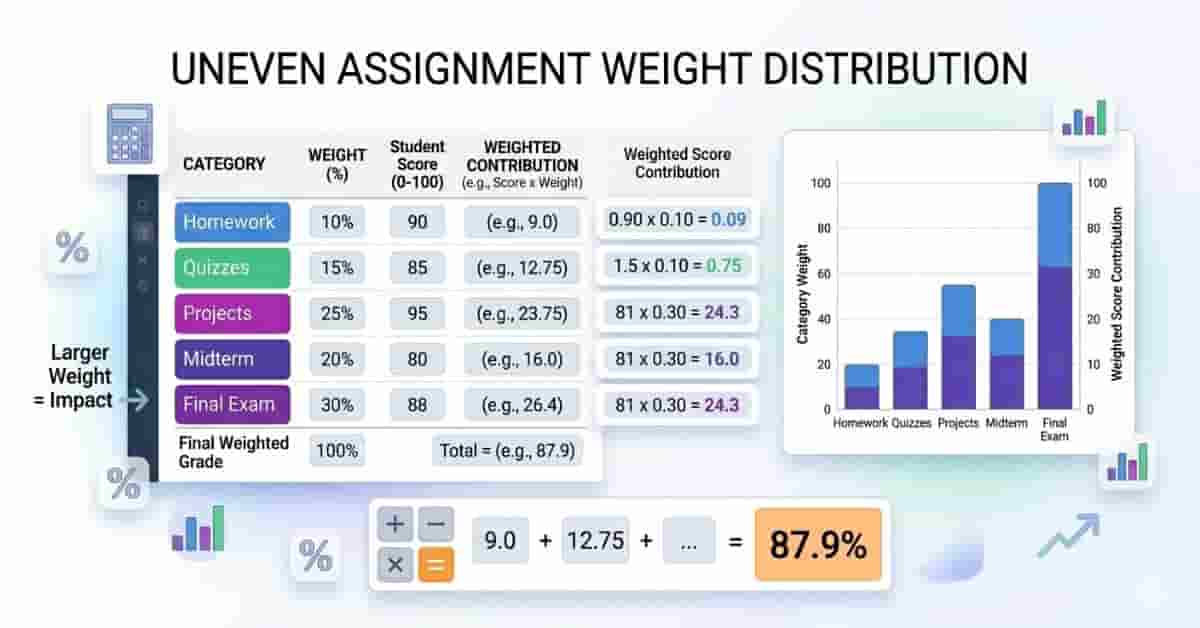
Not all classes use evenly balanced grading systems. Some teachers give heavy weight to exams, while others focus more on projects, participation, or coursework. This uneven distribution can make grade calculations feel confusing at first.
For example, one class may use this grading structure:
- Homework: 10%
- Quizzes: 15%
- Projects: 25%
- Midterm Exam: 20%
- Final Exam: 30%
In this setup, the final exam has a much greater impact on the overall grade than homework assignments. Even a strong homework average may not fully offset a low exam score.
To calculate grades with different weights, follow the same weighted grade formula. Multiply each score by its decimal weight and then add all weighted contributions together.
Here’s a simple example:
| Homework | 95% | 0.10 | 9.5 |
| Quizzes | 80% | 0.15 | 12 |
| Projects | 90% | 0.25 | 22.5 |
| Midterm | 70% | 0.20 | 14 |
| Final Exam | 85% | 0.30 | 25.5 |
Final Grade:
Weighted Grade Total
Add all weighted contributions together to get your final grade.
The final weighted grade is 83.5%.
This example shows how different weights affect each category’s impact. Even though the midterm score was lower, strong project and final exam scores helped balance the final average.
Expert Tips for Uneven Weight Systems
- Focus more study time on high-weight categories.
- Keep track of weights early in the semester.
- Double-check that all percentages add up to 100%.
- Use a weighted grade calculator to avoid math errors.
- Do not ignore low-weight assignments because they still affect the final score.
Mini Case Study
A high school student struggled with quizzes but performed well on major projects and exams. Since projects carried higher weights, the student still finished the semester with a strong final grade.
Common Mistakes to Avoid
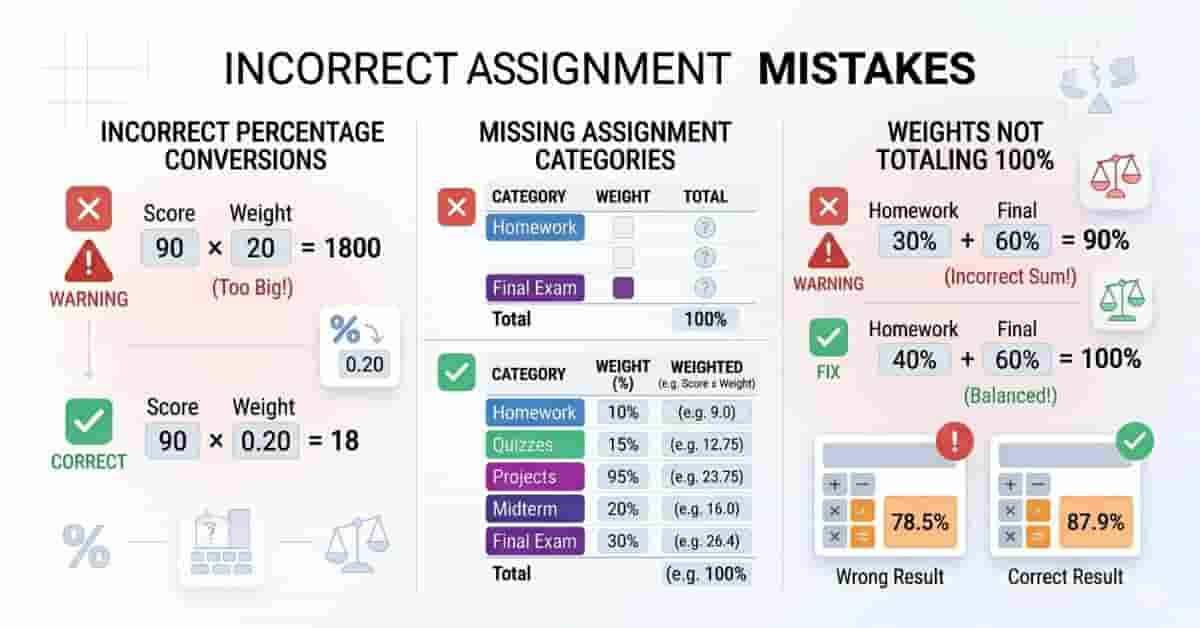
Many students understand the weighted grade formula but still make small mistakes during calculations. These errors can lower accuracy and create confusion about the final grade.
The good news is that most weighted grade mistakes are easy to avoid once you know what to check.
Weights Do Not Equal 100%
One of the most common problems happens when assignment weights do not add up to 100%.
For example:
- Homework: 20%
- Quizzes: 20%
- Final Exam: 40%
These weights only total 80%, which means part of the grading system is missing.
Before calculating your final grade, always add all percentages together. Most teachers design grading systems that equal exactly 100%.
If the total is incorrect, ask your teacher whether a category is missing or weighted differently.
Wrong Percentage Conversion
Students also make mistakes when converting percentages into decimals.
Incorrect example:
- 25% = 25
Correct example:
- 25% = 0.25
This small error can completely change the final weighted average. Always move the decimal point two places to the left when converting percentages.
Here are quick examples:
| 10% | 0.10 |
| 35% | 0.35 |
| 50% | 0.50 |
Correct decimal conversion is essential for accurate weighted grade calculations.
Missing Assignment Components
Another common issue is forgetting to include one or more grading categories.
Students sometimes calculate:
- homework
- quizzes
- tests
But forget:
- participation
- projects
- labs
- attendance
Even smaller categories can affect the final grade. Missing components often lead to lower accuracy and unexpected results.
Expert Tip
Create a checklist of every grading category before starting calculations. This simple habit helps prevent skipped assignments and missing percentages.
Conclusion
Understanding how to calculate weighted grades becomes much easier when you follow the correct steps. In this guide, you learned the weighted grade formula, percentage conversions, common mistakes, and real examples used in US schools and colleges.
Once you understand how weighted percentages work, tracking your academic progress feels less stressful. Whether you are calculating quizzes, assignments, or final exams, the right method helps you avoid errors and improve accuracy.
If you want faster and more reliable results, try our Weighted Grade Calculator to instantly calculate grades with weighted percentages. It saves time and simplifies complex grading systems for beginners.
Found this guide helpful? Share it with classmates or explore our other grade calculation tools to improve your academic planning.

Team ClassRank builds smart, student-friendly calculators to make grade and rank tracking simple and accurate. For questions or feedback, contact us at classrankcalculator@gmail.com.